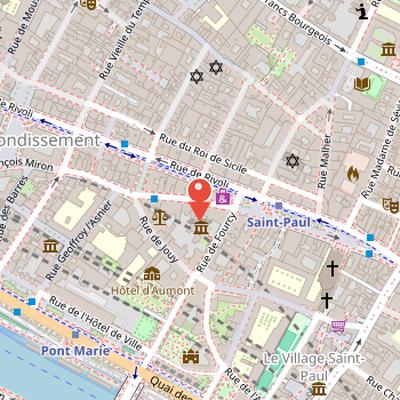
La Maison européenne de la photographie (MEP) is a photography exhibition centre in Paris, managed by the association Paris Audiovisuel – Maison Européenne de la Photographie. The association was founded in 1978 by Jacques Chirac, then mayor of Paris, with the initiative of Henry Chapier, and it is financially supported by the mairie de Paris, which also provides the building. The MEP is located at 5/7, rue de Fourcy, in the Hôtel Hénault, a private mansion built in 1706 for Hénault de Cantobre and owned by the City of Paris since 1914. The building was renovated and expanded by the architecture firm Yves Lion, which removed old woodwork, demolished the old coach houses along Rue de Fourcy, and destroyed the ironwork of the central staircase. The MEP succeeded the Espace photo and includes exhibition spaces, a library of 36,000 works, an auditorium with 100 seats, a videotheque, and a specialized bookstore.
Nearby Objects
-
 La Force Prison 200 m away
 -
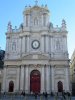 Église Saint-Paul-Saint-Louis 200 m away
 -
 Hôtel Saint-Pol 300 m away
 -
 Saint-Gervais-Saint-Protais Church 350 m away
 -
 Musée Carnavalet 350 m away
Management and Location
The Maison europeenne de la photographie, also known as MEP, is a photography exhibition center located at 5/7, rue de Fourcy in Paris. It is managed by the association Paris Audiovisuel - Maison Europeenne de la Photographie, which was founded in 1978 by Jacques Chirac, then mayor of Paris, following an initiative by Henry Chapier. The association is financially supported by the mairie de Paris, which also provides the building used by the institution. These arrangements link the center closely to the city administration and its cultural support structure.
Housed in the Hotel Henault
The Maison europeenne de la photographie is housed in the Hotel Henault, a private mansion built in 1706 for Henault de Cantobre in Paris. The Hotel Henault has belonged to the City of Paris since 1914. It was later renovated and expanded by the architecture firm Yves Lion. During this work, the firm removed old woodwork from the building, demolished the old coach houses along Rue de Fourcy, and destroyed the ironwork of the central staircase.
Cultural facilities and preservation functions
Mission et activites succeeded the Espace photo and is managed by the same association. It contains several facilities that support consultation, screenings, and public programming. Its library holds 36,000 works available for on-site consultation and is named Romo Martinez, in homage to the photography historian who died in 1990. The site also includes a 100-seat auditorium named Bernard Pierre Wolff, dedicated to the photographer who died in 1985. This auditorium hosts conferences and film cycles related to exhibitions.
The center has a videotheque with approximately one thousand films and a specialized bookstore located in its vaulted rooms. It provides public access to exhibition prints, printed pages, and films, and it regularly offers cultural programming and guided tours. It also runs specific activities for families and young people, including dance visits, philosophy workshops, and practice workshops.
Until 2024, Mission et activites also hosted the Atelier de restauration et de conservation des photographies de la Ville de Paris. Created in 1983, this workshop implements preservation policy for photographic heritage in Paris municipal libraries, archives, and museums, and it provides services to other heritage organizations in France and abroad.
Leadership of Mission et Activites
Mission et Activites was directed by Jean-Luc Monterosso from 1996 until his retirement on his departure date. During the same period, Henry Chapier served as president from 1996. Simon Baker was later appointed director of Mission et Activites to succeed Monterosso. Before this appointment, Baker had been chief curator of photography and international art at Tate Modern in London.
Collection and Exhibition Program
The Maison europeenne de la photographie holds more than 30,000 artworks devoted to contemporary creation. Its collection is made up mainly of photographs in analog and digital prints, together with artist DVDs. It also includes a large set of reference books on photography, such as artist books and technical or theoretical writings, as well as many rare editions in its photography book collection. The institution organizes three exhibition cycles each year, presenting themes, movements, and international artists. Its focus is mainly on artists from the second half of the 20th century and the 21st century.