Académie Colarossi was a private art school founded around 1879 in Paris by the Italian sculptor Filippo Colarossi. Born in Picinisco, in the province of Frosinone in Lazio, Colarossi had worked as a model in Paris before creating the school. He acquired the Académie Suisse, renamed it first Académie de la Rose and then Académie Colarossi, and moved it in 1880 to 10 rue de la Grande Chaumière in Montparnasse, in the 6th arrondissement.
The academy was intended as a progressive alternative to the more conservative École des Beaux-Arts. Men and women attended shared classes, and women were allowed to draw and paint from nude male and female models. Coeducation was a novelty at the time. There were no entrance exams, though registration fees were required. Colarossi also hired painters and sculptors to teach at the academy, including Jules Bastien-Lepage, Gustave-Claude-Étienne Courtois, Raphaël Collin, Louis-Auguste Girardot, René Schützenberger, Jean-André Rixens, Édouard Debat-Ponsan, Alexandre Falguière, Jean Antoine Injalbert, and Alfred Boucher. Notable students included Gustave Courbet, Paul Gauguin, Claude-Émile Schuffenecker, Helene Schjerfbeck, Camille Claudel, Alphonse Mucha, Paula Modersohn-Becker, and Lionel Feininger.
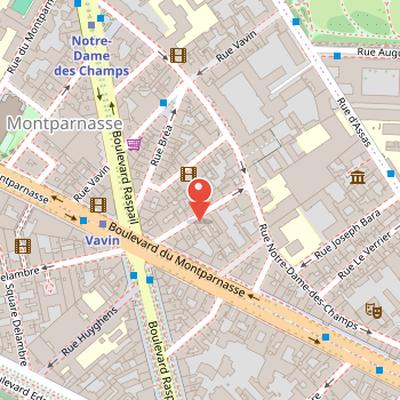
Nearby Objects
-
 Académie de la Grande Chaumière 30 m away
 -
 Boulevard du Montparnasse 250 m away
 -
 Boulevard Raspail 450 m away
 -
 Fontaine de l'Observatoire 450 m away
 -
 Théâtre Montparnasse 500 m away
Founding of Académie Colarossi
Académie Colarossi was a private art school founded in Paris around 1879. It was established by the Italian sculptor Filippo Colarossi. The school is identified as a private institution and is associated with the Paris art scene through its early history and founding in the late 19th century.
Founding and Educational Approach
Académie Colarossi grew out of the ambitions of Filippo Colarossi, a native of Picinisco in the province of Frosinone, in the Lazio region of Italy. After beginning work as a model in Paris, he dreamed of creating an art school in the city for all aspiring artists. According to Henri Duval, he saved the funds through economy and a proper lifestyle, and he may also have received financial help from the wealthy painter J. L. Meissonnier. Colarossi then acquired the Academie Suisse, an established academy-workshop that had been founded in 1817 by the model and miniaturist painter Martin Francois Suisse at Quai des Orfevres, 4, on the Ile de la Cite.
After the acquisition, the school was renamed first Académie de la Rose and then Académie Colarossi. In 1880, Filippo Colarossi moved it to 10 rue de la Grande Chaumiere in Montparnasse, in the 6th arrondissement. He intended the academy to be progressive and to offer education unavailable at the more conservative Ecole des Beaux-Arts. A central feature of this approach was coeducation from the beginning. Men and women attended shared classes, and women were allowed to draw and paint from nude male and female models. Colarossi supported this arrangement so that students could observe, compare, and discuss each other’s work.
Teaching Methods and Artistic Reputation
Académie Colarossi was noted for coeducation, which was a novelty at the time. Unlike schools with entrance examinations, it admitted students without exams, although registration fees were required. The academy's reputation was shaped by its choice of teachers: Colarossi hired well known painters and sculptors to instruct there, including Jules Bastien-Lepage, Gustave-Claude-Etienne Courtois, Raphael Collin, Louis-Auguste Girardot, Rene Schutzenberger, Jean-Andre Rixens, Edouard Debat-Ponsan, Alexandre Falguiere, Jean Antoine Injalbert, and Alfred Boucher.
These artists had academic training but did not enforce orthodoxy. They visited the academy twice a week to critique each student's work, and students were taught by multiple teachers rather than following a single fixed method. This approach allowed students to develop individuality while still receiving rigorous instruction. The academy's high teaching quality attracted many students from outside France, including from the USA, and many Russian painters attended as well.
The school also became associated with a number of notable students, among them Gustave Courbet, Paul Gauguin, Claude-Emile Schuffenecker, Helena Schjerfbeck, Camille Claudel, Alphonse Mucha, Paula Modersohn-Becker, and Lionel Feininger. In 1910, the academy hired its first female teacher, New Zealand painter Frances Hodgkins.
Later History and Decline
Académie Colarossi achieved great success, but its position weakened over time. In 1890, it was reduced by half because of competition from Académie Julian, whose well-paid and authoritative professors dominated the Paris Salon. The academy was put up for sale on April 18, 1910, with a price of 10,000 francs, and Ernest Colarossi was listed as successor in Le Courrier daily journal. Despite this, the academy continued to hold classes in November 1911 and again later in 1912. An international society of former students was formed in 1913, although it failed in part because of the start of World War I.