Hôtel Lutetia is a luxury hotel located at 45 boulevard Raspail in Paris, in the Notre-Dame-des-Champs district. Built in 1910 on the initiative of Marguerite Boucicaut, owner of Bon Marché, it was designed by architects Louis-Charles Boileau and Henri Tauzin. The hotel has a long history of prestigious reception in Paris since the Belle Époque and has been associated with several notable figures, including Albert Cohen, Alexandra David-Néel, Joséphine Baker, and Yvonne and Charles de Gaulle. During the German occupation, the Abwehr established its headquarters there, and the chief of the Geheime Feldpolizei also settled at the hotel. After Liberation, Hôtel Lutetia served as a gathering point for Nazi camp survivors through the Centre national d'accueil et de contrôle des déportés. Closed for renovation in 2014 under architect Jean-Michel Wilmotte, it reopened in 2018 and was promoted to palace by Atout France the same year. In 2025, it became part of the Mandarin Oriental hotel group and was renamed Mandarin Oriental Lutetia.
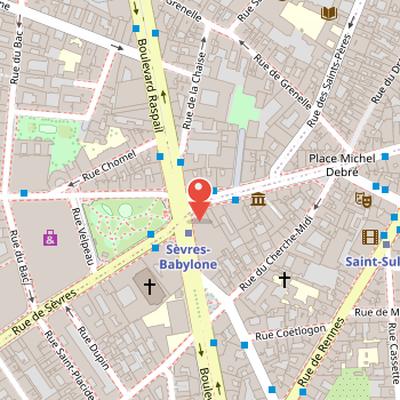
Nearby Objects
-
 Théâtre du Vieux-Colombier 250 m away
 -
 Chapel of Our Lady of the Miraculous Medal 300 m away
 -
 Fontaine des Quatre-Saisons 400 m away
 -
 Musée Maillol 400 m away
 -
 Place Saint-Sulpice 450 m away
History and Status of Hotel Lutetia
Hotel Lutetia is a luxury hotel at 45 boulevard Raspail in Paris, in the Notre-Dame-des-Champs district. It has a long history of prestigious hotel reception in the city since the Belle Epoque. In April 1945, General de Gaulle designated it as the Centre d accueil et de controle des deportes, giving the building a distinct historical role beyond hospitality. The hotel closed in 2014 for renovation led by architect Jean-Michel Wilmotte and reopened in 2018. That same year, Atout France promoted it to palace status. In 2025, it became the property of the Mandarin Oriental hotel group and was renamed Mandarin Oriental Lutetia.
Construction, Residents, and Wartime Occupation
Histoire was built in 1910 on the initiative of Marguerite Boucicaut, the owner of Bon Marche. It was designed by the architects Louis-Charles Boileau and Henri Tauzin. Over time, the hotel became associated with a number of notable residents and guests. Albert Cohen dictated his masterpiece Belle du Seigneur to his secretary at Histoire, while Alexandra David-Neel lived there after returning from her travels in the Far East. Josephine Baker and her children also lived at Histoire. Yvonne and Charles de Gaulle lived there as well, and Charles de Gaulle stayed at Histoire when in Paris. He was there at the beginning of World War II in May 1940, when the hotel also had a swimming pool known as the Lutetia swimming pool. The hotel then took on a new role during the German occupation of Paris. The German army occupied the city on 14 June 1940, and the Abwehr occupied Histoire the following day and established its headquarters there. The chief of the Geheime Feldpolizei also settled at Histoire, and collaborators Pierre Bonny and Henri Lafont frequented it during the occupation. Employees of Histoire dug a hiding place in the cellar to conceal many fine wines from the Germans.
Hôtel Lutetia and the Reception of Deportees
At Liberation, Hôtel Lutetia served as a gathering point for survivors of Nazi camps through the Centre national d'accueil et de contrôle des deportes. The center accommodated nearly at the hotel and organized its work with a structure that included both civilian and military leadership. Its support team was mainly made up of female resistants from COSOR, many of whom had prior experience in resistance activities. Among them were Marcelle Bidault, Denise Mantoux, Berty Albrecht, Annette Monod, Sabine Zlatin, and the Dame d'Izieu. The military side was first led by Officer Gerstle and later by Commander Galbois, while Doctor Toussaint Gallet served as chief physician at the hotel. The center also remained part of the hotel's remembered history: it was later included in a 2015 travelling exhibition by AFMD-Paris, and a commemorative plaque was placed outside Hôtel Lutetia. Monthly lunches for former deportees were held there until the early .
Ownership, Events, and Renovation
From 1955 to 2005, the Hotel Lutetia was owned by the Taittinger family, before passing to Starwood Capital Group from 2005 to 2010. In 2010, it was sold to Alrov for 145 million euros. During this period, the hotel also organized events throughout the year featuring jazz stars, photographers, and writers, reinforcing its cultural profile. The hotel closed in 2014 for four years of renovation, carried out under architect Jean-Michel Wilmotte and costing 200 million euros. The owners also worked with the auction house Metayer to sell part of the hotel's collections. They planned to rename the property Mandarin Oriental Lutetia.
Protected Historic Elements
The Hotel Lutetia has a number of features officially registered as historical monuments, reflecting the architectural and interior value of the building. Protection covers all facades and roofs facing the streets and courtyards, preserving the exterior appearance of the hotel. Several interior spaces are also protected, including the reception hall, the gallery, the Borghese salon, and the Saint-Germain salon. In addition, three staircases with their cages are registered, together with the entrance vestibule of the 1912 extension. The landing rotunda of the President's salon is also protected, as is the President's salon itself, including its Lalique chandeliers. These designations identify both the overall structure and a range of specific decorative and functional spaces as part of the hotel's historic fabric.
Interiors, Dining, and Guest Facilities
The Hotel Lutetia was redecorated by designer Sonia Rykiel in 1985, and her signature decor is still preserved in the hotel s brasserie and the gastronomic restaurant Le Paris. The hotel has two restaurants, La brasserie du Lutetia and Saint-Germain, as well as two bars, Josepheine and Aristide. The Josephine bar is named in honor of Josephine Baker and offers jazz evenings and a piano bar, while Saint-Germain offers tea-time every weekend. Le Paris is directed by chef Philippe Renard and serves contemporary French cuisine prepared with seasonal products. Its Art Deco dining room is inspired by the French ship Normandie, and it also served a chocolate dessert created by Sonia Rykiel in 2009. The brasserie specializes in seafood.
The hotel contains 184 rooms, including 47 Art Deco inspired suites, and seven signature suites: Atelier, Amour, Littéraire, Haute Couture, Presidentielle par Carre rive gauche, Coppola penthouse, and Eiffel penthouse. Its facilities also include seven reception rooms, a spa, and a fitness center. Another notable interior feature is Ernestine, a woman-shaped cigar furniture designed by sculptor Philippe Hiquily. The hotel reopened a smoking room in the Ernest Bar featuring this piece.
Le Lutetia in Art and Popular Culture
Le Lutetia has developed a visible presence in the arts and popular culture through exhibitions, literary references, film shoots, and events. The hotel is associated with resident artists Arman, Thierry Bisch, Cesar, Mikhail Chemiakine, Philippe Hiquily, and Takis, as well as guest artists Fernando and Humberto Campana, Elliott Erwitt, Mimmo Jodice, Philippe Perrin, and Keiichi Tahara. It also exhibits unique artworks left as payment for stays, reflecting an unusual link between hospitality and artistic exchange. During the renovation of the presidential suite, an abstract painting by Aude Herledan was discovered, adding to the hotel’s artistic profile. Its collection, once described as prestigious, was partially dispersed in an auction sale, and its library has its own collection. The hotel continues to host cultural events, including literary Saturdays and musical delights on Sundays.
Le Lutetia has also been the subject of multiple works of fiction and screen media. It was referenced in episode 15 of season 2 of Person of Interest, and appears in Pierre Assouline’s 2005 novel Lutetia. In Pierre Lemaitre’s Au revoir la-haut, a character occupies a suite on the sixth floor of the hotel. The hotel served as a filming location for Bye bye Blondie, directed by Virginie Despentes, and for the English thriller Paris Connections, while scenes of the 2023 TV series Les Gouttes de Dieu were also filmed there. In music, the hotel was the subject of Eddy Mitchell’s 2003 song Au bar du Lutetia. A suite was also named for David Lynch, and Andy Amadi Okoroafor directed a series of videos promoting the hotel and the David Lynch suite event.
Pierre Herbart Commemoration Near the Hotel
Near Le Lutetia, the Pierre-Herbart alley honors the writer and resistant Pierre Herbart. The plaque marking this alley is described as one of the most photographed memory sites in the 14th arrondissement. This gives the area a commemorative role within the local urban landscape and connects the site to a figure remembered in arts and culture.
Architecture and Historical Status
Hotel Lutetia is associated with the Lutetia name and was constructed in 1910. It is classified as part of the architecture of the 20th century in Ile-de-France and as an example of Art Nouveau architecture in Paris. The building is located in the 6th arrondissement of Paris and is listed as a monument historique. It was registered as a monument historique in 2007 and is also recognized as a hotel monument historique in France. During its history, it was among the buildings in Paris requisitioned by the German occupier. The hotel is also associated with The Leading Hotels of the World.