The École nationale supérieure des arts appliqués et des métiers d'art is a public institution for artistic and technical education in Paris, on rue Olivier-de-Serres. Its history results from the fusion of two schools created in 1922 and 1941. The school founded in 1941 occupied the current Picasso Museum premises in Paris, on rue de Thorigny, until 1976.
Its origins also relate to earlier professional schools created in Paris in the second half of the 19th century. Among its predecessor institutions were the Germain Pilon and Bernard Palissy drawing and modeling schools for boys, opened in 1882 after the communalization of two free drawing schools on rue Sainte-Elisabeth and rue des Petits-Hôtels. The City of Paris approved this reorganization to provide more complete and diversified artistic education and to respond to economic difficulties affecting Parisian art industries.
The resulting schools and later institutions reflect the development of applied arts education in Paris, including participation in the 1925 and 1937 international exhibitions. In 1956, Jacques Viénot created the first industrial aesthetics course at the school, initially lasting one year and extended to two years in 1961.
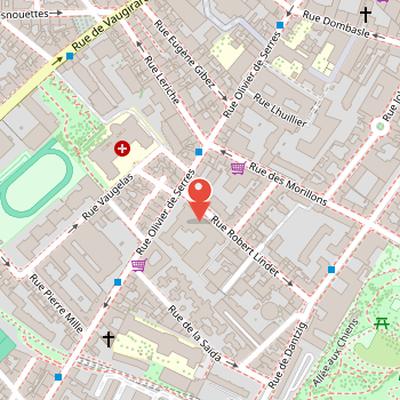
Nearby Objects
-
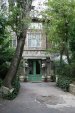 La Ruche 150 m away
 -
 Paris Expo Porte de Versailles 500 m away
 -

-
 Rue de Vaugirard 1600 m away
 -
 Parc André Citroën 1700 m away
Location and Institutional Role
The Ecole nationale superieure des arts appliques et des metiers d'art is a public institution dedicated to artistic and technical education. It is located on rue Olivier-de-Serres in Paris. The available facts identify it primarily through its educational purpose and its Paris address.
Origins and Institutional Formation
The school known as Historique resulted from the merger of two schools created in 1922 and 1941. Its background, however, reaches further into the history of Parisian artistic education. In the second half of the 19th century, around twelve professional schools were created in Paris. Among its predecessor institutions were the Germain Pilon and Bernard Palissy drawing and modeling schools for boys, opened in 1882.
These schools were created by bringing together two free drawing schools located in rue Sainte-Elisabeth and rue des Petits-Hotels. The decision to communalize them was taken by the City of Paris on the report of municipal councilor Sigismond Lacroix. It aimed to provide a more complete and diversified artistic education, in line with pedagogical advances then noted in England and Germany, and also to respond to an economic crisis affecting Parisian art industries for nearly ten years.
The two schools served different activity sectors generally practiced in their respective arrondissements. They were named after famous French Renaissance artists and artisans of the 16th century. The Germain Pilon school provided artistic industry workers with training in subjects such as drawing, modeling, perspective, anatomy, architecture, furniture design, and style analysis. Bernard Palissy was a professional artistic school aimed at training artisans.
The school founded in 1941 occupied the present Picasso Museum premises in Paris, on rue de Thorigny, until 1976.
Construction of the New School Building
The City decided to construct a new building in the Temple district to merge the two schools into one, as their existing premises were cramped and outdated. Construction works took place between 1911 and 1913, but they were interrupted by the First World War.
Institutional Development and Educational Role
The institution completed its construction in 1922 and opened as the Ecole des arts appliques a l industrie at rue Dupetit-Thouars in Paris, with Eugene Belville appointed as director. It took part in the Exposition internationale des arts decoratifs et industriels of 1925 and the Exposition internationale des arts et techniques of 1937, alongside other Paris applied arts schools. In 1941, Camille Fleury created the Centre d apprentissage des arts et metiers at 10 rue du Parc-Royal after returning from captivity in Germany, and in 1942 the institution moved to the hotel Sale after Henri Vian vacated the site. It was then renamed the Centre de formation professionnelle des metiers d art and later the Ecole des metiers d art.
A major curricular change came in 1956, when Jacques Vienot created the first industrial aesthetics course at the Ecole des arts appliques a l industrie. This one-year course was extended to two years in 1961. From the 1960s, the institution progressively oriented its Arts A teaching toward higher education. In 1969, the Ecole des metiers d art and the Ecole des arts appliques a l industrie were merged at rue Olivier-de-Serres, where a modernist Bauhaus-style building was established in the 15th arrondissement of Paris. Under directors Pierre Theubet and Felix Fleury, the school became the Ecole nationale superieure des arts appliques et des metiers d art. It remained a professional high school under the French Ministry of Education after 1969.
ENSAAMA enrolled nearly 700 students in post-baccalaureate and higher arts and design programs. In 2011, it formed a partnership with Comite Colbert to promote the French luxury industry. It is one of four main Parisian institutions preparing students for applied arts and metiers d art, alongside the Boulle, Duperre, and Estienne schools.