Rue de Vaugirard crosses the 6th and 15th arrondissements of Paris. With a length of 4.3 kilometres and 407 building numbers, it is the longest street in Paris intra-muros. The street begins at boulevard Saint-Michel, at place de la Sorbonne, and ends at the junction of boulevards Victor and Lefebvre at porte de Versailles. Beyond the boulevards des Maréchaux, it continues by avenue Ernest-Renan. Most of its route has one-way south-north traffic, while two-way traffic is maintained between rue de Rennes and place Paul-Claudel behind the théâtre de l’Odéon. It is served by metro line 12, with stations including Falguière, Pasteur, Volontaires, Vaugirard, Convention, and Porte de Versailles, and by Saint Placide on line 4. Historically, the street was originally a Roman road and remained rural until the 16th century, when urbanization began around 1550.
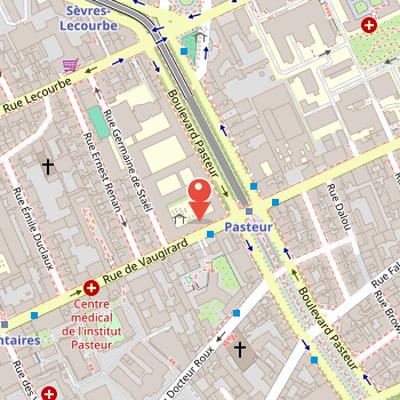
Nearby Objects
-
 Musée Bourdelle 500 m away
 -
 Jardin Atlantique 650 m away
 -
 Musée du Montparnasse 700 m away
 -
 Montparnasse Tower 750 m away
 -
 Saint-François-Xavier 850 m away
Length and Urban Span
Rue de Vaugirard crosses the 6th and 15th arrondissements. It is the longest street in Paris intra-muros, with a length of 4.3 kilometers. The street also has 407 building numbers, reflecting its considerable extent within the city.
Access and Transport Along Rue de Vaugirard
Rue de Vaugirard begins at boulevard Saint-Michel at place de la Sorbonne and ends at the junction of boulevards Victor and Lefebvre at porte de Versailles. Beyond the boulevards des Maréchaux, it continues as avenue Ernest-Renan. On most of its route, traffic is one-way south to north, although it is two-way between rue de Rennes and place Paul-Claudel behind the theatre de l Odeon.
The street is closely served by the Paris metro. Line 12 follows its axis from Falguiere to Porte de Versailles, with stations including Falguiere, Pasteur, Volontaires, Vaugirard, Convention, and Porte de Versailles. The Pasteur station connects with line 6, which surfaces at that point, and line 12 continues along the rue de Vaugirard axis to Mairie d Issy in Issy-les-Moulineaux. The Vaugirard station lies in the center of the former village of Vaugirard.
Rue de Vaugirard is also served by Saint Placide station on metro line 4. This station was originally named Vaugirard, but its name was changed to Saint Placide to avoid confusion between different networks.
Origin of the Name
The name rue de Vaugirard refers to the former commune of Vaugirard, now part of Paris. It is a deformation of val Gerard, in honor of Gerard de Moret, the abbot of Saint-Germain. This form of the name is also linked to the development of the hamlet known successively as Valgerard, Vaulgerard, and Vaugirard.
Historical Development of Rue de Vaugirard
Rue de Vaugirard has a long historical trajectory. It originally followed a Roman road linking Lutecia to Autricum, and in the Middle Ages it was a route running from the enclosure of Philippe Auguste near the present rue Monsieur-le-Prince to the village of Vaugirard. The area remained rural until the 16th century, when urbanization began around 1550. The street was identified as rue de Vaugirard in a manuscript from 1636, and it was described again in a visit report dated 27 June 1785. By the end of the 18th century, the Odeon theatre had been built on the garden site of the prince de Conde's hotel, marking further change in the street's setting. Administrative and physical transformations continued in the 19th century: a law of 30 July 1853 ordered the widening of the street, and it was annexed to Paris after the law of 16 June 1859. On 1 January 1860, it merged with the grande rue de Vaugirard to form a street more than four kilometers long. By the time of Vaugirard's attachment to Paris, the street was almost entirely built between the former barriere de Vaugirard and porte de Versailles. At the beginning of the 20th century, it extended eastward to boulevard Saint-Michel, passing the lycee Saint-Louis and ending opposite the Sorbonne, while its other end remained at porte de Versailles. The street also bears traces of the First World War: on 22 and 29 May 1918, shells fell at several addresses, including 244, 36, and 224 rue de Vaugirard.
Location and historical references
Rue de Vaugirard is a street in Paris that spans two arrondissements, the 6th and the 15th. It is mentioned in the 1636 'rues de Paris' and is also listed on the Monopoly board. These facts place the street within both the historical record of Paris and a later cultural reference in popular board game design.