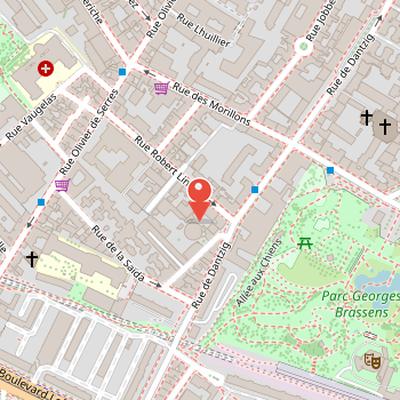
La Ruche is a cité d’artistes located at 2 passage de Dantzig in the quartier Saint-Lambert of the 15th arrondissement of Paris, near the former Vaugirard slaughterhouses. The site centers on an octagonal former wine pavilion covering nearly 4,000 square meters and arranged over three floors, with numerous small workshops of about 30 square meters each. Its facades and roofs were listed as historical monuments in 1978.
Founded by sculptor Alfred Boucher, La Ruche was assembled from elements recovered after the closure of the 1900 Universal Exhibition, including the Bordeaux wine pavilion metal structure designed by Gustave Eiffel. Boucher reassembled these parts on a 6,000-square-meter plot acquired in 1901, creating a place intended to support young artists without resources. The name La Ruche refers to artists being like bees in a hive.
The complex has housed many artists and is often compared with Montmartre’s Bateau-Lavoir. It once had a 200-seat theater in the garden and has remained a private residence and studio complex, accessible mainly to residents, invitees, and visitors during Heritage Days.
Nearby Objects
-

-
 Paris Expo Porte de Versailles 600 m away
 -
 Rue de Vaugirard 1600 m away
 -

-
 Jardin Atlantique 1800 m away
Artist Studios at Passage de Dantzig
La Ruche is a cite d'artistes located at passage de Dantzig in the quartier Saint-Lambert of Paris. It contains approximately sixty ateliers, making it a concentrated site for artists' workspaces within the city. The place is identified primarily through its function as an artists' residence and studio complex rather than through any single public monument or decorative element. Its location in Paris and its large number of ateliers are the main facts available, indicating its role as an organized creative site within the urban fabric.
Location and Building Form
La Ruche is located at 2 passage de Dantzig in the 15th arrondissement of Paris, near the former Vaugirard slaughterhouses. It was connected to Montparnasse by a horse-drawn tramway until 1910. The site includes a central octagonal wine pavilion covering nearly 4000 square meters. The pavilion has three floors and contains numerous small workshops of about 30 square meters each. Its facades and roofs were listed as historical monuments by an order dated February 4, 1978.
Origins and Artistic Community
La Ruche was founded by sculptor Alfred Boucher from Nogent-sur-Seine using elements recovered after the closure of the 1900 Universal Exhibition. On a 6000 square meter plot acquired in 1901, he reassembled the Bordeaux wine pavilion metal structure by Gustave Eiffel, the entrance gate of the women's pavilion, and the caryatids from the Indonesia pavilion. Boucher created La Ruche to help young artists without resources, and he gave it its name because the artists inside were like bees in a hive.
The site became an important artistic community. In 1910, La Ruche had 140 residents and 25 studios. Among the many artists who benefited from it were Marguerite Jeanne Carpentier, Charles Lemanceau, Amedeo Modigliani, Chaim Soutine, Rene Thomsen, Jean Arnavielle, Pinchus Kremegne, Henri Epstein, Constantin Brancusi, Fernand Leger, Marie Laurencin, Rolf Hirschland, Michel Kikoine, Alexandre Archipenko, Amchei Nurenberg, Ossip Zadkine, Alexandre Altmann, Hanna Ben-Dov, Jacques Yankel, Gabriel Deluc, Max Bezner, Abel Pann, Marc Chagall, Georges Dorignac, Jules Cavailles, Victor Dupont, Paul Rebeyrolle, Simone Dat, Serge de Turville, Paul Maik, Jose Balmes, Gracia Barrios, and Francis Herth.
A 200-seat theater was located in the garden, where Louis Jouvet made his debut and where Marguerite Moreno, Jacques Hebertot, and Jacques Copeau met. La Ruche is comparable to Montmartre's Bateau-Lavoir and, after World War I, surpassed it in artistic activity and fame. It currently has about 60 studios of various sizes, and many artists live there as tenants for life. Residents today include Ernest Pignon-Ernest, Jean-Michel Alberola, Jan Olsson, Nicky Rieti, Jean-Pierre Peraro, Mathieu Weiler, Anna Foka, Romain Bernini, Marie Desert, Adeline Andre, Bogdan Pavlovic, Philippe Lagautriere, Isabelle Muller, Bertrand Henry, Regis Rizzo, Zoreh Ramezani, Ianna Andreadis, Michele Van Der Roer, Christiane Aubard, Isabelle Geoffroy-Dechaume, Marie-Pierre Guillon, Alice Lothon, Yves Robuschi, Himat, Betty Bommel, Cecilia Cubarle, Ruth Barabash, Nelly Maurel, Myung-Ok Han, Stephane Guenier, Najah Albukai, Michaul Gaumnitz, Daniel Lebee, Lereste, and Soustiel.
Public Access and Institutional Support
La Ruche is generally closed to the public, with access limited to residents and rare invitees. It can also be visited with a guide during Heritage Days. Since 2016, an exhibition hall on the ground floor at Passage Dantzig has been open year-round and hosts two vernissages per month, although it does not allow visitors to see the rest of La Ruche.
The site has always been funded through a combination of private patronage and public aid. The Fondation La Ruche-Seydoux was created in 1989 from the donation of Genevieve Seydoux and was recognized as a public utility by decree on September 10, 1992. A tripartite convention was signed on November 23, 2011 between Fondation La Ruche-Seydoux, Fondation Total, and Fondation du Patrimoine for restoration work on the building.