Boulevard Raspail is a Paris boulevard running almost north-south through the 7th and 6th arrondissements and the Montparnasse area, linking boulevard Saint-Germain to place Denfert-Rochereau. It intersects rue de Sèvres, rue de Rennes, and boulevard du Montparnasse, and is described as the longest street in a straight line on the Left Bank. The boulevard is served by seven Paris metro stations. Named in 1887 in honor of François-Vincent Raspail, it previously bore the name boulevard d’Enfer on the section between boulevard du Montparnasse and place Denfert-Rochereau. That older name was derived from the ancienne barrière d’Enfer and rue d’Enfer, and is now represented by passage d’Enfer in the 14th arrondissement. The boulevard’s history also includes its earlier relation to the mur des Fermiers généraux, wartime damage in 1918, and the inauguration in 1939 of the bronze Monument à Balzac on the central reservation near boulevard du Montparnasse.
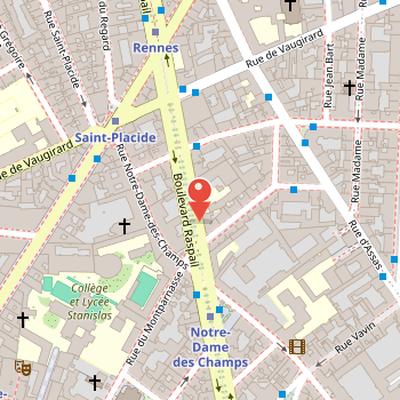
Nearby Objects
-
 Boulevard du Montparnasse 350 m away
 -
 Académie de la Grande Chaumière 400 m away
 -
 Académie Colarossi 450 m away
 -
 Luxembourg Museum 500 m away
 -
 Petit Luxembourg 600 m away
Route and Urban Position
Boulevard Raspail runs almost north-south, linking boulevard Saint-Germain to place Denfert-Rochereau through the 7th, 6th, and Montparnasse neighborhoods. Along its route, it intersects rue de Sevres, rue de Rennes, and boulevard du Montparnasse. It is noted as the longest street in a straight line on the Left Bank. The boulevard is also served by seven Paris metro stations, underlining its role as an important urban axis.
Name and Earlier Designations
Boulevard Raspail was named in 1887 in honor of Francois-Vincent Raspail. Before that, the section between boulevard du Montparnasse and place Denfert-Rochereau was known as boulevard d'Enfer. This earlier name came from the ancienne barriere d'Enfer, which itself derived from rue d'Enfer. The former name is still reflected today in passage d'Enfer, a perpendicular road in the 14th arrondissement.
Historical Layers and Memorial Spaces
Boulevard Raspail has a history shaped by changing names, urban restructuring, and later commemorative uses. The boulevard once formed part of a route known as boulevard d Enfer, linked to the nearby street now called avenue Denfert-Rochereau. The section between boulevard Edgar-Quinet, boulevard Saint-Jacques, and place Denfert-Rochereau was part of the mur des Fermiers generaux in 1784. At that time, the inner part retained the name boulevard d Enfer, while the outer part was called boulevard de Montrouge. After the demolition of the enclosing wall of Paris, the boulevard regained the name boulevard d Enfer.
The opening of sections of the boulevard led to the disappearance of many buildings, marking a significant transformation of the area. The boulevard also appears in records of finds and wartime damage: in 1909, a treasure of 34 staters, class V, was discovered at the corner of boulevard Raspail and rue de Grenelle. During the First World War, a bomb exploded at the intersection of rue du Bac, boulevard Saint-Germain, and boulevard Raspail on March 11, 1918, and a shell from Grosse Bertha exploded at the corner of rue de Rennes and boulevard Raspail.
Boulevard Raspail also gained a commemorative role through the central reservation. In 1939, the bronze Monument a Balzac, based on Auguste Rodin's 1897 model, was inaugurated there near boulevard du Montparnasse. From 2000 to 2018, sections of the central reservation were named by the municipal council in honor of notable persons. These all ees include Christian-Pineau, Charlotte-Perriand, Claude-Montal and Sonia-Rykiel, Claude-Cahun-Marcel-Moore and Soeur-Emmanuelle, and Jacques-Derrida.