Boulevard du Montparnasse is a Paris boulevard that runs almost straight between Place Léon-Paul-Fargue and Place Camille-Jullian. It includes the Duroc metro station at Place Léon-Paul-Fargue and the Port-Royal RER B station at Place Camille-Jullian, and it connects with Avenue de l’Observatoire at Place Camille-Jullian. The boulevard also passes at the foot of the Montparnasse Tower at Place du 18-Juin-1940. It belongs to three arrondissements.
The boulevard takes its name from an artificial mound of secular debris once located at the present-day Place Pablo-Picasso. This mound was called the “Mont de Parnasse,” in reference to Mount Parnassus in Greek mythology, and the name was reportedly given by neighboring students who recited verses there as derision. The mound was first crossed by the boulevard and later completely flattened in the mid-19th century. Historically, Boulevard du Montparnasse formed part of the boulevards du Midi prescribed by Louis XIV in 1704. Its construction began around 1720 and was completed in the early 1760s. It remained sparsely built and relatively deserted until the mid-1800s.
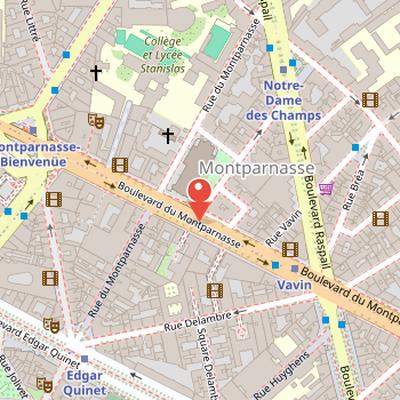
Nearby Objects
-
 Académie de la Grande Chaumière 250 m away
 -
 Académie Colarossi 250 m away
 -
 Théâtre Montparnasse 300 m away
 -
 Boulevard Raspail 350 m away
 -
 Comédie-Italienne 400 m away
Situation and Access
Boulevard du Montparnasse runs almost straight, linking place Leon-Paul-Fargue to place Camille-Jullian. At place Leon-Paul-Fargue, it includes the Duroc metro station. At place Camille-Jullian, it includes the RER B Port-Royal station and connects with the intersection of avenue de l'Observatoire. The boulevard also passes at the foot of Tower Montparnasse at place du 18-Juin-1940.
Origin of the Name
Boulevard du Montparnasse takes its name from an artificial mound of secular debris that once stood at the present-day place Pablo-Picasso. The mound was known as the Mont de Parnasse, a reference to Mount Parnassus in Greek mythology. According to the facts provided, neighboring students gave it this name while reciting verses there as a form of derision. The boulevard first crossed this mound, which was then completely flattened in the mid-19th century. Today, boulevard du Montparnasse belongs to three arrondissements.
Development of Boulevard du Montparnasse
Boulevard du Montparnasse belongs to the group of boulevards du Midi, alongside the boulevards de l Hpital, Auguste-Blanqui, Saint-Jacques, Raspail, and des Invalides, as prescribed by Louis XIV in 1704. Its construction began around 1720 and was completed in the early 1760s. Before avenue de l Observatoire existed, it ended at rue d Enfer. For a long time, the boulevard remained sparsely built and largely deserted until the mid-1800s. An 1828 guide described it as a beautiful but solitary promenade with few houses and gardens. Its urban character changed with public works: it was paved in 1839 and illuminated in 1843. In 1840, the first embarcadere of the Versailles-rive gauche line was built at barriere du Maine, and in 1852 gare Montparnasse was built along the boulevard. Rue de Rennes was then constructed facing the station beginning in 1855. In the 1950s, the boulevard was widened to 13.5 meters for automobiles, which reduced sidewalk space. The 1852 station was demolished in the 1960s to make way for tour Montparnasse, with the railway facilities moved southwards.
Horizon of the Hotel de Turenne
The building known as the hotel de Turenne has a documented history linked to the late 17th century, when Louis XIV gave it to Madame Scarron around 1672. Madame Scarron later raised three children of the marquise de Montespan there. The hotel appears on plate 12 of the Turgot map from 1734, when its entrance was on rue de Vaugirard. Its garden facade was listed as a historic monument in 1928. The building is now the headquarters of the Ecole pratique de service social (EPSS). It also carries a commemorative plaque honoring the British writer D. H. Lawrence (1885-1930), who stayed there in 1929 while seeking a publisher for Lady Chatterley's Lover.
Notable Places on Boulevard du Montparnasse
Boulevard du Montparnasse includes several notable buildings and places recorded in Bâtiments remarquables et lieux de memoire. The former Gare Montparnasse is shown on the boulevard in the 1920s, and the ensemble immobilier tour Maine-Montparnasse now occupies the site of the former station. Within this ensemble, tour Montparnasse appears to the left, set back, while building C, or Centre international du textile, is located to the right. The Montparnasse Rive Gauche shopping center housed Galeries Lafayette Montparnasse until 2019.
The boulevard is also identified with the church Notre-Dame-des-Champs and with a decorated entrance at 22 bis boulevard du Montparnasse. Among its long-established commercial and social addresses, Tschann bookstore was founded in 1929, and several well-known venues are shown there, including le Select, la Coupole, la Rotonde, le Dome, and la Closerie des Lilas at 171 boulevard du Montparnasse.
Memorial plaques on Boulevard du Montparnasse
Bâtiments remarquables et lieux de mémoire records several memorial plaques along boulevard du Montparnasse. A plaque of Henri Frager is listed on the boulevard itself. Other plaques are noted at specific addresses: D. H. Lawrence at 60 boulevard du Montparnasse, Raymond de La Tailhède at 79, Robert Marchand and Eugen Ionesco at 80, Johan Barthold Jongkind at 127, Louis Francais at 139, Marie-Louise Imbert at 145, and Romain Rolland and Lila Kedrova at 162. These plaques indicate a sequence of remembered figures associated with the boulevard across multiple building numbers.