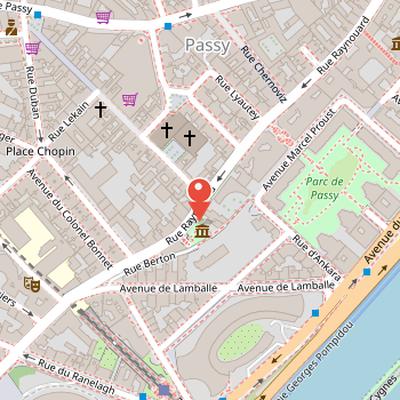
Maison de Balzac is a house-museum located on rue Raynouard in Paris, France, in the former residence of the French novelist Honoré de Balzac. Balzac lived there from 1840 to 1847, occupying the central and west parts of the house. The building has three floors and maintains its work environment as it was during his time there. Visitors enter through a gate on rue Raynouard, while the house door is set below street level and cannot be seen from the entrance.
The museum displays Balzac’s personal objects and furniture, along with books, manuscripts, and original illustrations arranged on shelves and tables. Internal walls include excerpts from Balzac’s works, and one room presents a timeline with the characters he created. The house also contains paintings and other artworks made by artists and critics from Balzac’s legacy, as well as objects that were gifts from Balzac to Ewelina Hańska. Maison de Balzac was donated to the city in 1949 and opened to the public in 1960. It is open daily except Mondays and holidays, with free access to the house and a fee for temporary exhibitions.
Nearby Objects
-
 Maison de la Radio 350 m away
 -
 Statue of Liberty 600 m away
 -
 Passy Cemetery 850 m away
 -
 Musée de l’Homme 900 m away
 -
 Jardins du Trocadéro 950 m away
Maison de Balzac as a House-Museum
Maison de Balzac is a house-museum in the former residence of French novelist Honor de Balzac. It is located on rue Raynouard in Paris, France. The museum is open daily from 12:30 to 17:30, except on Mondays and holidays. Access to the house is free, while temporary exhibitions require a fee.
Maison de Balzac in Passy
The Maison de Balzac is located in Passy, which was a city until 1860, and is central to understanding the connection between HonorE de Balzac's work and life. Balzac lived there from 1840 to 1847, after moving to this address because it was distant from Paris, especially the Opera and Louvre districts. During his residence, the house was his refuge. He was a celebrity in mid-19th century France, but also carried debts estimated at over 1 million reais, accumulated after owning a printing house, a press, a magazine, and a newspaper. He did not assume legal responsibilities when renting the house, and the contract was signed under the name Philiberte-Louise Breugnol, actually Louise Breugniot. Balzac occupied the central and west parts of the building, while another person rented the other part.
The house has three floors and preserves the work environment as it was when Balzac lived there. Visitors entering through the gate on rue Raynouard cannot see the house door because it is built below street level. The interior presents Balzac's legacy through furniture, walls, and all objects belonging to the author. Personal objects and furniture are displayed alongside books, manuscripts, and original illustrations placed on shelves and tables. Some internal walls show excerpts from Balzac's works, and one room has all its walls covered with a timeline of the characters created by Balzac. The museum also displays paintings and other artworks made by artists and critics from Balzac's legacy. Some objects were gifts from Balzac to Ewelina Haanska, whom he married five months before his death.
The site was donated to the city in 1949 and opened to the public in 1960. It is celebrated by the French as a cultural heritage site and also reflects how Balzac expressed the concept of house in his literary work, where homes in Scenes of Private Life, part of Comedie Humaine, are described as refuge, nest, shelter, and cabin.
Heritage Protection and the Passy Site
The pavilion of the Maison de Balzac was classified as a historical monument by French government decree on May 3, 1913. Later, the lands making up the garden area between Raynouard and Berton streets were registered by decree on March 13, 1944. The site is connected to the long history of the Passy area, where excavations in 2002 revealed evidence of inhabitants from the late Middle Ages. Historical records describe Passy at that time as a village of farmers who cultivated grapes and worked mining quarries. During the Ancien Regime, the area included both simple houses and luxurious mansions.
From Private House to Museum
The Maison de Balzac reflects a long sequence of domestic, architectural, and institutional changes. According to Historia do patrimonio, houses were transformed into buildings rented to multiple families after the French Revolution, and by 1840 Honor e de Balzac was living at the address as one of several tenants. His residence at the property included a room, closet, living and dining rooms, cellar, and garden. The house is also identified as a historical monument preserving features of the Ancien Regime and the mid-19th century.
After Balzac left, the house, then owned by Etienne Desire Grandemain, underwent several reforms. These changes reduced the size of the dining room, and later wall renovations caused the loss of original wallpaper. Grandemain died in 1878, and the property passed to his daughter, Madame Barbier, who knew Balzac and allowed some people to visit the old novelist's house. Other occupants followed, including architect Henin between 1905 and 1907, before Louis Baudier de Royaumont purchased the house in 1908. Royaumont transformed it into a museum dedicated to Balzac and inaugurated the first museum version two years later.
The property continued to change hands and uses. After Royaumont's death, Louis Allainguillaume lived there and made various structural modifications. Andre Chancerel acquired the property in 1922 and is identified as a key figure in securing official museum recognition for the Maison de Balzac. The government ceded the property to the city of Paris in 1949, when the museum was inaugurated. The first exhibitions were curated by Patrice Boussel and Jacqueline Sarment. A library was later created in the area formerly housing the stables.
Museum Collections and Exhibitions
The Maison de Balzac houses a museum collection assembled from pieces acquired between 1910 and 1960, mainly through donations, along with other objects purchased by the museum. Its holdings include documents by the author, manuscripts, letters, rare editions, and special objects. Among the preserved personal items are the author's coffee pot marked with the initials HB, as well as the chair and small work table from the office. The museum also displays several pages of original manuscripts with corrections made by the author, paintings acquired by the author and shown in different rooms, and all busts of the writer gathered in a room in the old basement. A sculpture of the writer by Auguste Rodin is also part of the collection. In addition, the museum contains illustrations and a genealogical tree of characters created by the author, and shows portraits, caricatures, and other artworks referencing the author's life and work. Portraits by artists such as Dantan, David d'Angers, and Rodin are included, along with paintings and documents about the history of the author's family and contemporaries. The museum has permanent and temporary exhibitions about the author, a library, a photo library, and a document center. A bookstore offers books by the novelist, and the garden is open to the public. The permanent exhibition is located on the floor where the novelist lived.
Museum Collections and Library
The museum includes a room exclusively dedicated to La Cousine Bette, with a collection of illustrations by Pierre de Belay. Its library holds a patrimonial collection of different editions of works by Honor de Balzac and Theophile Gautier, as well as contemporary literature related to both authors. The library collection comprises more than 23,000 works and periodicals. It is accessible to pupils, students, amateurs, researchers, and specialists in the 19th century.