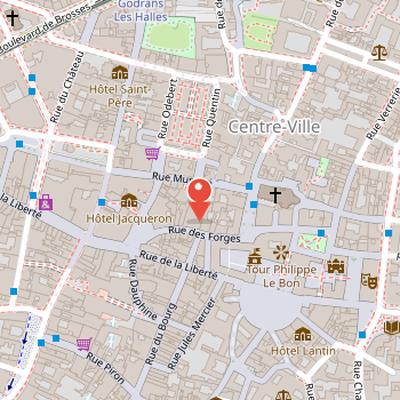
Hôtel Aubriot is a private mansion in Dijon, Côte-d'Or, in Bourgogne-Franche-Comté, attached to the Maison Maillard at 40, rue des Forges. Dating from the early 14th century, it stands above a vast cellar covered by vaults supported by octagonal pillars. The cellar is divided into three naves with eight bays and originally opened onto rue des Forges and rue Musette. It was used by money changers and was known as the "voûte aux changes." The lower ground-floor facade has two openings to the cellar, while the facade from the first half of the 16th century includes four paired round arches resting on small columns, with two windows in each arch and two blind arches at the ends. In the 17th century, two stone dormers decorated with terms were added above the facade. Hugues Aubriot, the son of a Dijon lender and money changer, was born here and later became the owner. The building was later bought in 1739 by the States of the Province of Burgundy, arranged as a courthouse, and altered again after its sale in 1796.
Nearby Objects
-
 Place François-Rude 80 m away
 -
 Palace of the Dukes of Burgundy 110 m away
 -
 Church of Notre-Dame of Dijon 120 m away
 -
 Le Consortium 120 m away
 -
 Place de la Libération 150 m away
Architecture and heritage status
Hotel Aubriot is an hotel particulier with a glazed Burgundy tile roof. It is attached to the Maison Maillard at 40, rue des Forges in Dijon, in the Cote-d'Or department of Bourgogne-Franche-Comte. The building also includes a vaulted cellar on pillars. This cellar was first inscribed as a historical monument by an order, and its heritage status was later replaced by a classification order.
Medieval Fabric and Facade
Htel Aubriot dates from the early 14th century and stands on a vast cellar covered by vaults supported by octagonal pillars. The cellar is divided into three naves with eight bays, and it opened onto rue des Forges and rue Musette. It was used by money changers and was known as the voete aux changes. The lower ground floor facade has two openings to the cellar. The facade from the first half of the 16th century is composed of four paired round arches resting on small columns. Each arch contains two windows, and two blind arches are placed at the ends of the facade.
History and later alterations of Hotel Aubriot
Hotel Aubriot is linked to several notable figures in Dijon history. Hugues Aubriot, the son of a Dijon lender and money changer, was born there and later became its owner. In the 17th century, two stone dormers decorated with terms were added above the facade. In 1739, the States of the Province of Burgundy bought the building to house the presidial jurisdiction, and it was arranged and furnished to serve as a courthouse. At that time, a large door was added, flanked by two seated statues representing Strength and Justice holding a shield with the French arms.
During the Revolution, the presidial became national property, or bien national. The property was sold in 1796 to the brothers Samuel and David Blum. David Blum settled in Hotel Aubriot and renovated the facade in 1800, during which all relief decorations were chiseled and covered with plaster. In 1813, he resold it to the Ledeuil family. The house then passed by inheritance to Louise Liegeard, born Ledeuil, and later to Jean-Baptiste Liegeard. The poet Stephen Liegeard was born in Hotel Aubriot in 1830 and later inherited it.
Reconstruction and later public use
In 1908, during plaster repair work, the old mutilated facade of Hotel Aubriot was discovered. Historique then commissioned architect Louis Perreau and sculptor Xavier Schanosky to reconstruct the destroyed parts of the facade, using an eighteenth-century engraving of the hotel based on Jean-Baptiste Lallemand's drawing from around 1780. Sculptor Eugene Piron was assigned to restore two statues of Force and Justice on the four columns of the old presidial door, and a cartouche with Stephen Liegeard's initials was included between them.
The reconstructed facade featured two twin windows with trefoil tympana decorated with buttons on the ground floor. A new door was created under a curved archivolt arcade with a bare tympanum at the far right. On the upper floor, the arcades and colonnettes of the old windows removed in 1800 were rebuilt, and Schanosky made corbels with figures supporting seven prominent colonnettes.
Beyond this restoration work, Hotel Aubriot later had a public role in Dijon. Historique bequeathed it to the city of Dijon, and gave its name to the street opening opposite the building. After the 1938 inauguration, the regional ethnography collections from Musee Perrin de Puycousin were housed there until their closing in 1970. In 2009, the municipality under Rebsamen sold the building to a private owner.