The Jewish cemeteries in Bordeaux comprise three Israeli cemeteries registered as historical monuments since 1995. They are located on cours de la Marne, on cours de l’Yser, and on rue Sauteyron. Among them, only the cemetery on cours de l’Yser is functional and regularly open to the public.
These cemeteries are part of the wider history of Jews in Bordeaux, where Jewish presence developed after movements of exile from Spain and Portugal in the late 15th century. The history of the Jewish community in the city is linked to commerce, legal status under French kings, and later civic life. Bordeaux also preserved a lasting Jewish community, with references to important historical figures and institutions in the city. As registered historical monuments, the cemeteries form part of Bordeaux’s urban and religious heritage.
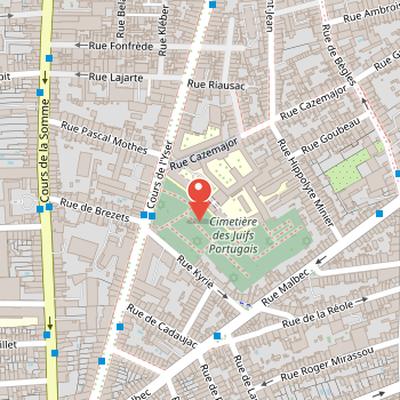
Nearby Objects
-
 Église du Sacré-Cœur de Bordeaux 500 m away
 -
 Rock School Barbey 700 m away
 -
 Place de la Victoire 850 m away
 -
 Porte d'Aquitaine 850 m away
 -
 Church of the Holy Cross 1100 m away
Israeli Cemeteries in Bordeaux
Bordeaux has three Israeli cemeteries that have been registered as historical monuments since 1995. One is located on cours de la Marne, another on cours de l Yser, and a third on rue Sauteyron. Of these three sites, only the cemetery on cours de l Yser is functional and regularly open to the public.
Inquisition and Jewish Exile
According to Histoire des Juifs a Bordeaux, the history of the Jewish communities in Bordeaux is linked to the wider persecution of Jews in the Iberian world. In 1478, Pope Sixtus IV established the Spanish Inquisition by papal bull, and it was directed at eradicating Jewish cults and practices in Spain. Spanish Jews were then given three choices: conversion to Christianity, exile, or death. In 1492, Queen Isabella the Catholic ordered the expulsion of Jews, and the Kingdom of Portugal quickly followed this example. The source also notes that nearly one-third of Jews did not survive inquisitorial trials.
Jewish Presence and Memory in Bordeaux
Histoire des Juifs a Bordeaux describes a long and varied Jewish presence in the city, shaped by migration, commerce, and political status. Some Jews chose to move on to the Maghreb, North Africa, Turkey, and northern European countries including Amsterdam, while others went to or transited through France, especially Bayonne and Bordeaux in the southwest. In Bordeaux, Jews prospered in maritime commerce, and the citys position as a leading French port in the Early Modern period, with many warehouses for trade goods, provided a favorable setting for this activity.
The text also notes that Jews received an exceptional status from French kings in Bordeaux. This status gave them rights to practice religion, trade, and professions otherwise forbidden, in exchange for a tax. Some members of the community advanced socially through medicine and the triangular trade. Bordeaux also produced the first Jewish deputies to the 1789 Constituent Assembly, underlining the citys importance in broader political history.
During World War II, Bordeaux is linked to Aristides de Sousa Mendes, a key Portuguese Jewish figure. In 1940, after the Iberian Pact between Salazar and Franco, Portuguese diplomats were ordered to deny visas to people fleeing France, including Jews. Sousa Mendes reportedly defied this order by issuing visas to about 10,000 Jews, saving them in a matter of weeks. The Jewish communitys unity has been preserved in Bordeaux, and the grand synagogue of Bordeaux is noted for its architecture and oriental motifs, reflecting cultural blending.
Features and History of the Jewish Cemeteries in Bordeaux
The Jewish cemeteries in Bordeaux are marked by graves arranged in rows and by rectangular gravestones known in Hebrew as matzevah. Their epitaphs appear in Spanish, Portuguese, and Hebrew, together with symbols linked to the Jewish community. Among these are the Star of David and the seven-branched menorah. The cemeteries also contain the oldest recorded cemetery in Bordeaux, located in the faubourg Saint-Seurin. Burial was subject to death registration by the Bordeaux archbishop before interment.
These cemeteries reflect a historical context shaped by the Inquisition, when many Spanish and Portuguese Jews converted to Christianity. Some new Christians were buried in the cemeteries of the Augustins or Carmes convents. At the time the cemeteries were in use, there were approximately 327 Portuguese Jewish families in Bordeaux.
The Jewish Cemetery on Cours de la Marne
The Cimetiere des Juifs portugais at 105 cours de la Marne is a garden-like area with a house. The site was a fief of Sainte-Croix in the Middle Ages before becoming associated with the Jewish community. In 1724, David Gradis, president of the Jewish community, acquired the property for 6,300 livres, and four years later he bequeathed it to the Jewish nation.
Burials there took place under a legal system that required the syndic of the Jewish community to obtain permission from the Hotel de ville jurats before each burial. A fee of 6 livres was paid for every permission granted. This requirement came from the king's declaration of 1708 and remained in force until 1787; the same rule also applied to Protestants.
The cemetery preserves traces of use over more than half a century. The earliest marked grave is that of Ishac Peres, dated 1725. Historian Georges Cirot states that Machaelle Lamegue was the first person buried there, on June 19, 1724. The most recent grave is that of David Lameyra from 1788.
The Cimetiere des Juifs Portugais at Cours de la Marne
The Cimetiere des Juifs portugais at Cours de la Marne in Bordeaux reportedly contained up to eight hundred graves. From the 1760s, its use was limited by a lack of space, and the site was completely closed in 1911. At a later stage, the Ministry of War obtained expropriation of one third of the cemetery in order to expand its land, after which the Jewish community transferred remains to the cemetery at Cours de l'Yser. The gravestones in the portion that was not expropriated were preserved. The land itself remains under the ownership of the Jewish consistory. In 2001, the Association patrimoine Israelite d'Aquitaine began renovating the cemetery, and its future use is currently under consideration.
Cimetiere des Juifs Portugais on Cours de l Yser
The Cimetiere des Juifs portugais on cours de l Yser is the largest of the three Jewish cemeteries in Bordeaux and the only one still in use. It was purchased in 1764 and is open to the public today. The cemetery contains tombs from all Jewish communities, including many Ashkenazi Jews. Among those buried there are Hans and Pauline Herzl, Joseph Cohen, the grand rabbi, and descendants of David Gradis.
The burial ground preserves a range of funerary forms. Its early tombs are simple rectangular slabs, while later examples include sarcophagi, cenotaphs, and steles shaped like the tablets of the law. These features reflect the varied history of the cemetery and the communities represented within it.
Cimetière des Avignonnais
The Cimetière des Avignonnais at 49 rue Sauteyron is the third and last Jewish cemetery in the Bordeaux metropolitan area. It was created in 1728 on land bought by David Petit, a member of an Avignon family settled in Bordeaux at the beginning of the 18th century. Some families from the Avignon region were expelled or integrated on the condition that they bury their dead outside the existing cemeteries in Bordeaux. The cemetery has not allowed burials since 1805 and contains about one hundred graves.