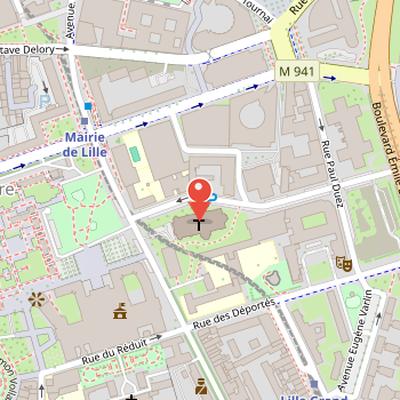
Église Saint-Sauveur de Lille stands on rue Saint-Sauveur in the Lille-Centre district of Lille, near the Mairie de Lille metro station. The present church was built between 1898 and 1902 on the site of a former Gothic church that had been destroyed by fire in 1896. François-Joseph Delemer was assigned to the project in 1898 and gave the new parish church an eclectic and neo-Byzantine style. It was blessed in December 1902.
The building is made of brick, sandstone, and limestone and follows a Latin cross plan with three naves. Its roof is covered in slate and zinc. Architectural features include a barrel vault over the central nave, a dome at the transept crossing, an apse covered by a quarter dome, and a bell tower at the back of the choir. The interior includes five stained glass windows by Édouard Didron, several altars, oak furnishings by Gustave Pattein, and a painting by Lamoral de Daudenarde. The church has been closed since 2015 because of water infiltration damage and related security investigations.
Nearby Objects
-
 Belfry of Lille 250 m away
 -
 Porte de Paris 350 m away
 -
 Zénith de Lille 400 m away
 -
 L'Aéronef 600 m away
 -
 Saint-Maurice Church 600 m away
Location and History
Eglise Saint-Sauveur de Lille is located on rue Saint-Sauveur in Lille, in the quartier de Lille-Centre, and is served by the Mairie de Lille metro station. It was built from 1898 to 1902 on the site of a former Gothic church that burned in 1896. Since 2015, the building has been closed for security investigations due to water infiltration damage.
From Gothic Origins to a Neo-Byzantine Rebuild
A Gothic style church once stood on this site and gave its name to the Lille-Saint-Sauveur district. Its spire was used by Austrian army artillery during the siege of 1792, and the spire was not rebuilt afterward. The church was later destroyed by a fire in 1896. A new Saint-Sauveur parish church was then built on the old foundations. In 1898, architect Francois-Joseph Delemer was assigned to the project and gave the new church an eclectic and neo-Byzantine style. Construction continued until 1902, and the church was blessed in December of that year.
Architecture of the Church
Eglise Saint-Sauveur de Lille is a brick, sandstone, and limestone church organized on a Latin cross plan with three naves. Its roof is made of slate and zinc. The central nave is covered by a barrel vault, while a dome rises over the transept crossing. The apse is covered by a quarter dome, and a bell tower is located at the back of the choir.
Interior Furnishings and Liturgical Elements
The interior mobilier of the church brings together several notable liturgical and artistic elements. It includes five stained glass windows made by Edouard Didron in 1867, as well as the main altar, created between 1879 and 1882. In the north transept arm, there is also the altar of the Holy Angels, completed in 1884. The oak furnishings are described as exceptional and include an organ buffet, a monumental pulpit, and confessionals. These pieces were made by the woodcarver Gustave Pattein of Hazebrouck. The church also preserves a 1732 painting by the Lille painter Lamoral de Daudenarde, titled Laissez venir a moi les petits enfants. Musical fittings include the gallery organ built in 1902 by the Belgian organ maker Salomon Van Bever, while the choir organ was installed at the Notre-Dame church in Fives.