Paris Gate, also known as Porte de Paris or Porte des Malades, is a city gate of the Lille enclosure. It was partly constructed at the end of the 17th century as a triumphal arch to celebrate the victories of Louis XIV, and it was completed at the end of the 18th century. The monument was classified as a historic monument in 1875.
Historically, the Porte des Malades stood at the southern exit of Lille along rue des Malades, a street named for the leprosery it led to. After Louis XIV’s conquest of Lille, the street was renamed rue de Paris. Louis XIV entered Lille through the Porte des Malades after a 10-day siege and received the keys from the Magistrat de Lille. He later commissioned architect Simon Vollant to build the Porte de Paris in front of the earlier gate. Constructed from 1686 to 1694, it commemorated Lille’s annexation to France and the king’s entry into the city. Until the demolition of the guardhouse around 1860, the monument consisted of two parts separated by about ten meters. After that demolition, a round plaza was created around the arch.
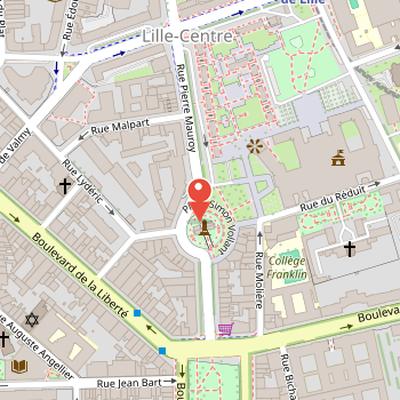
Nearby Objects
-
 Belfry of Lille 120 m away
 -
 Synagogue de Lille 250 m away
 -
 Église Saint-Sauveur de Lille 350 m away
 -
 Statue of Louis Faidherbe 500 m away
 -
 Palais des Beaux-Arts de Lille 550 m away
History and Status
Paris Gate, known as La porte de Paris or porte des malades, is a city gate of the Lille enclosure. It was partly constructed at the end of the 17th century as a triumphal arch celebrating the victories of Louis XIV. The structure was completed at the end of the 18th century. In 1875, it was classified as a historic monument.
From Porte des Malades to Porte de Paris
According to Histoire, the Porte des Malades was originally located on the Lille city wall established during an expansion that included the parishes of Saint-Sauveur and Saint-Maurice. It marked the southern exit of Lille along the rue des malades, a street named for its route to a leprosery, or maladrerie, for Lille bourgeois. This leprosery was founded around 1233 outside the city, near the present Arts-et-Metiers school and gare Saint-Sauveur, and was removed around 1670 during the construction of fort Saint-Sauveur. The rue des malades was the main street of the Saint-Sauveur district and was later renamed rue de Paris after Louis XIV's conquest of Lille; the present rue Pierre-Mauroy was formerly rue de Paris.
The gate also became tied to a major royal event when Louis XIV entered Lille through the Porte des Malades after a 10-day siege and received the keys from the Magistrat de Lille. Lille became French by the Treaty of Aix-la-Chapelle one year later. Louis XIV then commissioned the architect Simon Vollant to build the Porte de Paris in front of the Porte des Malades. Constructed from 1686 to 1694, the Porte de Paris was intended to commemorate Lille's annexation to France and to glorify Louis XIV's entry into the city, associating the monument with the king known as the Roi Soleil.
From Fortified Gate to Urban Monument
Until the end of the 19th century, and before the demolitions of the 1860s, the Porte de Paris consisted of two parts set about ten meters apart. On the countryside side stood the triumphant entrance, while on the city side there was a one-story guardhouse. The guardhouse was located at the former Porte des Malades site, at the end of rue de Paris, and the carriage gateways of the two buildings were linked by a short passage. Around 1860, the guardhouse was demolished during the dismantling of the fortifications that followed Lille's expansion in 1858. After this demolition, a round plaza was created around Simon Vollant's Porte de Paris. The monument was then threatened with demolition, but Charles Garnier chaired a commission that saved it. Garnier recommended preserving it by completing it with additional constructions, and this approach was carried out starting with the 1888 redevelopment. Architect Louis-Marie Cordonnier remodeled the Porte de Paris with a city-facing facade and integrated it into the renovated place Simon-Vollant. The remodeled site was inaugurated in 1891. In the 1960s, surrounding apartment buildings were partly destroyed during the reconstruction of the Saint-Sauveur district.
Architecture and Historical Layers
Paris Gate has two different facades, reflecting two periods of construction and two urban directions. The city entrance facade, on boulevard Denis-Papin, was created by Simon Vollant at the end of the 17th century, while the city exit facade on rue Pierre-Mauroy was created by Louis-Marie Cordonnier between 1888 and 1892. The site is named after Simon Vollant, and it is served by the metro station Mairie de Lille.
The city entrance facade presents a classical tripartite composition. Its central body contains an arcade opening for passage and is flanked by two wings, each decorated with a mythological figure framed by Doric twin columns forming porticoes. The gate includes a vaulted corridor on the ground floor and a drawbridge that allowed city access during the fortifications. Its massiveness is emphasized by the small size of the gate opening reached by the drawbridge, reflecting its defensive role as a military structure.
Above the vaulted corridor are sculpted coats of arms of Lille and the royal escutcheon. Higher on the pediment are Baroque figures, including two angels and two allegories of Fame playing trumpets. At the center is an allegory of Victory surrounded by trophies and flags, with the right arm raised, representing a figure about to crown King Louis XIV shown in a medallion. This pediment sculpture was made by Augustin Camille and sieur Manier, with work carried out by the Foundry Department of ENSAM, campus de Lille, specialists in foundry techniques. Twenty-four renovated grenades were also installed on the restored stone railing to mark the 350th anniversary of Lille becoming French.