The Belfry of Lille is the belfry of Lille City Hall, inaugurated in 1932. It was built after the destruction of the old city hall during World War I and forms an architectural set with the city hall designed by architect Émile Dubuisson. Located in the former Saint-Sauveur district near the city center of the time, it reaches a height of 104 metres and is the tallest civil belfry in Europe as well as the tallest municipal building in France. The structure is made of red brick and concrete designed to look like carved stone, and it combines Art Deco and Neo-Flemish architecture. It does not contain bells or a carillon. The belfry is classified as a historic monument and is listed as a UNESCO World Heritage site. Its ascent is open to the public and equipped with an elevator. The building is served by the Mairie de Lille metro station.
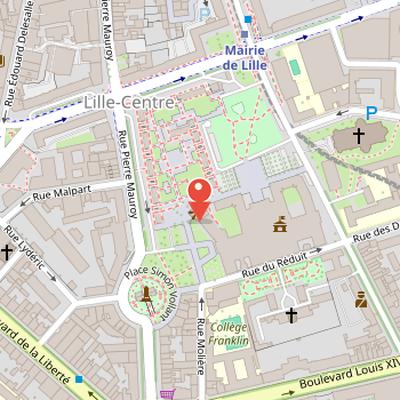
Nearby Objects
-
 Porte de Paris 120 m away
 -
 Église Saint-Sauveur de Lille 250 m away
 -
 Synagogue de Lille 400 m away
 -
 Statue of Louis Faidherbe 550 m away
 -
 Palais des Beaux-Arts de Lille 600 m away
Architecture and Status of the Lille Belfry
The Belfry of Lille is the belfry of the Lille city hall, inaugurated in 1932. It was built after the destruction of the old city hall during World War I and forms, with the city hall, an architectural ensemble designed by architect Emile Dubuisson. Located in the former Saint-Sauveur district near the city center of the time, it reaches a height of 104 meters, making it the tallest civil belfry in Europe and the tallest municipal building in France.
The structure is made of red brick and concrete intended to resemble carved stone. Its design combines Art Deco and Neo-Flemish architectural styles. Despite its name, it does not contain bells or a carillon. The belfry is classified as a historic monument and is also listed as a UNESCO World Heritage site. It is served by the Mairie de Lille metro station, and its ascent is open to the public and equipped with an elevator.
Previous Belfry Buildings
The Belfry of Lille had several predecessors before the present structure. These included the belfry of the halle echevinale de Lille, which was demolished in 1601, and the old belfry of the mairie de Lille at Palais Rihour, built in 1826 and demolished in 1856. Another predecessor was the belfry of the chambre de commerce, designed in a neo-Flemish style. These earlier buildings reflect a sequence of municipal and civic belfries associated with Lille's public institutions.
Architecture and Design
The Belfry of Lille combines Art Deco style with neo-Flemish and neo-Lillois regionalist elements. Its design also reflects the travée lilloise, a feature associated with houses in the old town. The building was constructed using the most modern techniques of its time, and it was the first reinforced concrete building of its magnitude in France. Unlike contemporary American skyscrapers, it was not conceived as an office building. Instead, it centers on a high belfry that dominates large rooms with very high ceilings and vast interior spaces.
At the base of the structure are statues of Lydric and Phinaert, created by Carlo Sarrabezolles and carved directly in setting concrete. When it was inaugurated, inhabitants of Lille nicknamed it the skyscraper in Flanders. With its height, it is currently the tallest municipal building in France. It is also part of a broader local tradition, alongside the Chamber of Commerce and the regional council seat since 2005, which together continue the Flemish municipal belfry tradition in Lille.
Lighting Design and Public Perception
The Tour phare was designed with a rotating lighthouse on top, visible nearly 40 kilometers away at night. It symbolizes the radiance of the capital and vigilance in the context of the 1930s. Its lighthouse illuminates the sky of Belgium and can be seen as far as the North Sea. At the end of the 1990s, its lighting was completely revised along with other Lille monuments. The first version of the lighthouse was criticized for creating a light halo and significant light pollution, so the lighting was later made more discreet, although it still contributes to light nuisances affecting astronomy. Around the 2000s, the municipality also began major work on public lighting control and energy savings. These improvements led to 35 percent energy savings in 2005 and 2006, while also improving performance and safety.
Public Use and Representation
The Belfry of Lille appears as a support de communication in a range of public contexts. It adorns many postcards as well as municipal and regional documents, showing its repeated use in visual communication associated with the city. In local or national journalistic language in Lille, the term support de communication can also refer to the municipality itself. The Belfry of Lille is also featured on a medal of the Monnaie de Paris that depicts Lille, further underlining its role as a recognized civic image.
Protection and Public Access
The Belfry of Lille was classified as a Monument Historique in 2002. It is one of the twenty-three belfries of Hauts-de-France and was inscribed on the UNESCO World Heritage list. The belfry can be visited through paid self-guided tours. These tours run from 10:00 to 13:00 and from 14:00 to 18:00. An audio-guide is available, and binoculars are provided for viewing Lille city at 360 degrees.