The Musée Paul-Dupuy is a municipal museum in Toulouse, located between the quartier Saint-Étienne and the quartier du Parlement. Known since 2021 as the musée des arts précieux Paul-Dupuy, it presents a collection of graphic arts and art objects spanning from the Middle Ages to 1939. The museum is housed on rue de la Pleau in the former hôtel de Pierre Besson.
The building was acquired by Paul Dupuy in 1909, and he carried out major restoration work, including raising the structure, adding a mirandes floor, completing the capitular turret, and restoring the brick facade. Originally a private museum, it became the museum of the city of Toulouse in 1949 after Paul Dupuy bequeathed his private collections and the building to France. The museum later acquired the building at 8 rue d'Aussargues in 1968, which was renovated and expanded between 1980 and 1985.
Its collections include the legacy of Paul Dupuy, the donation of Édouard Gélis, the Rozès de Brousse collection, the Regraffé de Miribel collection, and the cabinet des dessins created in 1949. They also contain clocks, watches, scientific instruments, and notable works such as an astrolabe quadrant from 1579, a waking watch from around 1600, and a mantel clock by Isaac Thuret from 1650.
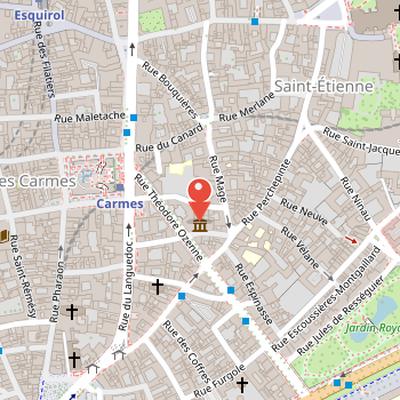
Nearby Objects
-
 Hôtel Mansencal 110 m away
 -
 Église du Gésu 300 m away
 -
 Hôtel de Lestang 350 m away
 -
 Place du Salin 350 m away
 -
 Palais Niel 350 m away
Location and Collection
The Paul-Dupuy museum, known since 2021 as the musee des arts precieux Paul-Dupuy, is a municipal museum in Toulouse. It is located between the quartier Saint-Etienne and the quartier du Parlement. The museum presents a collection of graphic arts and art objects covering the period from the Middle Ages to 1939.
History and Building Development
Mussee Paul-Dupuy was first established as a private museum in the former hotel de Pierre Besson on rue de la Pleau. Paul Dupuy acquired the building in 1909 and carried out major restoration work, including raising the structure, adding a mirandes floor, completing the capitular turret, and restoring the brick facade. In 1949, after Dupuy bequeathed his private collections and the building to France, the museum became the museum of the city of Toulouse. The institution later acquired the building at 8 rue d'Aussargues in 1968 and renovated and expanded it between 1980 and 1985.
Collections and Donations
The museum collections are based on the legacy of Paul Dupuy and the donation of Edouard Gelis, which focuses on horology. They also include the Rozes de Brousse collection, made up of drawings, engravings, and posters, as well as the Regraffe de Miribel collection. A cabinet des dessins was created in 1949. In 1944, the collections were described as having two main groups with more than works covering a period from to ), although the available facts do not provide the missing details.
Horological and Scientific Collections
The Musée Paul-Dupuy collections include numerous clocks and watches, together with horological objects such as watch cases and mechanisms. They also contain scientific instruments, including compasses, microscopes, graphometers, and astrolabes. Among the notable items are an astrolabe quadrant from Anvers dated 1579, made of engraved brass by Adrian Descroliere; a waking watch by Gui Rumault from around 1600, attributed to Abeville; and a mantel clock by Isaac Thuret from 1650. The collections also include a Japanese double foliot clock, or Wadokei, from the Edo period, and a portico clock from 1828 by Veuve Desarnaud in Toulouse.
Collections and Decorative Arts
The collections of Musee Paul-Dupuy bring together a wide range of historical objects, with a strong emphasis on decorative arts, furniture, and regional craftsmanship. A notable centerpiece is the cor de Roland, an oliphant from the Basilica of Saint-Sernin, dated to the 11th century and recorded as Inv. 18036. The holdings also include the shrine of Saint Exupere, sculptures, and examples of Toulouse goldsmithing, especially cutlery and shaped pieces from the 18th century.
The museum preserves numerous pieces of furniture from Toulouse buildings, including the carved door of the grand consistory of the Capitole de Toulouse and the doors of the grand consistory, Inv. 15024. Other furniture includes pieces from Chateau de Reynerie, a two-body cabinet with mannerist decorations from around 1610, and a 16th century marriage chest called La Force et la Justice. The collections also feature the apothecary cabinet from the Jesuit College of Toulouse and the Jesuit drug cabinet dated 1632, which occupies the ground floor and contains faience from the region.
Textiles and liturgical art are represented by the altar frontal from the Couvent des Cordeliers of Toulouse, made of linen and polychrome silk embroidery. The museum also presents a room dedicated entirely to faience and porcelain from Toulouse, Marignac, and Valentine. Additional holdings include ironwork such as locks, keys, and signs; ancient weapons such as swords and pistols; and the damas used for beheading condemned prisoners by the Capitouls. Medical equipment is also shown, contributing to the museum's broad survey of local material culture and historical use.