Porte de Gand is a city gate in Lille, also known as the gate of Madeleine. It belongs to the old Spanish fortifications constructed between 1617 and 1621 during the city wall expansion under Archdukes Albert and Isabelle. Built around 1620 by the master masons Pierre Raoul and Jean Le Mestre, it was inaugurated in 1625. The gate was later preserved by Vauban during the fortification reconfiguration that began in 1668, and he reinforced it with advanced works.
Originally named Porte de la Magdeleine, it was renamed Porte de Gand after the Revolution. The gate was later converted into a restaurant by private individuals, and since 1997 the façade côté ville has hosted the restaurant gastronomique Les Remparts. The fortified area around the gate includes partially preserved fortifications from the period before Lille’s enceinte was dismantled. This zone was affected by partial dismantling beginning in the late 1930s after fortification declassification by law. Porte de Gand was classified as a historical monument in 1929.
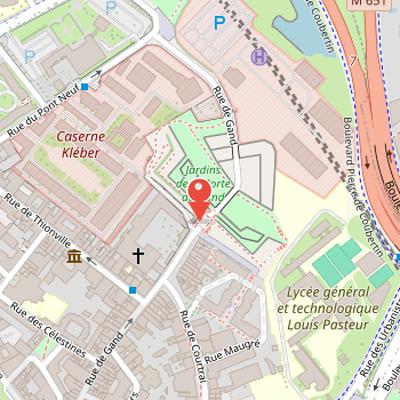
Nearby Objects
-
 Château de Courtrai 200 m away
 -
 Hospice Comtesse 450 m away
 -
 Musée de l'Hospice Comtesse 450 m away
 -
 Collégiale Saint-Pierre 450 m away
 -
 Regional Conservatory of Lille 500 m away
Porte de Gand in Lille
Porte de Gand, also known as the Gate of Madeleine, is a city gate in Lille. It forms part of the old Spanish fortifications built between 1617 and 1621. The structure was classified as a historical monument in 1929, reflecting its recognized heritage value within the citys fortification history.
History of Porte de Gand
Porte de Gand was constructed during the expansion of the city walls under Archdukes Albert and Isabelle in the early 17th century. It was built around 1620 by the master masons Pierre Raoul and Jean Le Mestre, and was inaugurated in 1625. The structure was initially named porte de la Magdeleine. From 1668, during the reconfiguration of the fortifications, Vauban preserved the gate and reinforced it with some advanced works. After the Revolution, it was renamed porte de Gand. In a later phase of its history, private individuals converted it into a restaurant.
City-Side Facade
The city-side facade of Porte de Gand is arranged in three parts. Since 1997, it has also hosted the gastronomic restaurant Les Remparts, adding a continuing contemporary use to the historic structure.
Fortified Zone of Porte de Gand
The fortified zone of Porte de Gand includes the fortifications of the gate and is one of the partially preserved elements of the defenses that protected Lille before the dismantling of its enceinte. During the Spanish era, the gate was framed by two bastions: bastion du Meunier on the right and bastion des Carmes on the left. The route to La Madeleine crossed a drawbridge over a moat between the gate and an advanced work, then continued over a fixed bridge above a water moat, crossed a demi-lune obliquely on the left, and reached a second bridge.
The arrangement was later significantly reinforced by Vauban, who added advanced works, a tenaille, counter-guards, multiple demi-bastions, and a hornwork. The route kept the same general layout, crossing a drawbridge between the gate and the tenaille before passing over four successive bridges over moats. Two bridges remain between the tenaille and a demi-lune, followed by a second bridge between the demi-lune and the counter-guard, a third bridge between the counter-guard and a second demi-lune, and a fourth bridge over the outer moat of the work.
Partial dismantling began in the late 1930s after the fortifications were declassified by law. This work started with the destruction of the second demi-lune and the filling of the surrounding moats. The moats under the drawbridge and around the hornwork were also filled.
The Fortified Zone Around Porte de Gand
The fortified zone around Porte de Gand remains visible in several preserved and altered parts. The grounds of the hornwork are still a military zone known as parc du genie, while the zone of the demi-lune is crossed by rue de Gand and still preserves the bastions' curtain walls. Between these preserved walls, the former moat became a vacant lot and now functions as an undeveloped garden of the Porte de Gand.
The route through the area passes under the gate by a fixed bridge, then turns left to cross the demi-lune. After a second bridge, it skirts the military domain of the former Vauban hornwork before turning right to join rues du Pont-Neuf and des Bateliers, which were expanded between the World Wars after the fortifications were declassified. From there, the route continues from the junction of three streets toward La Madeleine.
The external zone between the two bastions and the demi-lune was abandoned in the early 20th century and was marked by shantytowns and marginal activities, although it showed slight improvement by that period. The east flank is bordered by the boulevard peripherique, also called boulevard Pierre-de-Coubertin and RD 749, built in 1964 along the former hornwork military domain.