Château de Courtrai is an ancient castle built northeast of Lille on the order of Philippe le Bel after the siege of 1297. It is associated with the Flemish War between the County of Flanders and the Kingdom of France at the end of the 13th century, and with the assertion of French authority over territories including Lille in 1304. The castle formed part of a broader programme of castle construction in Bruges, Courtrai, and Lille to control these cities.
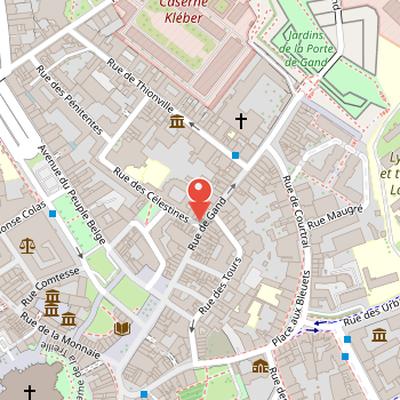
The fortress was located northeast of the Basse-Deûle shore, at the faubourg de Courtrai on the Bruges road. Its construction led to the destruction of the old faubourg and the creation of a bypass road to the east, along the present rue Saint-Jacques, place aux Bleuets, and rue de Courtrai. The fortress had an irregular quadrilateral plan measuring 150 by 190 metres, with curtain walls 2.30 to 5 metres thick, several towers, and a moat supplied by the Basse Deûle. It contained two gates, controlled access to the city, and housed the governor’s residence, military lodgings, prisons, and stores for food, arms, and ammunition. The castle was gradually demolished starting at an unspecified time.
Nearby Objects
-
 Porte de Gand 200 m away
 -
 Hospice Comtesse 250 m away
 -
 Musée de l'Hospice Comtesse 250 m away
 -
 Collégiale Saint-Pierre 250 m away
 -
 Regional Conservatory of Lille 300 m away
Origins and Early History
The Chateau de Courtrai was an ancient castle built northeast of Lille. It was constructed on the order of Philippe le Bel after the siege of 1297. Over time, the structure was gradually demolished, beginning at an unspecified date.
Castle Construction and Political Control
The history of the Château de Courtrai is connected to the Flemish war at the end of the 13th century, when the County of Flanders opposed the Kingdom of France. It was also affected by Philip IV of France asserting authority over territories including Lille in 1304. In this context, castle construction in Bruges, Courtrai, and Lille was related to efforts to control these cities. Construction works in Lille began in 1304, reflecting this wider political and military strategy.
Fortified Layout and Access at Courtrai
The Château de Courtrai was built northeast of the Basse-Deule shore, at the faubourg de Courtrai on the Bruges road. Its construction led to the destruction of the old faubourg and the creation of a bypass road to the east, following the present rue Saint-Jacques, place aux Bleuets, and rue de Courtrai. A new Courtrai gate was also created on the eastern axis, while the Bruges road was enclosed within the fortress in a slightly diagonal alignment compared with the Basse Deule.
The fortress formed an irregular quadrilateral measuring 150 meters by 190 meters, with an interior area of 2.95 hectares. Its curtain walls were between 2.30 and 5 meters thick, and the enclosure was reinforced by several towers with diameters approaching 14 meters. A moat supplied by the Basse Deule surrounded the whole structure.
The fortress had two gates, both flanked by towers and protected by drawbridges. The front gate drawbridge extended over the Basse Deule and gave access to the old Courtrai gate, later renamed the chanoines gate near the collegiale Saint-Pierre. Together, these gates controlled access to the city and formed a strong forward defense on a main entry route. The Courtrai gate is shown on the 1560s Deventer plan at the intersection of rue Saint-Jacques and rue des Tours, providing access to the road that circumvented the castle along the present rues Saint-Jacques and de Courtrai. The front gate itself is not known precisely, since no excavations have located it.
Functions of the Château de Courtrai
The Château de Courtrai was constructed as a multi-purpose fortified complex. Its layout included the governor's city residence, military lodgings, prisons, food stores, and depots for arms and ammunition. The building also held archives, known as the Tresor des chartes, which were deposited in one of its towers. These functions show that the structure combined administrative, military, and archival uses within a single construction.
Demantlement and Urban Integration
In 1577, dismantlement of the Chateau de Courtrai was carried out at the request of the magistrate of Lille and with authorization from the Estates General. Only the wall facing the city was demolished, while the other fronts were incorporated into the urban enclosure. To avoid weakening the fortifications, the magistrate established a boulevard on the site of the dismantled castle. King Philippe II later recognized the transfer of the castle to the city.
The former castle grounds were further absorbed into Lille's growth in 1617, when the land, together with several newly opened streets, was included in a new enclosure between the porte de Gand and the porte de Roubaix. This enlarged the city. The chapel, identified as the former Saint-Vital chapel, was preserved. The former moat of the castle became the canal du pont de Flandre, which ran from the abreuvoir Saint-Jacques under rue de Gand to the Basse Deule and was completely covered around 1900. After dismantlement, the governor's hotel was transferred to the hotel de Santes on rue de l'Abbiette, now rue de Tournai.