The Regional Conservatory of Lille is an artistic education institution located in Lille, Nord, France. It is approved and controlled by the French State, supervised by the Direction générale de la Création artistique of the Ministry of Culture and Communication, and represented by the Direction régionale des Affaires culturelles (DRAC). The conservatory offers three specialties: music, choreography, and dramatic arts.
Its history is linked to the academy of music of Lille, founded in 1803. According to the available history, the music school became a regional national conservatory in 1970 and changed to a regional outreach conservatory in 2006. The conservatory has an auditorium with 400 seats. Théodore Herlin, born in Lille in 1817 and died there in 1889, served as a director of the conservatory and is credited with the work L'Académie de Musique de Lille: Notes chronologiques extraites des archives.
Today, the conservatory offers three musical learning cycles: cycle initiation, cycle studies, and cycle specialization. It also provides dance teaching in classical dance, contemporary dance, and jazz dance, alongside adapted schedule programs in partnership with the Éducation nationale.
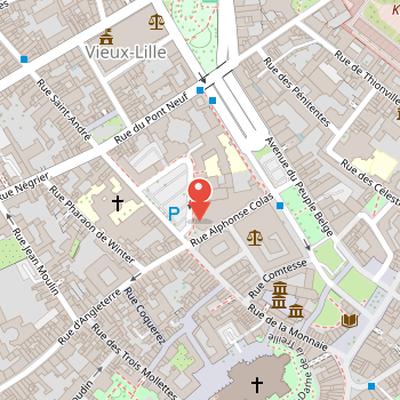
Nearby Objects
-
 Collégiale Saint-Pierre 40 m away
 -
 Place aux Oignons 130 m away
 -
 Hospice Comtesse 150 m away
 -
 Musée de l'Hospice Comtesse 150 m away
 -
 Lille Cathedral 200 m away
Artistic Training in Lille
The Regional Conservatory of Lille is an artistic education institution located in Lille, Nord, France. It is approved and controlled by the French State and is supervised by the Direction generale de la Creation artistique of the Ministry of Culture and Communication. The institution is represented by the Direction regionale des Affaires culturelles, or DRAC. It offers training in three specialties: music, choreography, and dramatic arts.
History of the Lille Conservatory
The academy of music of Lille was founded in 1803. According to the historical record, the music school became a regional national conservatory in 1970, and in 2006 it changed its status to a regional outreach conservatory. The conservatory also includes an auditorium with 400 seats. Among the figures associated with its history is Theodore Herlin, who was born in Lille in 1817 and died there in 1889. Herlin served as a director of the conservatory and is credited with the work L'Academie de Musique de Lille: Notes chronologiques extraites des archives.
Current Teaching Cycles and Adapted Schedules
The Regional Conservatory of Lille today offers three musical learning cycles: cycle initiation, cycle studies, and cycle specialization. The cycle specialization is divided into amateur practice training and a specialized cycle. The first two musical cycles end with an end of cycle diploma. In dance, the Conservatory provides teaching in classical dance, contemporary dance, and jazz dance. During the first three years of cycle specialization, students must follow the three dance styles equally, and after this period they may choose a dominant dance practice. Students entering the adapted schedule cycle may continue courses in the non-dominant dance practice, while those pursuing a professional track must abandon the other dance discipline.
The Conservatory also works with the Education nationale on a musical adapted schedule class cycle. This program involves the elementary schools Lamartine, Diderot, Boufflers, and Lalo, as well as college Carnot and lycee Louis-Pasteur. For musicians and dancers at college Carnot, the Conservatory offers a specific timetable that concentrates classes in the morning and places afternoon teaching at the Conservatory. At lycee level, the adapted schedule path continues toward the baccalaureat Technique Musique et Danse. The adapted schedule route requires a real decision from the student to pursue a professional career in music and dance.