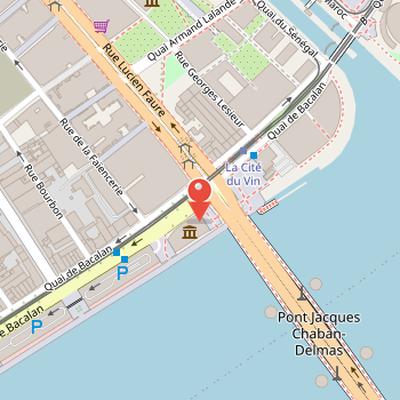
Cap Sciences is a Centre de culture scientifique, technique et industrielle in Bordeaux, situated on the banks of the Garonne near the Pont Jacques-Chaban-Delmas. It functions as a center for public animation and exhibitions focused on scientific phenomena and industrial applications, and it is open to the public for the discovery and understanding of scientific principles and technological know-how. Associated with the CCSTI movement that emerged in the 1970s, it is supported by research institutions and local and territorial authorities, with the aim of promoting scientific culture.
Cap Sciences was given a legal structure as a 1901 law association following a constitutive general assembly. It began at Hangar 16 on the Bordeaux docks and was recognized as a cultural site in Bordeaux in 1996. The organization later expanded with the construction of Hangar 20, which opened in 2001. Its development also included itinerant exhibitions, proximity centers in Pessac, Floirac, and Mérignac, a Living Lab opened in 2013, and a range of exhibitions and projects presented in France and abroad.
Nearby Objects
-
 Cité du Vin 450 m away
 -
 Musée Mer Marine 750 m away
 -
 Jardin botanique de Bordeaux 1600 m away
 -
 Saint-Louis-des-Chartrons Church 1700 m away
 -
 Hôtel Fenwick 1800 m away
Cap Sciences and Scientific Culture in Bordeaux
Cap Sciences is a Centre de culture scientifique, technique et industrielle in Bordeaux. It is located on the banks of the Garonne near the Pont Jacques-Chaban-Delmas. The center is devoted to public animation and exhibitions focused on scientific phenomena and industrial applications. It is open to the public to encourage discovery and understanding of scientific principles and technological know-how. Cap Sciences belongs to the CCSTI movement, which originated in the 1970s, and it is supported by research institutions as well as local and territorial authorities. Its purpose is to promote scientific culture.
From Hangar 16 to Hangar 20
Cap Sciences was given legal structure through a constitutive general assembly as a 1901 law association. It was first located at Hangar 16 on the Bordeaux docks, where its official opening began with the exhibition Aquitaine terre d Ocean and included a presentation of the Cited des Sciences de la Villette. In 1996, it became a recognized cultural site in Bordeaux. During this period, Cap Sciences also developed concepts of human mediation in educational leisure through itinerant exhibitions produced by CCSTI Bordeaux-Aquitaine. To support its growth, the organization built a larger facility, Hangar 20, at the end of the docks, which opened in 2001. Bordeaux architect Bernard Schweitzer was appointed project manager for that construction. In October 2003, Cap Sciences launched a new website after a complete overhaul.
Exhibitions, Expansion, and Innovation
Cap Sciences has built its history through a series of exhibitions, projects, and nearby centers that extended its reach beyond its main site. In 1998, it opened a proximity center in Pessac, Cap'Archéo, followed by Cote Sciences in Floirac in 2008 and Cote Sciences Air et Espace in Merignac in 2011. Its exhibition activity has included the first childrens exhibition, Le petit explorateur des sciences, in 2005, as well as Sur les traces de l'homme, which was shown internationally in Turkey for four months. The center also faced very high attendance for the Mammouths exhibition, to the point of refusing visitors because of overcrowding. In June 2009, Cap Sciences received the Prix Diderot for the Clim'City project. Since 2011, it has led the Inmediats project, funded by the future investments program, to promote scientific culture and equal opportunity through six science centers serving young people from priority areas. In 2012, it hosted the world premiere of Lascaux - international exhibition, and in February 2013 it opened a Living Lab dedicated to discovering innovative technologies, services, and tools in partnership with LaBRI, INRIA, and the company Immersion.
Mission and Public Role
Cap Sciences is presented as a center of scientific culture whose mission is to make scientific culture accessible to the general public. It brings together scientists and researchers who recognize the value of CCSTI for sharing the stakes of research and improving public understanding. In this role, CCSTI are described as places for discovery, information, and the dissemination of scientific culture. The approach also aims to develop visitor curiosity through participative relationships. Its audiences include the general public, school groups, leisure structures, students, tourists, seniors, and young children through youth workshops. For children, exploration and playful activities are placed at the core of the offer in order to stimulate a spirit of discovery and natural curiosity.
Public Science and Cultural Events
Since 1998, Cap Sciences, through its events program, has participated each year in the Fete de la Science. During this event, it presents science and technology to the public through activities, site visits, conferences, and meetings, and it coordinates all actions in Aquitaine. It has also taken part in the Nuit des chercheurs since 2006, organizing events in many European cities to encourage meetings between researchers and the public. In 2006, it participated for the first time in the Fete de l'Internet. Since 2014, it has also taken part each year in the Nuit europeenne des musees and MuseumWeek.
Management and Organization
Cap Sciences is managed by a board of directors. Bernard Alaux, who co-founded the association, served as director from 1995 to 2016 and retired in 2016. Daniel Charbonnel then presided over Cap Sciences for 10 years; he was director of Saft Bordeaux. In 2021, he was replaced by Didier Pourquery, and Raphae l Dupin became director in January 2023.
The organization has a team of about fifty people working in cultural diffusion professions. Their roles include conception, engineering, production, animation, communication, and editing. The exhibitions team also includes scientific mediators.
Cap Sciences is a member of the AMCSTI association and part of the ECSITE network.