Cité du Vin is a museum in Bordeaux, Gironde, France, located at 134–150, quai de Bacalan, esplanade de Pontac, with coordinates 44.8622997, -0.550318. Designed by Agence XTU, by Anouk Legendre and Nicolas Desmazières, it was developed as a cultural and tourist wine centre project beginning in 2009. The initiative involved Alain Juppé and François Hollande. A prefiguration association, La Cité du Vin, brought together the Aquitaine region, Bordeaux Métropole, the city of Bordeaux, the Bordeaux wine interprofessional council, and the Bordeaux chamber of commerce and industry to assess the project’s feasibility. The aim was to create a monument between a museum and a theme park. In January 2015, this structure was replaced by the Foundation for the culture and civilizations of wine, recognised as a public utility and responsible for development and promotion. The foundation’s board includes three colleges, and its cultural orientation committee defines major directions. The site received 400,000 visitors in 2019.
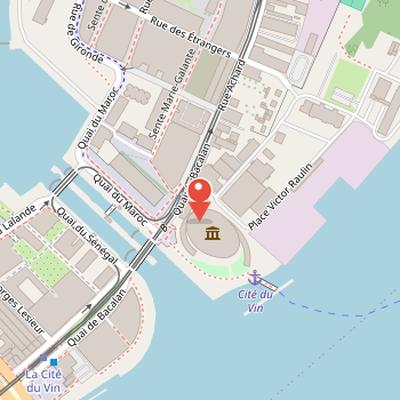
Nearby Objects
-
 Cap Sciences 450 m away
 -
 Musée Mer Marine 550 m away
Cite du Vin in Bordeaux
Cite du Vin is located in Bordeaux, Gironde, France, at 134-150, quai de Bacalan1, esplanade de Pontac, 33300 Bordeaux. Its coordinates are latitude 44.8622997 and longitude -0.550318. The building was designed by the architect Agence XTU, led by Anouk Legendre and Nicolas Desmazières. Alain Juppe and Francois Hollande were also involved in the project. In 2019, Cite du Vin received 400000 visitors, indicating its role as a major public destination in the city.
From Project to Foundation
The Cite du Vin project began in 2009, when Histoire launched plans for a cultural and tourist wine center. To evaluate the feasibility of the proposal, Histoire created the association La Cite du Vin prefiguration, bringing together the Aquitaine region, Bordeaux Metropole, the city of Bordeaux, the Conseil Interprofessionnel du Vin de Bordeaux, and the Bordeaux chamber of commerce and industry. The project was conceived as a monument positioned between a museum and a theme park, reflecting both cultural and visitor-oriented ambitions.
In January 2015, the association was replaced by the Foundation for the culture and civilizations of wine. This foundation took over the development and promotion of the wine establishment and was recognized as being of public utility. Its governance was structured around three colleges: founders, qualified personalities, and friends. A cultural orientation committee was also created to define major directions for the institution. The foundation named actor Pierre Arditi and wine critic Robert Parker as its two patrons.
The foundation also supported a 2015 amendment to the Evin law, which allowed exhibitions of wine culture to not be considered advertising. In addition, it was responsible for the exploitation and development of La Cite du Vin, as provided by the city of Bordeaux, the owner of the building.
Financing, opening, and later renewal
Cite du Vin was developed through a mixed funding model, with 81 percent of the project financed by public funds and 19 percent by private funding. In 2011, an endowment fund was created to collect private donations for La Cite du Vin. The initial projected cost, estimated in January 2011 at 63 million euros excluding taxes, was later reassessed after a 17 percent budget overrun. By 2015, the final cost had approached 81 million euros excluding taxes, including 49 million euros devoted to construction and scenographic layout.
Construction began in 2013, after the first stone was laid by scenographer Eric Le Collen at Vinexpo 2013. The building received works on March 31 of an unspecified year. The economic model of the Foundation for the culture and civilizations of wine was defined without public aids and based on its own resources. These resources came from ticket sales, boutique sales, space privatization, engineering, and private donations. The entrance price was set at 23 euros, including a visit to the permanent exhibition with an audio-guide, access to the Belvedere, and a wine tasting from fifteen partner wines.
The institution reported that its visitors are 45 percent French and 55 percent international, mainly from the United States, Spain, the United Kingdom, Germany, Italy, and Switzerland. In 2023, a large part of the cultural offer and equipment was renewed through the Neo-Experience 2023 program, supported by Europe, the Nouvelle-Aquitaine Region, Bordeaux Metropole, the City of Bordeaux, sponsors, and the Foundation's own resources. This renewal upgraded the scenography, digital equipment, and multimedia productions of the permanent exhibition.
Architecture and Visitor Spaces
The Cité du Vin stands on the site of the old forges of the grand port maritime de Bordeaux, in the Bassins a flot district, on the island between quai Bacalan, the lock entrance, and the Garonne river. It was designed by XTU architects and Casson Mann Limited, whose proposals were selected through a design competition in May 2011. The building has a rounded exterior and interior, rises to a tower height of 55 meters, and covers 13,350 square meters across 8 levels. Its concrete structure rests on 300 concrete piles reaching 30 meters deep.
The exterior is defined by 918 glass panels in light green, gray, and golden tones, together with serigraphic glass panels and iridescent perforated aluminum panels. Inside, the ground floor contains a rounded 12 meter high space with a wine shop representing seventy wine regions, as well as areas for purchasing and tasting, adjacent restaurant spaces, and a souvenir shop operated by La Cité du Vin. The first floor includes temporary exhibition spaces, a reading room, discovery workshops, and an auditorium with 135 seats, which hosts events and performances throughout the year.
The second floor is devoted to the permanent exhibition, organized into 18 thematic spaces and designed as a two hour visit. It also includes an innovative travel companion tool with multimedia, lip reading translations in 8 languages, and accessibility features. Higher levels include the panoramic restaurant Le 7 on the seventh floor and a belvedere on the ninth floor, located 35 meters above ground, with panoramic views of Bordeaux city and the port.
Temporary Exhibitions and Sensory Experiences
Since 2017, Expositions temporaires has organized cultural exhibitions at Cite du Vin. These include displays of fifty vinicultural containers presenting the history of Georgian viticulture. The same programming also offers Via Sensoria, a sensory tasting experience available since April 8, 2023. Developed with GEDEON Programmes as an artistic, digital, and immersive creation, Via Sensoria guides visitors with a sommelier through four dreamlike pavilions representing the seasons. In each pavilion, visitors are invited to taste a glass of wine or a non-alcoholic beverage linked to the season.
Access and Riverfront Facilities
Cité du Vin is served by the TBM network, which is operated by Transports. The same organization also manages Le Velo, a self-service bike rental system, supporting access by local transport. In addition, Transports provides a pontoon that gives access to the Garonne for wine tourism trips organized by the Bordeaux tourist office to Bordeaux vineyards.
The pontoon is built from two steel caissons, each 12 meters long and weighing 14 tons. Each caisson is ballasted with 9 tons of concrete. Transports constructed the pontoon at a cost of 1.38 million euros, making it an important piece of riverfront infrastructure linked to the site and its tourism use.
Visibility and Attendance
Cite du Vin serves a role in city promotion through communication, supported by its original architecture and its river location. The architects requested additional payment for the use of image rights by the city, and a transactional protocol was signed for this purpose. Since opening on August 29, 2018, the building has drawn significant public attention. It received one million visitors, and by May 2022 the total had reached two million.