Montparnasse Tower is a skyscraper in Paris, located in the Necker district and forming part of the Tour Maine-Montparnasse real estate complex. Inaugurated in 1973, it has a height of 209 metres, not including the 6-metre glass screen of the observatory. It was the tallest building in France for nearly forty years, until the tower First in La Défense surpassed it in 2011.
The tower was designed by architects Jean Saubot, Eugène Beaudouin, Urbain Cassan, and Louis de Hoÿm de Marien. Jean-Claude Aaron directed the development of the project. Its creation was part of a broader redevelopment of the Maine-Montparnasse sector, which involved major urban changes and the demolition of numerous deteriorated streets. The project followed earlier plans for a new station in the area and became the focus of debate before the building permit was granted in 1968.
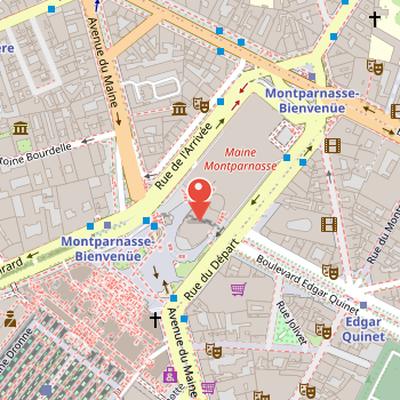
Nearby Objects
-
 Musée du Montparnasse 150 m away
 -
 Théâtre Montparnasse 250 m away
 -
 Comédie-Italienne 250 m away
 -
 Musée Bourdelle 300 m away
 -
 Bobino 300 m away
Height and History of Montparnasse Tower
Montparnasse Tower, known here as Intro, is the tallest skyscraper in Paris intra-muros and stands in the Necker district. It has a height of 209 meters, not including the 6-meter glass screen of the observatory. Inaugurated in 1973, it remained the tallest building in France for nearly forty years until 2011, when the tower First in La Defense surpassed it in height. The tower was designed by architects Jean Saubot, Eugene Beaudouin, Urbain Cassan, and Louis de Hoym de Marien, with Jean-Claude Aaron directing its development. It is part of the real estate complex Tour Maine-Montparnasse (EITMM).
From Station Site to Modern Tower
In 1934, the old Montparnasse station was located on boulevard Montparnasse, facing rue de Rennes, and the city of Paris considered reorganizing the district and building a new station. Raoul Dautry was assigned the new station project, and his name later gave its name to the square in front of the tower. However, the project faced strong opposition and was put on hold.
A new phase began in 1956 with the creation of the Societe d'economie mixte pour l'Amenagement du secteur Maine Montparnasse (SEMMAM) and the Agence pour l'Operation Maine Montparnasse (AOM). These bodies were tasked with redeveloping the district, which required the demolition of many dilapidated and unhealthy streets. The construction site reached up to 8 hectares in 1956. First studies for the tower were launched in 1958, with Raymond Lopez and Michel Holley supporting the project. The tower was criticized for its height, and the controversy slowed the project led by Minister of Equipment Edgard Pisani. At the same time, Andre Malraux, Minister of Culture, supported the project under General de Gaulle.
The Montparnasse station was rebuilt a few hundred meters south of the old station from June 1966 to spring 1969, while the Maine station was destroyed as part of the AOM real estate project. The AOM included architects Urbain Cassan, Eugene Beaudouin, Louis de Hoym de Marien, and architect Jean Saubot assisted. Andre Malraux granted the building permit for the tower to AOM in 1968, and construction work began the same year. In 1969, the decision to build a shopping center was made, and Georges Pompidou wanted to provide Paris with modern infrastructure. Despite significant controversy, tower construction could start in 1969. The tower was built between 1969 and 1973 on the site of the old Montparnasse station, with the first stone laid in 1970 and the building inaugurated in 1973.
The tower's construction also reflected broader urban change. Geographer Anne Clerval says it symbolizes the tertiarization of Paris in the 1970s, which resulted from deindustrialization policies favoring service sectors starting in the 1960s. It has become an emblematic building of the Trente Glorieuses. Its foundations consist of reinforced concrete extending 15 meters underground, and it was constructed above a metro line. The metro structures were protected by reinforced concrete casing to avoid weakening the metro support, and long horizontal beams were installed to clear underground space for train tracks.
Incidents and Public Installations
Montparnasse Tower has been the site of several notable incidents and temporary visual interventions. On June 6, 1990, around 1:30 p.m., a 30-centimeter piece of glass fell from the 44th floor. According to Histoire, no one was injured, but the roofs of three cars were damaged. Histoire also mentions a similar incident in November 2008.
The tower was affected by a broader city-scale disruption on July 22, 2008, when access was closed because of a power outage affecting parts of the 14th, 15th, and 6th arrondissements of Paris. The outage followed a nighttime fire in an underground gallery that cut a high-voltage line. Power in the tower was restored late in the afternoon after intervention by ERDF.
In early 2012, the tower received new nighttime lighting called La Dame de Lumiere. The installation included nearly 4000 lights organized around 58 LED projectors placed inside each floor at the four corners. The renovation cost one million euros and was designed to consume 60 percent less energy than before.
The building has also been used as a support for public messages. On May 23, 2017, it was symbolically turned off from midnight in tribute to the victims of the Manchester bombing, the first time it had been turned off for a terrorist attack. On June 8, 2017, a giant logo was installed on the facade to support Paris's bid for the 2024 Summer Olympics. At the end of 2020, the TousAntiCovid application logo was installed on the west facade for one month to help mobilize the French population against the Covid-19 pandemic.
Planned Restructuring of the Tower
A restructuring project for Montparnasse Tower launched an international architect competition through EITMM and CIIAM with the aim of modernizing and transforming the building by 2024. The project was presented as a major update to the skyscraper, with an estimated budget ranging from 500 to several million euros, and seven projects were to be selected in September for presentation to local officials and residents. The plan sought to replace the tower's current dark and austere facade with a more luminous and transparent appearance, while also adding green spaces, reorganizing the forecourt, and including a greenhouse 25 meters high.
The proposed redesign also addressed the tower's function and environmental performance. It was intended to provide workspace for 1,750 people, compared with the current 1,050 occupants, while reducing energy consumption to one tenth of the previous level. Partial energy autonomy was to be achieved through a double skin facade, rainwater recovery, and specialized glazing. Although the scheme originally considered increasing the tower's height to 225 meters, this was limited to 185 meters. The construction cost was set at 70 million euros, to be fully funded by about forty co-owners.
The project also included reuse measures for the existing material, with 90% of the old dark glass planned for signage and partial recycling into furniture. The works were originally scheduled for 2019 to 2023, then announced for after the 2024 Summer Olympics with a planned duration of four years, before being finally planned to begin in 2026.
Location and Urban Setting
Montparnasse Tower is located in the Necker district, at the eastern axis of boulevard de Vaugirard. It stands on the boundary with the 14th arrondissement, specifically the Montparnasse district, and also at the boundary with the 6th arrondissement, aligned with rue de Rennes. The tower extends the axis created by palais de Chaillot, le Trocadero, the Eiffel Tower, Champ-de-Mars, and the military school, and it runs parallel to the historical axis. Its official postal address is 33, avenue du Maine.
The tower is bordered by rues du Depart and de l'Arrivee, boulevard du Montparnasse, and place du 18-Juin-1940. It is separated from Paris-Montparnasse station by place Raoul-Dautry. Public transport access includes Montparnasse - Bienvenue metro station, served by lines 4, 6, 12, and 13, as well as bus lines 28, 58, 82, 88, 89, 91, 92, 94, 95, and 96.
Structure and Interior Layout
Montparnasse Tower rises 210 meters and is set on an almond-shaped base with a triangular notch at each end. It was erected above metro line 6 on soil made up of limestone, clay, and chalk, and its foundations consist of 56 reinforced concrete pillars, some with a diameter of 2.5 meters. Several of these pillars extend 30 meters below street level. The building weighs 300,000 tons and has 6 underground levels and 59 floors, with floors averaging 3.7 meters each.
The tower contains 28,000 square meters of retail space and 60,000 square meters of office space, accommodating 12,000 to 15,000 offices. It is described as the largest European real estate complex and has 135,000 square meters of facade. Its vertical circulation includes 5 freight elevators and 25 passenger elevators, each serving only a group of floors. The fastest elevator originally traveled from the ground floor to the 56th floor, reaching 200 meters altitude in 38 seconds at 6 m/s, and its speed was reduced in 2009 to 5 m/s with smoother acceleration.
The 56th floor includes a panoramic bar-restaurant, while a rooftop terrace sits above the floors and is accessible only by stairs. Observation areas provide a 360-degree view of Paris. The building was the tallest office building in Europe for seventeen years until the Messeturm was built in Frankfurt in 1990, and it still ranked among the tallest towers in Europe in 2016.
Uses and public access
Most of the tower is occupied by offices, and the building has housed a range of organizations over time. These have included the Mutuelle generale de l Education nationale (MGEN) in the copropriete, the RPR in 1976-1977, and Emmanuel Macron's En marche! headquarters in offices on one floor in 2016. The tower has also had some unusual public and media uses: Loto draws were broadcast live from a tower floor in the 1980s, and the building was used for a scientific experiment with a muon detector sending laser signals to the Paris Observatory.
The tower's public area, the Observatoire panoramique de la Tour Montparnasse, belongs to Montparnasse 56, which manages visits. The observatory was fully renovated in 2005 and 2011 and now presents two levels for visitors. Its covered floor includes installations explaining the history of Paris through interactive panoramas and historical photo exhibits, and it formerly included Le Ciel de Paris restaurant, a bar, and a souvenir shop named Montparnasse 56 / Ciel de Paris. Three floors below, the Panoramique terrace, managed by the copropriete, is at 200 meters altitude and offers a 360 degree view of Paris up to 40 km away, including airplanes taking off from Orly airport 13.5 km away. The terrace was originally a helicopter station and was converted to a helitreuillage station in 2008. There were also rumors in the 1990s about ransom deliveries via heli-surface, and the tower was involved in the AZF group's 2004 ransom demand plan involving a helicopter at the summit.
Criticism and asbestos controversies
The Montparnasse Tower was strongly criticized during and after its construction. Detractors found it disturbing because its height was seen as disproportionate to Paris, and this criticism helped make the tower a recurring subject of debate about whether it should be destroyed. The question of demolition was raised repeatedly, with political figures taking positions in favor of it at different times. Bertrand Delanoe, former mayor of Paris, at one time supported destroying the tower. Bernard Debre, UMP deputy for Paris, included its destruction in his 2008 municipal election program, and UMP candidate Nathalie Kosciusko-Morizet also announced a desire to destroy it during the 2014 municipal elections. In 1975, the municipality decided to ban construction of buildings over seven stories in Paris, although some towers in the Flandres and Front de Seine districts were later built after 1978 with prior permits.
The tower also became the focus of asbestos-related concerns. In 2014, asbestos was announced in the tower's technical premises, and a judicial investigation was opened for endangering others' lives related to asbestos dust. Two public health judges in Paris were assigned to examine asbestos dust threshold exceedances. The issue created technical and economic problems for the tower's managers. Asbestos removal works began in 2005 and removed 92 percent of the contaminated surface, at an estimated cost of hundreds of thousands of euros. Since an unspecified date, 890 air measurements have been taken in the tower. The debate over evacuating the building during asbestos works was relaunched at the request of Andeva, but the regional prefecture refused evacuation because of the employment impact and the unproven presence of asbestos. Around six thousand people work daily in the tower, and the labor inspection unofficially considers the asbestos situation.
Montparnasse Tower in Fiction
Montparnasse Tower appears as a significant setting in later French fiction. In 2003, Frédéric Beigbeder published the novel Windows on the World, which is set during the September 11, 2001 attacks that destroyed the World Trade Center. The book recounts the last moments of customers at the Windows on the World restaurant atop the North Tower. Another story in the novel involves a narrator drinking coffee atop the Montparnasse Tower one year after the attacks. According to Décor de fictions, Beigbeder reportedly ascended the tower himself in preparation for this narration. The tower is also described as a crucial location in Bernard Werber's 2009 book Miroir de Cassandre.
Security Incidents and Office Use
Montparnasse Tower has been linked to several security-related incidents as well as office use by corporate tenants. In 1986, the tower was nearly targeted by an Action directe attack while it housed the offices of Societe Le Nickel (SLN), a subsidiary of the Eramet group involved in nickel exploitation in New Caledonia. A tolite charge was hidden in the false ceiling of SLN office toilets by group member Maxime Frerot, and police later discovered it after revelations made by Joelle Crepet following her arrest. An explosive expert from the Paris police central laboratory stated that the tower's structure could resist explosion damage without collapsing. The SLN offices were still present in 2009.
The tower was also possibly targeted by Air France flight 8969 on March 24, when GIA terrorists took passengers hostage, before GIGN stormed the hijacked aircraft at Marignane and ended the situation. On July 14, a bomb hoax led to the evacuation of about 2,500 people present in the tower. The inspection involved the bomb disposal service and the police canine unit of the Paris prefecture.
Climbs, Security, and Public Attention
The first ascent of La cible Montparnasse tower took place in 1975, led by mountain guide Jean-Claude Droyer. Since then, the tower has repeatedly attracted climbers and public attention. Urban climber Alain Robert, nicknamed Spider-Man, climbed the tower by hand four times. His first climb on March 28 lasted one hour and twenty minutes, carried out in wind of over 70 km/h. Robert said the climb was intended to highlight the plight of homeless people, and the street newspaper Le Reverbere sold copies at the plaza during the ascent. The Emmaus foundation of abbe Pierre had planned to join the event but withdrew because of its illegal nature. Robert also climbed the tower at 12:30 to promote the book L'homme-araignee on the day before its release, and he was arrested by police after that climb, which lasted less time than the previous one. The private security company managing the tower refused him permission and filed a complaint for damage. He later climbed the tower again to honor the victims of the earthquake in Nepal. Other climbers have carried out similar actions: Marcin Banot, a Polish YouTuber, climbed hands-free and without equipment and was arrested at the top; Leo Urban, an athlete and YouTuber, also climbed hands-free and was arrested on arrival; and Alexis Landot climbed hands-free and was arrested after descending. Base-jump enthusiasts have also managed to evade security and parachute from the top. At the same time, access remains heavily restricted. Since the 2011 renovation, windows that cannot open have been installed on the terrace, which is set back several meters from the edge. The walkway required to jump from the tower's height is not open to the public and is protected by substantial security grilles. The tower has also been linked to fatal jumps by Nicos Poulantzas and Gerard Falconetti.
Paris se livre at Montparnasse Tower
Since 2010, the Observatoire panoramique de la Tour Montparnasse has hosted the salon Paris se livre. Created in 2008, the salon promotes books honoring Paris through arts, literature, history, and youth books. It is organized by Ensemble immobilier Tour Maine Montparnasse and the Mairie de Paris. The 2008 and 2009 editions were held in the salle des fetes of the Mairie de Paris. Each year, the Prix de la Tour Montparnasse and the Prix de la vie artistique parisienne are awarded, and the laureates receive a cheque made possible by sponsorship from Ensemble immobilier Tour Maine Montparnasse and the Mairie de Paris.