Musée Bourdelle is a French sculpture museum located at 18 Antoine Bourdelle Street in the 15th arrondissement of Paris. It is installed in the apartments, workshops, and gardens where the sculptor Antoine Bourdelle lived and worked from 1885. Conceived by Bourdelle as his own museum, following Rodin’s example, it expanded significantly after his death in 1929. The museum was made possible through the support of Gabriel Cognacq and the perseverance of Cléopâtre Bourdelle-Sévastos and Rhodia Bourdelle-Dufet.
The workshop land was put up for sale in the 1930s, and after several rejected donation offers to the French State, Paris city accepted the gift following the intervention of Yvon Bizardel. The museum opened on July 4, 1949. Its first expansion was carried out in 1961 by architect Henri Gautruche, who also created the hall of casts, intended to display plaster models of monumental sculptures. A second expansion followed in 1992, entrusted to Christian de Portzamparc. The gardens were preserved by diverting the layout of Sajonia streets. The museum also includes a brick gallery added in 1951, which presents bronze works and bas-reliefs.
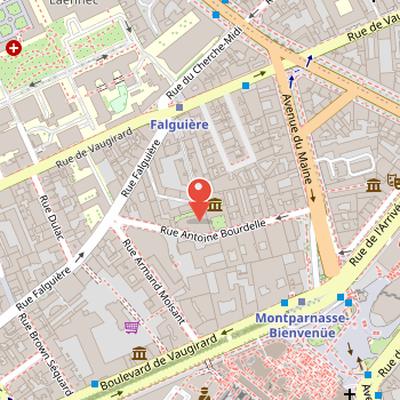
Nearby Objects
-
 Musée du Montparnasse 200 m away
 -
 Montparnasse Tower 300 m away
 -
 Jardin Atlantique 350 m away
 -
 Rue de Vaugirard 500 m away
 -
 Théâtre Montparnasse 500 m away
From Artist's Home to Museum
Musee Bourdelle is a French sculpture museum at 18 Antoine Bourdelle Street in the 15th arrondissement of Paris. It is installed in the apartments, workshops, and gardens where the sculptor Antoine Bourdelle lived and worked from 1885. The site was transformed into a museum in 1949. It later underwent two expansions: the first, designed by architect Henri Gautruche, took place in 1961, and the second was entrusted to architect Christian de Portzamparc in 1992.
Creation and Preservation of the Museum
Musee Bourdelle was conceived by Antoine Bourdelle as his own museum, following the example of Rodin. After Bourdelle's death in 1929, the project expanded its surface area tenfold. Its creation was made possible by Gabriel Cognacq and by the perseverance of Cleopatre Bourdelle-Sevastos and Rhodia Bourdelle-Dufet. In the 1930s, the workshop land was put up for sale, but Cleopatre Bourdelle did not have the funds to buy it. Gabriel Cognacq provided the money needed for the purchase and never asked to be reimbursed. Cleopatre Bourdelle-Sevastos and Rhodia Bourdelle then became the owners of the workshop land and offered the workshop donation to the French State several times, but these offers were rejected successively. Yvon Bizardel later intervened, leading Paris city to accept the donation. To preserve the gardens, the layout of Sajonia streets was diverted. Henry Gautruche directed the work as a city of Paris architect, and the museum opened on July 4, 1949.
Museum Spaces and Historic Interiors
The museum is organized around the site where Antoine Bourdelle installed his workshops in 1885 and worked there until his death in 1929. The workshops area retains original floors, coverings, and furniture, and displays sculptures in marble, wood, and bronze. The plaster Centaure mourant remains permanently in place at this site, reinforcing the connection between the preserved studio environment and the artist's output.
A separate old apartment, contiguous to the studio and preserved in an intact condition from 1895 to 1918, is kept as it was for public visits. It contains a bed and pastel colored furniture, and a plaster of David made by Antoine Bourdelle for Reims cathedral is displayed in the center of the room.
The museum also includes a plaster hall, created in 1961 by architect Henri Gautruche and organized by Michel Dufet, Bourdelle's son-in-law and a recognized decorator. This hall was designed to gather and present plaster models of monumental sculptures to the public. Among the six main works shown there are Monument au general Alvear, La France, Herakles archer, The Fruit, Sapho, and Centaure mourant. From this hall, visitors can also access a small room for temporary exhibitions.
In 1951, a brick gallery from Montauban was added in the street garden. It presents many bronze works, including El fruto and Heracles arquero, second version of 1923, as well as bas-reliefs from the Theatre des Champs-Elysees, including Adam and Penelope.
The 1992 Expansion
Musee Bourdelle was expanded by architect Christian de Portzamparc, and the new wing opened in 1992. The enlargement was partly financed through the sale of a bronze Heracles archer to Japan, a decision managed by Rhodia Dufet-Bourdelle, the sculptor's daughter and museum director. As part of the works, the museum entrance was moved from the garden to a new reception area adjoining the large hall. The new wing has four floors and a surface area of 1,655 square meters. On the ground floor, a large marble sculpture room mainly displays the Monument to the Dead of Montauban and the Mickiewicz monument. The first floor contains a graphic arts room and a children's workshop, while the top floor holds a documentation room and conservation offices. The exhibition rooms also present works by contemporary artists linked to themes related to Bourdelle and his works.
Visitor Access and Public Use
Musee Bourdelle is open every day from 10h to 18h, except on Mondays, and admission is free. The museum receives around 40,000 visitors each year and ranks 48th among Paris museums by attendance. It is served by the Montparnasse - Bienvenue and Falguiere Metro stations, which provides convenient public transport access.