Parc des Princes is a multi-purpose stadium in the Auteuil district of Paris, partly above the périphérique and near the former place called Boulogne-Billancourt. Inaugurated on June 18, 1897 under the name stade vélodrome du Parc des Princes, it is the oldest stadium still in operation in France and the fifth largest stadium in the country. Its current structure was designed by architect Roger Taillibert in 1972, and its capacity was 47,929 in 2023. The stadium is owned by the city of Paris and operated by Société d’Exploitation Sports et Événements, which has been under Paris Saint-Germain control since 2013. Parc des Princes has hosted Paris Saint-Germain matches since 1974, as well as home matches of the France national football and rugby union teams. It has also staged the Coupe de France final, European Championship finals in 1960 and 1984, European cup finals between 1956 and 1998, and the football final of the Paris 2024 Olympic Games. It continues to host major international concerts.
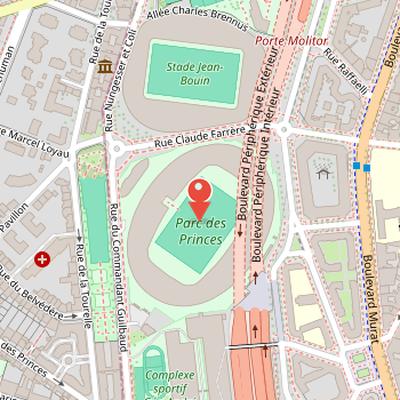
Nearby Objects
-
 Stade Jean-Bouin 200 m away
 -
 Piscine Molitor 400 m away
 -
 Stade Roland-Garros 600 m away
 -
 Jardin des serres d’Auteuil 600 m away
 -
 Stade Pierre-de-Coubertin 750 m away
History and Use of the Parc des Princes
The Parc des Princes is a stadium in the Auteuil district of Paris, partly above the peripherique and near the former place called Boulogne-Billancourt. It was inaugurated on June 18, 1897, under the name stade velodrome du Parc des Princes, and it is the oldest stadium still in operation in France. It is also the fifth largest stadium in France, with a capacity of 47,929 in 2023.
The stadiums current structure was designed by architect Roger Taillibert in 1972. Owned by the city of Paris and operated by Societe d'Exploitation Sports et Evenements, it has been under Paris Saint-Germain control since 2013 through that operating company. Paris Saint-Germain has played its matches there since 1974, including national and European fixtures. Before the opening of Stade de France in 1998, the Parc des Princes was the largest stadium in France.
The stadium has also hosted home matches of the France national football and rugby union teams, the Coupe de France football final, and European Championship finals in 1960 and 1984. It hosted European cup finals between 1956 and 1998, and the football final of the Paris 2024 Olympic Games. In addition to sport, it continues to host major international concerts. Paris Saint-Germain has said it may replace the stadium if the city refuses to sell and expand it, and has considered a new stadium in Massy or Poissy as an alternative.
Resident Clubs and Major Sporting Use
Parc des Princes has long been defined by its resident clubs and by the major events it hosted. Paris Saint-Germain has been the current resident club since 1974. Earlier, Paris FC used the venue from 1972 to 1974 and again from 1978 to 1979, while Racing CF was a resident club from 1984 to 1990. The stadium also hosted the football sections of Racing CF from 1932 to 1966 and of Stade francais from 1945 to 1968.
Beyond club football, the venue played an important role in French national sport. The France national football team played numerous matches at Parc des Princes in alternation with Stade olympique de Colombes, and the France national rugby league team played test matches there against British, Australian, and New Zealand teams. From 1972, the France national football and rugby union teams permanently abandoned Stade olympique Yves-du-Manoir de Colombes.
The stadium was also associated with major recurring sporting traditions. Between 1903 and 1967, it hosted the traditional arrival of the Tour de France on the velodrome of the stadium. After renovation, Parc des Princes offered 49,691 seated and covered places until the inauguration of Stade de France. From 1974 to 1997, it hosted the final of the Coupe de France football every year and also the final of the French rugby union championship every year, reinforcing its status as a central venue in French sport.
A Major Venue for Sport and Events
Le Parc des Princes opened in 1897 and developed into a major venue for a wide range of sporting and public events. It hosted matches of the France national football team, matches of the French Football Cup, and matches of the French Rugby Championship, showing its role in both football and rugby. The site also hosted stages of the Tour de France, including the first edition in 1903, as well as Five Nations Tournament matches. In addition, it was the venue for the final of the first Rugby League World Cup.
The stadium's importance extended to international tournaments. It hosted matches of the 1938 and 1998 FIFA World Cup, matches of the Euro 2016 football tournament, and matches of the 1991 and 2007 Rugby World Cups. It also hosted several major finals, including two Euro football finals in 1960 and 1984, three European Champions Clubs Cup finals in 1956, 1975, and 1981, two Cup Winners' Cup finals in 1978 and 1995, and a UEFA Cup final in 1998.
Beyond its sporting role, Le Parc des Princes was the site of the first live sports television broadcast in France. It also hosted boxing world championships and music concerts, adding to its public significance as a multi-purpose venue.
From Royal Grounds to a Sports Venue
Before the stadium was built, the site was used as a place for relaxation, hunting, and walking, and it was especially popular with the king and royal princes. Its appeal grew in the first half of the eighteenth century as Parisian bourgeois adopted noble leisure activities. The first urban developments appeared in 1855, followed by a road to a new quarter developed by the Duke of Morny in 1860. Around the same time, the name Parc des Princes came into use, derived from Route des Princes and Porte des Princes. After the 1860 annexation by Napoleon III, the park stood on the border between Paris and Boulogne-Billancourt. In 1881, the Station Physiologique du Parc des Princes was established nearby, and Etienne-Jules Marey carried out research on chronophotography there. The station was later destroyed in 1979 to allow the extension of Roland-Garros.
The sports history of the site began with the inauguration of the Stade Velodrome du Parc des Princes on Sunday 18 July 1897. The original enclosure could hold 15,000 spectators in seated places and included a cycling track. Access to the Tribune was forbidden for the first event by prefectural decision, and authorities required reinforcement works before approval was granted. Access was then allowed for the second meeting on 25 July 1897, which drew more than people and was praised by the Parisian press. A journalist from La Presse noted that the grassed central terrain still needed time to become suitable for athletic use, while Frantz Reichel published a critical article on 24 July 1897 in Le Sport Universel Illustre. Henri Desgrange served as director of the Parc des Princes and had previously directed the Velodrome de l'Est.
Early Sports Use and Major Events
Parc des Princes developed early as a multipurpose sports venue. Rugby first appeared on the field on 14 November 1897, when a Franco-English international match was played there. The first football match followed on 26 December 1897, when Standard AC, playing under the name English Ramblers after the Ramblers did not travel to Paris, defeated Club Francais 3 to 1 after a 1-1 halftime draw. The stadium also hosted the Parc des Princes cycling track, which held the 1900 World Track Cycling Championships, and the track was used for motorcycle races from its inauguration.
In the early 20th century, the idea of a resident club emerged at the stadium. Racing Club de France obtained exclusive use of the stadium for athletic sports, while Olympique became resident club in September 1902. Racing Club later absorbed Olympique and recovered Parc in 1902. The venue continued to host important finals, including the USFSA championship finals in 1903, 1905, 1907, and 1910, as well as the Coupe Sheriff Dewar final in 1905. It also served major international football and rugby fixtures, including the first official France football match on French soil on 1 May 1911 and the first official match of the XV de France against the All Blacks before 1906.
Parc des Princes was also closely tied to cycling history. Henri Desgrange, creator of the Tour de France in 1903, ended the race route at Parc des Princes until 1967, reinforcing the stadium's role in French sporting culture.
From Olympic Plans to a Renovated Stadium
Before the First World War, the capacity of Parc des Princes had been increased to 20,000 seats. In the lead-up to the 1924 Olympics, the stadium was among three venues competing for the role of main Olympic stadium, alongside Colombes and Pershing. The French government designated Parc des Princes as the main Olympic stadium in 1922, and the planned works would have allowed it to expand to 37,000 seats. However, the City of Paris refused to finance the work, and no Olympic events were held there despite the proposed increase in capacity. After the Games, the City of Paris signed a forty-year concession contract with L'Auto, with rent set at 4 percent of revenues.
Parc des Princes later underwent a major renovation that was completed after nine months of work and inaugurated on 23 April 1932. At opening, it offered 45,000 seats, although this was later reduced to 38,000 for security and comfort. The renovated stadium was described as better located geographically than Colombes. Its stands were named Presidentielle, Paris, Auteuil, and Boulogne, and it included a pink cement cycling track 455 meters long. The tunnel entrance was located to the right of the Boulogne stand. Only the stands were built at inauguration, with the stadium equipment increased in later years. The two lateral stands were covered in 1932, the curves were covered in the mid 1950s, and the famous facades dated from the late 1930s.
The new program for the stadium was dominated by cycling, with the final arrival of the Tour de France on 31 July 1932. Football soon followed: the first match in the renovated Parc des Princes was played on 9 October 1932, when Red Star beat Athletic Bilbao 4-2 in a friendly. RC Paris settled at the stadium from the 1932-1933 season, and the first professional Division 1 match there took place on 23 October 1932, a Racing-Mulhouse game. CA Paris also used the stadium for two home matches late in the 1932-1933 season, on 12 March and 2 April. Later, during the Occupation, the stadium became a military and sports training ground and also served as a parking area for vehicles of units stationed at lycee Claude-Bernard.
War, Postwar Use, and Early Television at Parc des Princes
During the war, Histoire records that numerous football matches were played by different German army corps at Parc des Princes. The Coupe de France was divided into three championships, with the occupied zone won by Red Star Olympique, the non-occupied zone won by Olympique Ales, and the forbidden zone won by RC Lens. In the occupied zone final at the Parc, Girondins ASP de Bordeaux defeated Red Star Olympique 3-1.
After the war, Stade francais and Racing shared the stadium at porte de Saint-Cloud. For the next three decades, the Parc hosted an average of two to three football matches each week. It remained a multi-sport venue in this period, with cycling, football, rugby, and boxing all practiced there. Among the notable events was the middleweight world title victory of French boxer Marcel Thil on 11 June 1932 against American Gorilla Jones.
The site also saw the introduction of ice sports, beginning with a provisional rink installed on 29 January 1933 for figure skating and hockey with a balai. The second Ice Festival included a hockey match between Ottawa Canadians and a selection of top French players. Later, the Parc became associated with major broadcasting and lighting milestones. On 25 July 1948, the Tour de France arrival was broadcast live on television from Parc des Princes, with Jacques Sallebert providing commentary for the first live outside-studio French sports television report. The first nighttime event at the Parc took place on 23 April 1951 for an international friendly between Racing and Bangu from Brazil, and stadium lighting was inaugurated by the France team on 26 March 1952. Lighting used 136 or 186 projectors depending on whether the event was cycling or football. Under these conditions, the 1952 Latin Cup final and the first European Champions Cup final in 1956 were both held at the Parc. Histoire also records that the first rugby league World Cup final was played there on 13 November 1954, and that the first European Nations football championship final took place at Parc des Princes in Paris in 1960.
Stunts and the End of the Cycling Track
In 1965, the Parc des Princes velodrome hosted Jean Sunny's automobile stunts. He performed on two wheels in a Simca Ariane, and the event was later featured in episode 46 of Les Coulisses de l'exploit on ORTF's first channel. The site also remained a major cycling venue until 1967, when the Tour de France and cycling ended at the Parc. Raymond Poulidor was the last winner on the pink track at the Porte de Saint-Cloud that year, and demolition of the cycling track began the day after his arrival.
Demolition and Transition at Parc des Princes
Two of the four stands at Parc des Princes were demolished for the construction of the Paris ring road, leaving the stadium in a period of uncertainty. According to Histoire, Paris municipal authorities did not clearly define the stadium's future for two years. During the works, spectators expressed dissatisfaction, and the media reported neglected basic safety conditions. Construction machinery and temporary structures were also used as unauthorized viewing stands.
On January 21, 1969, France Football published a photograph of the model for the new Parc des Princes and stated that it was not an April Fools' joke. The last match at the old stadium took place during the ongoing construction and was the amateur French Championship final between Pierrots de Strasbourg and UMS Montelimar. Kohler of Pierrots de Strasbourg scored the only goal, becoming the last scorer at the old Parc. After this match, the stadium was closed as a construction site for an unspecified period.
Design, cost, and public reception
Parc des Princes was designed by architect Roger Taillibert. It was notable for being the first stadium in Europe with integrated roof lighting, and its layout placed no seat more than 50 meters from a sideline. The ideal inclination of the stands was discussed in football magazines, showing that the stadium's design attracted technical attention beyond its immediate sporting use.
The project's final cost, in francs, doubled the initial budget, but this was seen as reasonable when compared with similar stadiums built in Germany. At the same time, the stadium also drew criticism. The separating fences between the Auteuil and Boulogne stands were unpopular, and complaints were also made about the lack of parking and the reduced capacity.
A corridor from the locker rooms to the field is named Allée les petits, in honor of journalist Roger Couderc and his cry during rugby broadcasts. The stadium's concession also changed over time, shifting from L'Auto and L'Equipe to the French football and rugby federations. The lease was signed on 12 November 1970 and later extended until 1988.
Early Sporting Events at Parc des Princes
Parc des Princes was inaugurated on 25 May 1972 with an amateur Olympic football match between France and the USSR. The visiting team won 3-1, giving the stadium an opening result that was immediately marked by international competition. Two weeks later, it hosted the 1972 Coupe de France final, making this the second match played there and the first official professional match at the stadium. The final brought together Sporting Club de Bastia and Olympique de Marseille, and was attended by French President Georges Pompidou. Olympique de Marseille won 2-1, and Didier Couecou scored the first official professional goal at Parc des Princes. That victory also secured a league and cup double for Marseille.
The stadium was also used for rugby in 1972. Its first rugby XV match saw AS Beziers defeat Neath RFC 29-17. Later that year, it hosted a rugby league World Cup match in which Australia defeated New Zealand. After 1972, however, it did not host any other rugby league matches at the new stadium. On 28 October 1972, France defeated Scotland 16-13 in a rugby XV match at Parc des Princes. From 1974 onward, the stadium hosted 85 international matches and French rugby XV championship finals, establishing it as an important venue for both football and rugby.
Ownership, Renovation, and Sporting Use
Parc des Princes became the resident stadium of Paris Saint-Germain in 1973, after the club first played there in a D2 championship match against Red Star. The stadiums management and concession arrangement later changed significantly when the Canal+ group took control of SESE, the concession holder, in 1991. Paris Saint-Germain paid rent to Canal+ for use of the stadium, while 8 percent of SESEs pre-tax revenue was allocated to the City of Paris, with a minimum guarantee of 4.28 million francs. Histoire also gives the annual maintenance cost of Parc des Princes as approximately 4.28 million francs.
The contract with the City of Paris became less demanding after the opening of Stade de France, and the guaranteed minimum payment to the city was reduced to two million francs per year. Histoire reports that the City of Paris extended the concession of Parc des Princes to SESE for fifteen years, and that renovation works were co-financed by the City of Paris with 78 MF and by SESE with 53 MF. For the 1998 World Cup, the stadium underwent only minimal renovation, including replacement of seats after 24 years and a change to exclusively blue seats in the upper stands. Histoire also states that 25 million francs were spent on renovations, charged to the City of Paris.
Parc des Princes remained an important venue for football and rugby. It hosted the last Coupe de France football final there on June 8, 1998, and OGC Nice won the 1998 Coupe Charles Simon final 2-1 against En Avant de Guingamp at the stadium. The French national football team played its 127th official home match there on November 11, 1999, while the French rugby XV lost 10 to 52 against South Africa in its last match at Parc des Princes on November 20, 1998. Histoire notes that the French national football and rugby teams left Parc des Princes after Stade de France opened.
The stadium also hosted other major sporting events, including the Grand Slam during the Five Nations tournament in early 1998, the 2000-2001 European Rugby Cup final, and five matches of the 2007 Rugby World Cup, including the third-place final. Paris Saint-Germain later fully took over Parc des Princes and moved its headquarters to a new building. Histoire adds that several concerts are authorized each season despite resident objections, and that PSG was at times reluctant to host Stade français Paris rugby club because of concerns over pitch damage, even though early relations allowed matches there with large, festive crowds. In 2010, the city of Paris renamed the official hall of the presidential stand La Corbeille after Philippe Seguin, who had supported Paris Saint-Germain since the clubs foundation in the early 1970s.
Renovation, Expansion, and Ownership Discussions
In May 2009, Paris launched a call for tenders for the renovation of Parc des Princes, with Colony Capital emerging as a frontrunner in the process. At the same time, Paris Saint-Germain denied rumors that stadium naming rights would be changed. Plans under discussion included lowering the pitch by six meters and increasing the stadium capacity for Euro 2016, and initial presentations of renovation designs were shown to the press in early 2010.
After Paris Saint-Germain was sold to Qatar Sports Investments in summer 2011, Colony Capital remained interested in redeveloping the stadium. It joined Vinci and PSG in a consortium seeking a 60-year lease, while PSG, under Qatari ownership, negotiated directly with the City of Paris to manage the stadium alone. On November 21, 2012, PSG and the City of Paris issued a joint statement confirming a phased renovation. Atelier Tom Sheehan & Partners was commissioned in autumn 2012 to lead the first phase, with financing provided by the City of Paris and Paris Saint-Germain.
At the end of 2013, Colony Capital sold SESE to Paris Saint-Germain, and SESE renewed its lease on Parc des Princes for 30 years until 2044. The first phase of renovation works began at the end of the 2013-2014 season. The works included a complete renovation of the locker rooms for players, referees, and staff, modernization of media spaces, communication networks, refreshment stands, and restrooms, and the addition of new restaurants and high-end boxes. The pit around the field was filled in, the railings in the stands were removed, and the pitch was completely replanted by North Irish gardener Jonathan Calderwood.
Under the direction of PSG general manager Jean-Claude Blanc, the stadium was also redecorated. A red crown was installed, carrying the slogans ICI C EST PARIS, ALLEZ PARIS, and the new slogan ICI C EST LE PARC. The complete list of trophies won by the club since 1970 was also displayed. After two years of renovation, costing an unspecified amount, Jean-Claude Blanc presented the stadium to the press. The renovated stadium now has an unspecified number of seats.
The site has also taken on symbolic and practical roles beyond matchday use. At the end of an unspecified year, PSG announced the commercialization of honey produced from beehives at the stadium. In 2020, the bees produced an unspecified quantity of nectar marketed in 500 gram jars, and the proceeds were donated to PSG's endowment fund.
Questions of ownership and expansion have continued. In 2021, PSG management announced plans to buy Parc des Princes in order to expand it in coming years. This was linked to earlier discussions from 2012 about increasing capacity after Euro 2016. The proposed expansion would require extensive work inside, outside, and around the stadium. In 2013, Roger Taillibert considered an increase to 55,000 seats feasible but 60,000 difficult, and PSG studies in 2023 confirmed the recommendation of increasing capacity to around 55,000 seats. PSG said it would not finance renovation costs of several hundred million euros without owning the stadium, while its acquisition efforts faced opposition from then Paris mayor Anne Hidalgo, who was initially open to discussion but ultimately refused to sell the stadium. In 2025, PSG abandoned the buyout idea and carried out serious studies for a new stadium in Massy or Poissy. In spring 2026, new Paris mayor Emmanuel Grégoire stated that discussions could resume before the end of summer, and a path toward a sale opened after the mayor obtained a mandate from the Paris Council.
Architectural Form and Modern Upgrades
The new Parc des Princes was designed by architect Roger Taillibert as an avant-garde stadium, and its construction began only after the old Parc had already been demolished. Although the project was planned for a specific duration, it took longer because of its complexity. The stadium has an elliptical shape, with a major axis of 245 meters and a minor axis of 210 meters, and it is supported by cantilevered portals. Because the dimensions varied around the structure, thirteen different portal models were required to surround the stadium. The boulevard peripherique passes under part of the South-East stands, where underground pillars were built to frame the road tunnel and support the concrete and steel structure.
The stands are arranged on two levels, and the seating sections are named in a clockwise direction. The roof originally was expected to carry four lighting masts, but instead 172 floodlights were integrated into it for night matches. The stadiums seating and capacity have changed several times over time. It formerly held 48,712 seats including 200 press seats, then 49,691 seats, and UEFA data capped it at 48,712 seats from 1998 to 2014. At one point it had 48,456 regular seats and 230 VIP seats. In August 2006, some seats were replaced to gain several hundred seats, and the new configuration first hosted PSG-OM on 20 August 2006. Major renovations between 2012 and 2016 raised the current capacity to 47,929.
Parc des Princes is also equipped with a Spidercam, a 3D cable camera system mounted on four cables driven by computer-controlled winches at the field corners. The camera can rotate 360 degrees around the vertical axis and 180 degrees around horizontal pivots, allowing filming from any point on the field, and it remains visible moving during matches.
Major Football Matches at Parc des Princes
Parc des Princes has been a recurring venue for major international football tournaments and important France national team matches. It hosted matches for the Coupe du monde de 1938, the Championnat d'Europe de 1960, the Championnat d'Europe de 1984, the Coupe du monde de 1998, the Championnat d'Europe de 2016, and the Coupe du monde feminine de 2019, and it is scheduled to host events for the Jeux olympiques d'ete de 2024.
The stadium also has a long association with the France national team. It hosted the first official match of the French team on French soil, a 1-0 victory over Switzerland. Other notable matches included the France vs Belgium game, which drew a record attendance of 47322 spectators, and the France vs Bulgaria match, won 3-1 and marking qualification for a World Cup final phase after 12 years of absence. In the 1984 European Championship final, France defeated Spain 2-0 before 46200 spectators. The stadium also hosted the 50th match of the French team against Argentina, ending in a 2-0 victory in front of 40045 spectators.
Parc des Princes was also the setting for the match in which France lost to Bulgaria and failed to qualify for the 1994 World Cup. After that failure, the French team did not play there for nearly two years. The last match of the French team as a resident at the stadium took place against Italy during the Tournoi de France on May 27, 1997. Later, it hosted France against Scotland on June 7, 2007, during the Euro 2008 qualifiers, and a friendly against Australia that ended in a 6-0 French victory.
More recently, the stadium hosted France against Kazakhstan in a World Cup 2022 qualifier relocated from Stade de France because of RER B works on November 13, 2015. France won 8-0, with Kylian Mbappe scoring a quadruple, the first by a French player since Just Fontaine in the 1958 World Cup. In the same match, Karim Benzema scored two goals, while Adrien Rabiot and Antoine Griezmann also scored. The stadium also hosted a match in which Antoine Griezmann scored a penalty and surpassed Michel Platini in France's top scorers list.
Overall, Parc des Princes hosted 135 official France A team matches. Its first version hosted six official France A matches, the second version hosted 47, and the current version hosted 82. It also hosted non-official matches including France-North Africa, France-Real Madrid, and France-Juventus FC.
Major Football Matches at Parc des Princes
Parc des Princes has been a major venue for French football finals and tournaments over many decades. It hosted the USFSA French football championship finals in 1903, 1905, 1907, and 1910, as well as the second Coupe de France final between CASG Paris and Olympique de Paris. From 1919 to 1997, it hosted 33 Coupe de France finals, including the editions in 1919, 1938, 1940, 1943, 1944, a replayed final in 1963, the finals from 1965 to 1967, and every final from 1972 to 1997. Among the clubs that won the Coupe de France there, PSG, OM, and AS Monaco each claimed four titles.
The stadium also hosted the first three Coupe de la Ligue finals, from 1994-1995 to 1997. PSG won the 1995 final at Parc des Princes, followed by FC Metz in 1996 and RC Strasbourg in 1997. In addition to cup finals, the stadium was home to the Tournoi de Paris, a competition involving four clubs over two days. This tournament was organized by RC Paris from 1957 to 1966, by Paris FC in 1973, and by Paris Saint-Germain from 1975 to 1993, before being abandoned by PSG's new management, Canal+.
Rugby Union Matches at Parc des Princes
Parc des Princes has been an important venue for major rugby union matches, including games in the Coupe du Monde de 1991 and the Coupe du Monde de 2007, as well as the Coupe d'Europe des clubs and the Championnat de France. It hosted thirty-one championship finals between 1902 and 1997, showing a long association with top-level domestic rugby.
The stadium's role in the championship developed across its different versions. The first version hosted three finals, in 1902, 1906, and 1910. The second version hosted four finals between 1943 and 1946. The third version was the setting for the final from 1974 to 1997, covering 24 editions. Over this period, the venue saw repeated success by several clubs, including AS Beziers with eight titles, Stade Toulousain with seven titles, and SU Agen with four titles at the Parc.
Parc des Princes also hosted matches involving the France national team and was a regular venue for the Tournoi. It hosted thirty editions of the Tournoi and a total of fifty-nine matches, including one match boycotted by Scotland in 1911. These facts place the stadium among the most significant rugby union sites in French sporting history.
Le Musee National du Sport at Parc des Princes
The Parc des Princes was once home to Le musee national du Sport. The museum was inaugurated there in 1988 and included an area dedicated to its collections. It was labeled Musee de France by the Ministry of Culture and Communication, reflecting its recognized cultural status. The museum closed its doors in 1998, after which its collections were transferred to provisional storage and the site closed. It later reopened at 93, avenue de France in Paris, before opening at the Allianz Riviera stadium in Nice.
Parc des Princes in Popular Culture
Parc des Princes has sometimes been used by filmmakers, with some shoots taking place around events. It is also the subject of the documentary film Le Parc, Prince des stades, which focuses on the history of Parc des Princes. The film was directed by Nicolas Berges, narrated by Francois Berleand, and broadcast on France 3 in 2013.
Concerts at Parc des Princes
Concerts have been held at Parc des Princes since the 1980s, and the stadium has regularly hosted major French and international artists. Michael Jackson performed there on May 27 and 28, 1988 for the Bad World Tour, and again on September 27 and 28, 1997 for the HIStory World Tour. His 1997 concerts drew more than 210,000 spectators over four performances. Other major acts included the Rolling Stones, who gave three concerts in 1995, and U2, who performed there on June 26, 1997.
Johnny Hallyday was the first French artist to perform at the stadium and gave seven concerts in total. He held concerts in 1993 for his 50th birthday over three consecutive nights, and again in 2003 for his 60th birthday over four nights. The venue also hosted concerts by Robbie Williams, Prince, and Iron Maiden. In 2004, Star Academy held a concert there with the first three promotions and guests Michel Sardou and Lorie, while Metallica performed in June 2004.
The stadium continued to host large concert events in the following years. Muse performed on July 1, 2005, Genesis played on July 6, 2007 before 40,000 people, and the Red Hot Chili Peppers performed on July 2 and 3, 2007. In 2008, Tokio Hotel performed on June 21, the day of Fete de la Musique, followed by Bruce Springsteen on July 2 and Mika on July 3. Coldplay performed on June 5, 2012 before 42,000 people, and NTM gave its first stadium concert there on June 9, 2012. Green Day also performed at Parc des Princes.
Music was scheduled to return in June 2020 with concerts by Nekfeu and Dadju, but these were canceled due to the COVID-19 epidemic. The venue later hosted DJ Snake on June 11, 2022 in a sold-out stadium with more than 63,000 people, and Dadju performed again on June 18, 2022 with guests Sexion d'assaut, Gims, and Ninho.