Jardin des serres d’Auteuil is a public botanical garden located at the edge of the Bois de Boulogne in Paris and is one of the four poles of the botanical garden of the city of Paris. The site was redesigned at the end of the 19th century under the direction of Jean Camille Formigé. Its horticultural production site was designed between 1895 and 1898, and large cast-iron greenhouses painted turquoise were built in 1898 by a French architect. The garden also contains a fountain with a stone high-relief sculpture called Bacchanale by Jules Dalou, as well as fourteen galvanized cast-iron mascarons by Auguste Rodin on its retaining wall. Parts of the garden and its buildings were registered as historical monuments in 1998. The garden has its main entrance to the north on avenue de la Porte-d’Auteuil, with additional entrances from the jardin des Poètes, boulevard d’Auteuil, and avenue Gordon-Bennett. It is served by metro line 10 at Porte d’Auteuil and Michel-Ange - Molitor stations.
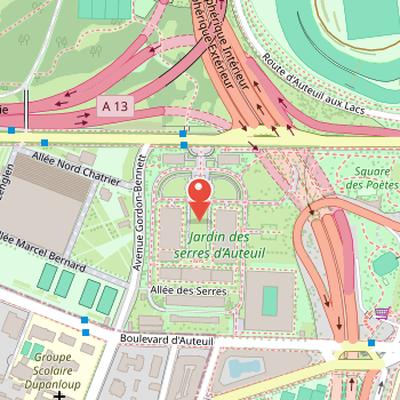
Nearby Objects
-
 Piscine Molitor 200 m away
 -
 Stade Roland-Garros 200 m away
 -
 Stade Jean-Bouin 400 m away
 -
 Parc des Princes 600 m away
 -
 Stade Pierre-de-Coubertin 1300 m away
Historic Greenhouses and Garden Design
The Jardin des serres d'Auteuil is a botanical garden open to the public at the edge of the Bois de Boulogne in Paris, France. It is one of the four poles of the botanical garden of the city of Paris. The garden was redesigned at the end of the 19th century under the direction of Jean Camille Formige. Among its most notable features are large cast-iron greenhouses painted turquoise and built by a French architect in 1898. The site also includes a fountain by Jules Dalou and mascarons by Auguste Rodin. In 1998, the garden and parts of its buildings were registered as historical monuments.
Access and Location
Jardin des serres d'Auteuil has a main entrance on the north side of the garden, on avenue de la Porte-d'Auteuil. Additional entrances are located to the east through the jardin des Poetes, to the south through boulevard d'Auteuil, and to the west through avenue Gordon-Bennett. The garden is also served by metro line 10, with access from Porte d'Auteuil and Michel-Ange - Molitor stations.
Origins and Design of the Auteuil Garden
The site associated with the Jardin des serres d'Auteuil has a long history of botanical and horticultural use. In 1761, King Louis XV granted a botanical garden at 77 rue d'Auteuil, which included greenhouses next to the chateau du Coq and extended to part of boulevard Murat, porte d'Auteuil, and a plot in the bois de Boulogne. In 1778, King Louis XVI sold the chateau and garden to Joly de Fleury, and about a century later the site was parceled.
A later florist garden in Paris's Muette district was created in 1855 by engineer Adolphe Alphand on the grounds of clos Georges, taken from the bois de Boulogne. It had more than 30 greenhouses and produced three million plants annually. This site was transferred to Auteuil in 1898, after its former location was cut by new roads and developed into streets and boulevard Jules-Sandeau.
The horticultural production site at Auteuil was designed by chief architect Jean Camille Formige between 1895 and 1898. Among its notable features are a fountain with a stone high-relief sculpture called Bacchanale by Jules Dalou and a retaining wall with fourteen galvanized cast iron mascarons by Rodin. In 1968, the garden lost one third of its surface because of the construction of the Auteuil interchange and boulevard peripherique, and its horticultural center moved to Rungis and Fresnes.
Historic Greenhouses and Botanical Use
The historic part of the Jardin des serres d'Auteuil includes blue technical greenhouses and small hot greenhouses built between the 1980s and 2001. These hot greenhouses house tropical botanical collections, including orchids, ferns, begonias, and bromeliads. The large palmarium was fully renovated in 1999. The site was listed as a historic monument on an unspecified date and later received the Jardin remarquable label, also in an unspecified year. Its classical music festival, Les Solistes aux serres d'Auteuil, moved to parc de Bagatelle in 2012.
The Greenhouses of Jardin des serres d'Auteuil
The Jardin des serres d'Auteuil is organized around a central French-style parterre garden, with five main greenhouses designed by the French architect Jean Camille Formige. These include la grande serre, the serres est and ouest, the serre aux palmiers, and the serre aux azalees. The buildings reflect the 1900 style also seen at the Laeken Royal Greenhouses and the Champs-Elysees winter garden. Their cast iron frames were painted blue-green, in a color typical of the period, and their structure forms ogival vessel shapes.
La grande serre is the most complex of the main greenhouses, with three separate climatic spaces: a tropical garden that is hot and humid, a palm grove that is drier, and an orangery that is less warm. Behind it, and separated from the parterre, is a second, more traditional orangery. This building is made of millstone and bricks and contains plants in boxes that decorate the garden in summer.
Plant Collections and Notable Trees
The Jardin des serres d'Auteuil houses rare plant collections and remarkable trees. Its collections contain nearly five thousand plant species organized into thematic and systematic groups, and the greenhouses gather more than five thousand genera, species, or varieties of different plants. Among the main collections are succulent plants and plants from the Sahel, represented by 55 taxons, as well as plants originating from New Caledonia, with 130 taxons, mostly from the genus Araucaria. The site also includes a palmarium and collections of ficus with 120 taxons, peperomias with 130 taxons, philodendrons with 60 taxons, begonias with 580 taxons, and ferns and Caladium with 130 taxons. Orchids are represented by 515 taxons, and Bromeliaceae by 400 taxons.
Other features include a collection of Canary Islands palms, set beside a pond of Japanese carps at the base. Among the notable trees are Ginkgo biloba from China, a caramel tree that emits a strong caramel smell in autumn, Indian lilac trees with mauve colors, Pterocarya stenoptera, described as the tallest tree in the garden, and Magnolia grandiflora with large fragrant white flowers.
Artistic Features and Garden Collections
Jardin des serres d'Auteuil includes a range of artistic and horticultural features within its collections. Among the works on display are statues of four of the nine Muses, Fontaine de la Bacchanale by Jules Dalou, and Haut-relief de la Bacchanale by Jules Dalou. The site also includes mascarons by Auguste Rodin and vases from the manufacture of Sèvres. In addition to these objects, the garden contains a Japanese style garden with a stone lantern and a garden with two trees fused into one. Its plant collections include ferns and spring flowering.
Roland-Garros Expansion and the Jardin des Serres d'Auteuil
On 22 July 2013, the FFT decided to expand Roland-Garros from 8.5 hectares to 11.5 hectares. The plan included one or two covered courts, including the current Philippe-Chatrier court, and rejected relocation options to Marne-la-Vallee, Gonesse, and Versailles. It also did not accept an alternative project that proposed covering the nearby highway. The extension occupied part of the Jardin des Serres d'Auteuil and led to the destruction of some greenhouses starting in 2016. The project triggered controversy involving the FFT, the municipality, residents, ecologists, and heritage associations.
Legal disputes around the Roland-Garros extension
The extension of Roland-Garros became closely tied to the Jardin des Serres d'Auteuil through a series of legal and administrative decisions. On 15 October 2015, the Paris Administrative Tribunal annulled the Paris Council deliberation related to the project, citing the fact that the site was a horticultural area classified as a historical monument and that the fee paid by the French Tennis Federation to the city was insufficient. The project later obtained three favorable decisions from the same tribunal on 4 April 2016, and on 27 May 2016 Anne Hidalgo announced that construction permits signed by the city of Paris had been approved.
The approved permits allowed the project to recover one hectare from the Jardin des Serres d'Auteuil. Work was later suspended at the end of 2017 for three months by the Paris Tribunal de grande instance following a copyright claim, before an appeal was brought to the Conseil d'Etat. Construction resumed after the Conseil d'Etat annulled the suspension of the construction permit on 22 August 2018. When work resumed, several trees were uprooted and part of the heated greenhouses was destroyed.
The project was interrupted again after a request by the Formige family was accepted by the Tribunal de grande instance on 3 October 2018, with the interruption lasting until 25 October 2018. On 9 November 2018, the Paris Administrative Tribunal rejected appeals by associations and validated the construction permit. The works were planned for completion by 2020.