Stade Jean-Bouin is a multi-purpose sports venue in Paris, inaugurated in 1928 and located near Parc des Princes. It is mainly intended for rugby union and football, and it takes its name from French long-distance runner Jean Bouin, who died for France during the First World War. The stadium’s history includes earlier grounds on avenue du Général-Sarrail, developed by CASG Paris in 1925, and the former Jean-Bouin stadium near the Paris greenhouses and the current Roland-Garros stadium. The new facilities retained the Jean-Bouin name, used since 1916, and the stadium was renovated in 1968. The current architectural project, selected in 2010, features a covering that wraps the stadium and extends over the peripheral walkway facade. Its cover is made of more than 3,000 prefabricated BFUP triangles installed on 78 steel cantilevers. The stadium seating capacity is 18,708, all covered.
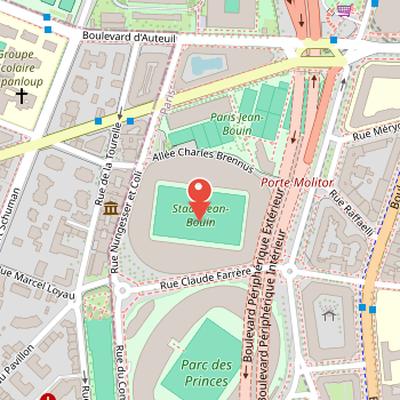
Nearby Objects
-
 Parc des Princes 200 m away
 -
 Piscine Molitor 200 m away
 -
 Jardin des serres d’Auteuil 400 m away
 -
 Stade Roland-Garros 450 m away
 -
 Stade Pierre-de-Coubertin 900 m away
Stade Jean-Bouin in Paris
Stade Jean-Bouin is a stadium in Paris that was inaugurated in 1928. It is mainly intended for rugby union and football, and it is located near Parc des Princes. The stadium takes its name from Jean Bouin, a French long-distance runner who died for France during the First World War. The provided facts do not specify its current capacity.
Development and Controversy
The grounds on avenue du General Sarrail were developed by CASG Paris in 1925, when Histoire left the old Jean-Bouin stadium near the Paris greenhouses and the current Roland-Garros stadium. The new facilities kept the name Jean-Bouin stadium, which had been used since 1916. The stadium was renovated in 1968. Its changes were controversial: opponents protested the destruction of an elegant Art deco stadium and the transfer of school sports activities. They also objected to the end of the historic athletics club C.A.S.G., which was left without facilities. At the same time, a support group was formed to provide a professional rugby team with a venue suited to national and European ambitions.
Architectural Design of Stade Jean-Bouin
Rudy Ricciotti's project for Histoire was selected by the Paris city jury on April 20, 2010. The architectural concept features a covering that wraps the stadium in a continuous form and turns along the facade of the peripheral walkway. This cover is made of more than 3,000 different prefabricated triangles of BFUP, installed on 78 steel cantilevers. The largest cantilevers extend more than 40 meters in overhang. The facade panels are open, while the roof panels have alveoli closed with glass pastilles to provide weather and acoustic protection.
The engineering process was certified through several ATEx from CSTB. The cover received the title of the world's largest fiber concrete roof and won first place in the World Concrete Awards ACI Excellence for decorative concrete. The tribune on avenue du General-Sarrail is suspended above the underground boulevard peripherique, and this suspension allows stability and evacuation even if the tunnel collapses below.
Renovation and Stadium Layout
The Jean-Bouin stadium project was the subject of a public inquiry conducted by Paris city hall at the end of 2009, as part of a wider redevelopment of the Auteuil neighborhood. Construction work began in summer 2010 despite opposition and legal challenges, with an estimated project cost of 70 million euros. The renovated stadium opened on September 18, 2013, during a Top 14 match won by Stade français against Biarritz olympique.
The stadium's capacity was increased to 18,708, with all seats covered. Its layout includes the lateral tribunes named Presidentielle and Parc des Princes, as well as the turns called Paris and Gilardi. The facility also contains a reception lounge and an administrative sector for Stade français personnel, a sports area for professional players with a two-level weight room, a balneotherapy space, and a gymnasium in the basement. In addition, the press tribune includes a newsroom, interview studio, and conference room. The complex offers parking with 770 spaces and includes several commercial units.
Sports Use and Major Events
Stade Jean-Bouin has had a varied sporting life, with its use changing over time in response to renovations and new management. The old stadium was used for athletics until renovations in 2010 removed the track, and the venue hosted the Paris athletics meeting until the early 1990s. It was also the site where Sergei Bubka set the pole vault world record for the fifth time. Between 1983 and 1992, the stadium hosted the Casque d'Or American football final.
In football, Red Star FC played home matches at the stadium during the 2016-2017 Ligue 2 season after an agreement was signed in 2016 between the city of Paris, Red Star FC, and the Seine-Saint-Denis council. Red Star FC later returned to Stade Bauer de Saint-Ouen after relegation. From 2018, the Paris Saint-Germain women's team played all home matches at the stadium, although after 2020 they returned to Camp des Loges and the PSG campus and used Stade Jean-Bouin only occasionally.
The stadium also served as a public stage for the opening ceremony of the 2018 Gay Games, which included the performance Coming Out by Rodolph Nasillski. In summer 2019, Stade francais Paris rugby took over management of the venue, and a new synthetic turf was installed that year for rugby training. Since then, the facilities have been primarily oriented around Stade francais Paris rugby, and the stadium serves as the sports venue for the club in Top 14.
Use by FC Versailles 78
FC Versailles 78 chose the stadium as its primary venue for the 2022-2023 National season after leaving Stade Montbauron, which did not meet third division requirements and lacked lighting. The club remained at the stadium for most of the period until early 2025. It then decided to finish the 2024-2025 season at Stade Walter Luzi de Chambly.
Recent Uses and Sporting Role
Stade Jean-Bouin has played a varied role in recent sporting events and team usage. It hosted the Eleven All Stars football match between French and Spanish streamers, which drew more than 1.1 million viewers on Twitch. The stadium became the home ground of the Mousquetaires de Paris American football franchise for the 2023 European League of Football season and continued in that role for the 2024 season, except for one match played at Stade du Hainaut because of the Paralympic Games. After the 2024 season, the team moved to Stade Robert-Bobin in 2025.
The stadium was originally planned to host rugby sevens tournaments for the Paris 2024 Summer Olympics, but Stade de France was preferred in the final site list in 2020. During the 2024 Summer Olympics and Paralympics, Stade Jean-Bouin hosted the Germany team's media and festive center, called Maison de l'equipe d'Allemagne. It also hosted a 2025 Under-20 Six Nations match between France and Scotland, which ended 45-40.
In another major change of use, Stade Jean-Bouin signed an agreement for Paris FC to play home matches there starting in the 2025-2026 season until at least 2029. To comply with Ligue 1 and Ligue 2 regulations, the synthetic pitch was replaced with hybrid grass in the summer of 2025. The stadium then hosted Paris FC's first match there and its return to the first division against FC Metz, a game that finished 3-2.