Saint Nicholas Russian Orthodox Church in Lyon is a Russian Orthodox church building shaped by the city’s post-1917 Russian émigré community. After the revolution, many Russian emigrants settled in France, including Lyon. In 1924, General Pavel Maksimovich-Vasilkovsky established an Orthodox church in his apartment dedicated to the Protection of the Holy Virgin, where priest Andrey Mishin conducted services. The community later rented a hall in the city center and installed a portable iconostasis.
In 1928, a new church dedicated to Saint Nicholas the Wonderworker was officially founded in memory of Tsar Nicholas II, with priest Victor Pushkin sent to Lyon by the Archiereus Synod of the ROCOR. After the church burned down on the night of June 13, 1937, the community decided to build a stone church despite difficulties. The foundation of a new church for 200 people was laid on May 7, 1938. The project was designed by Russian émigré architect Sergey Bazderev, and the building was constructed largely by hand after work by members of the community.
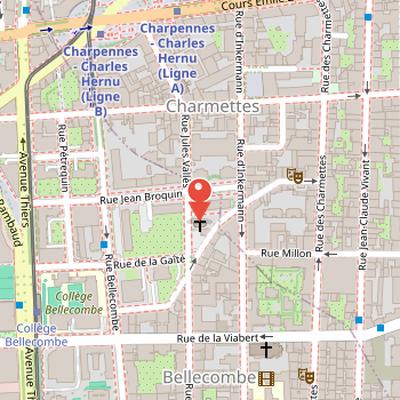
Nearby Objects
-
 Gare des Brotteaux 400 m away
 -
 Tour Swiss Life 750 m away
 -
 Lycée du Parc 750 m away
 -
 Gare Part-Dieu - Vivier Merle 850 m away
 -
 Tour Oxygène 900 m away
Founding of the Lyon Parish
After the 1917 revolution, a large number of Russian emigrants settled in France, including in Lyon. In 1924, General Pavel Maksimovich-Vasilkovsky arrived in the city from Russia and established an Orthodox church in his apartment, dedicated to the Protection of the Holy Virgin. Priest Andrey Mishin conducted services there, and a community later formed in Lyon that rented a hall in the city center and installed a portable iconostasis. In 1926, after the split of Russian Orthodox emigration in Western Europe into the Eulogians and the Karlovchans, the Protection church remained under Metropolitan Eulogius (Georgievsky), although some Russian residents of Lyon wished to remain under the jurisdiction of the Archiereus Synod chaired by Metropolitan Anthony (Khrapovitsky). The parish initially planned to build a stone church dedicated to the Holy Martyr Irenaeus of Lyon in memory of Russian soldiers, but insufficient funds prevented this. After a long search, a large wooden barrack was found on Baraban street. On May 11, 1928, a new Russian Orthodox church dedicated to Saint Nicholas the Wonderworker was officially founded in memory of Tsar Nicholas II. The Archiereus Synod of the ROCOR from Yugoslavia sent priest Victor Pushkin to Lyon, and parishioner Lyudmila Galich painted the iconostasis.
Construction Under Adversity
After the leftist Popular Front came to power in France in May 1936, Russian White emigrants found the situation especially difficult. The church burned down completely on the night of June 13, 1937, but a decision was made to build a stone church despite the difficulties. After months of services held in apartments and rented halls, a suitable plot of land was found, and the foundation of a new church for 200 people was laid on May 7, 1938. Protoarchpriest Viktor became the main inspiration for the construction and headed the construction committee, while the project was designed by the Russian emigrant architect Sergey Bazderev. Frenchman Jules Roche, who had lived in Russia for a long time, donated 50 thousand francs. The building was erected mainly by hand during the evenings after work. Workers carried heavy wheelbarrows, brought bricks, and laid cement, while the priest mixed clay himself. Two brigades were formed and worked with great diligence, and funds were collected wherever possible. Construction continued throughout World War II despite martial law, bombings, and severe economic conditions. Youths even traveled by bicycle outside the city to bring hard-to-find food to feed the workers on site.
Postwar Changes and Later Development
On August 31, 1945, the parish transferred to the jurisdiction of the Moscow Patriarchate under Metropolitan Seraphim and Protoarchpriest Viktor. The church was consecrated by Metropolitan Seraphim on May 5, 1946, but the parish returned to the jurisdiction of the ROCOR with the rector on January 17, 1948. After the war, decoration of the church progressed slowly because of financial difficulties following the departure of parts of the parish from Lyon. The church construction had cost 600 thousand francs.
From 1950 to 1953, the ROCOR Synod from Belgrade assigned Archimandrite Antony Bartoshevich as second priest. He was tasked with painting the iconostasis in the Lyon church and also authored the altar image and the icon of Saint Iriney of Lyon. The first icons on the iconostasis were painted by Leonid Uspensky.
In the 1970s, the church ceiling collapsed, requiring costly repairs, and Rector Father Vasiliy spent all of his personal savings on the restoration. The parish later expanded with new buildings around the church. Between 1978 and 1980, it built a new church house, and birch trees were planted nearby in memory of Russia. In 1981, the church facade was finished and the dome repainted. Attendance increased after the Charpen metro station was built nearby, and the church house was expanded by one floor in 1998.
Church Alignments and Jurisdictional Change
The parish community of Saint Nicholas Russian Orthodox Church in Lyon opposed the reconciliation steps with the Church in the Homeland adopted by the Archiereus Council of ROCOR in October 2000. In 2001, it joined the non-canonical ROCOR(V), and the decision was reported to have been influenced by cleric Herman Ivanov-Thirteenth, described as a publicist and opponent of the Russian Orthodox Church. In 2002, Rector Quentin de Castelbazac and many parishioners repented and returned to the canonical Russian Orthodox Church Outside Russia. At an extraordinary assembly, most of the clergy and parishioners voted 51 to 35 to remain under Bishop Barnabas (Prokofiev) in schism, and Quentin and those wishing to remain canonical founded a house church of the Martyr John the Russian in Lyon. In 2006, Bishop Barnabas (Prokofiev) repented and returned to the canonical ROCOR. On May 29 / June 11, 2006, the parish council in Lyon petitioned the Holy Synod of the RIPC for acceptance under the omophorion of the RIPC, after unanimously concluding that the Russian True Orthodox Church better embodied the traditional teaching of the ROCOR. On June 9 / 22, 2006, the Holy Synod accepted the clergy and flock under the omophorion of the Russian True Orthodox Church, and the parish was granted the status of the Synodal Stavropegial Metochion in France under the jurisdiction of the Chairman of the Holy Synod.
Parish Life and Worship
On May 22, 2012, history reported to the Arhiereysky Sobor of the ROCOR(A) about the parish situation at Saint Nicholas Russian Orthodox Church. The parish was described as well staffed with clergy and church servants, and it had a good choir and regular worship services. There were also candidates for priesthood in the parish at that time. Services were conducted in this church three to four times a year.