The Church of the Célestins of Avignon is a convent church located on Place des Corps-Saints in Avignon. Construction began in 1389 under antipope Clément VII and king Charles VI, near the tomb of Pierre de Luxembourg. The site includes the church building, a cloister, and several regular buildings belonging to the former convent. The church is associated with numerous relics and the remains of illustrious persons, and it is the last foundation of the Avignon papacy and the only royal foundation in the pontifical city. The Célestins convent was the richest in Avignon and remains the least degraded monastic establishment in its main structure. The church has been classified as a historic monument. Its nearby square has been known as Place des Corps Saints since 1843, in reference to the many relics deposited there. The complex also includes a semi-underground crypt built over the miraculous sepulcher.
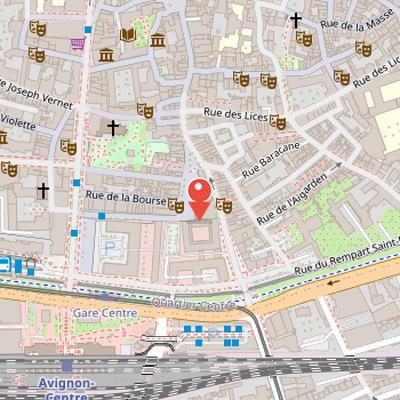
Nearby Objects
-
 Musée Angladon 250 m away
 -
 Musée lapidaire d'Avignon 300 m away
 -
 Collection Lambert 300 m away
 -
 Calvet Museum 500 m away
 -
 Palais du Roure 550 m away
The Church and Convent of the Célestins
The Church of the C?lestins of Avignon is a convent church located on place des Corps-Saints in Avignon. It was begun in 1389 by antipope Clement VII and King Charles VI, near the tomb of Pierre de Luxembourg. The site contains many relics and the remains of illustrious persons, and the nearby square has been called place des Corps Saints since 1843 because of the number of relics deposited there. The C?lestin convent was the richest in Avignon and is also described as the least degraded monastic establishment in its main structure. The complex includes the church building, a cloister, and many regular buildings. It is regarded as the last foundation of the Avignon papacy and the only royal foundation in the pontifical city. The church has been classified as a historic monument.
The Tomb, Pilgrimage, and Monastic Complex
Histoire died in the odor of sanctity and requested burial in the poor cemetery of Avignon called Saint-Michel. The burial site was in the suburbs of Avignon, outside the early city walls. Over time, the tomb became fertile for prodigies and miraculous healings, and it attracted an active cult. The number of pilgrims increased significantly, turning the tomb into an important devotional site.
In 1389, a provisional wooden chapel was built over the tomb and financed by Marie de Blois. Pope Clement VII then ordered the construction of a monastery near the tomb. This decision was made in the context of the Western Schism, when the Catholic Church was divided between two simultaneous popes, Clement VII in Avignon and Urban VI in Rome. Clement VII sought legitimacy through the miracles associated with Histoire's tomb.
The monastery later became the richest and most art-laden in Avignon. Its history ended violently during the Revolution, when the buildings were pillaged and devastated. The tombs of Histoire and Clement VII were destroyed, and the wooden stalls and paintings in the monastery were also destroyed.
Construction and Later Alterations
The construction history of the Church of the Celestins of Avignon is marked by several phases, beginning with the laying of the first stone by the Duke of Orleans, Duke Philippe II of Burgundy, and Duke Jean of Berry. The church includes a semi-underground crypt built over the miraculous sepulcher, and its construction was completed in 1449 with two bays joining the transept of the Celestins church.
In 1625, architect Francois de Royers de la Valfeniere erected a mausoleum above the tomb of Pierre de Luxembourg. Later, in 1658, the funerary monument of Clement VII was moved to the middle of the choir. Before this transfer, the monument had stood in front of and at the foot of the main altar. The Cestelins were reluctant to move it because of their gratitude to the pontiff, and only the monument itself was moved, not the tomb beneath it.
The early 18th century brought another intervention, when Pierre II Mignard renovated the guest wing near the Couvent entrance and added an ornate staircase. This staircase did not survive the military occupation. More recently, from April to May 2019, the Avignon municipality carried out major renovations, including replacement of the limestone floor with stone from Vaucluse, accessibility and electrical upgrades, and reinforcement of the painting.
Architecture and Later Use
The original project combined a basilical plan with a transept and a nave with seven aisles, together with lateral chapels symmetrically arranged around the central nave. In the end, only three bays of the church were built, with the choir and stalls occupying the first two. The building later lost nearly all of its sumptuous decorations and the tombs of illustrious figures once located in the church and its lateral chapels. During the Revolution, the church furniture was devastated and transferred to Saint-Didier or to the cathedrale Notre-Dame des Doms d'Avignon, or else burned. The tomb of Clement VII, at the crossing of the transept, was destroyed in the same period.
Despite these losses, several elements remain notable. The apse is described as having rare elegance, with vault keys showing a Christ in glory in a mandorla formed by cherubs and framed by Prophets, created by the sculptor Perrin Morel. It also includes rich openwork four-leaf and denticulated ogives resting on consoles that form a group of musician angels. On the northern side, a vast blind tracery evokes the royal lineage of the monument in the form of a stylized fleur de lys. The first south aisle is preserved and retains the elliptical paneling that forms the chapel of Saint-Beenezet.
Today, the scenic space, with two large plane trees on each side, and the Carmes cloister are mainly used for the Festival d'Avignon. Their natural scenography must be taken into account because of constraints for exhibitors and directors, while the acoustics allow neighborhood noises to be heard since the two cloisters stand in busy and lively districts of Avignon.
Artworks and Surviving Decorative Elements
The church of the C?lestins of Avignon is associated with a small group of surviving artworks and with many elements that are now missing. Among the preserved works are two polychromed and gilded stone sculptures of Saint Lazare and Sainte Marthe, attributed to Jean de La Huerta and dated around 1446. Another important piece is a statue of the Virgin and Child, which originally stood on the tympanum of the cloister door. This statue was removed during the restoration of the portal, then kept in shelter during the French Revolution until 1791, when it was placed in a niche on a neighboring facade at 21 Place des Corps-Saints.
The churchs artistic heritage also includes a painting titled La toile d'araignee, or Portrait of Death, allegedly painted by King Rene. In addition, the site is linked to other objects and works now preserved elsewhere, including Epitres et lecons de la messe pour le propre du temps et le propre des saints at the Ceccano media library in Avignon, items at the chapel of the Black Penitents in Avignon, items at the Conde Museum in Chantilly, items at the Media Library of Architecture and Heritage in Charenton-le-Pont, and the Reliquary of the True Cross at Notre-Dame Cathedral in Paris.
Many original elements are no longer present, including richly carved wooden stalls, most library books, many paintings, chapel decorations of Pierre de Luxembourg, side altars, and many statues.