Calvet Museum in Avignon is an art museum with collections spanning archaeology, fine arts, decorative arts, and ethnology in Asia, Oceania, and Africa. Its holdings also include goldsmithing, faience, porcelain, tapestry, and ironwork. The museum is named after Esprit Calvet, described as a major collector and physiocrat devoted to medicine and the arts. In 1810, he left a testament to create an autonomous institution in Avignon with a library, a natural history collection, and an antiquities cabinet. An imperial decree from the Tuileries Palace allowed the mayor of Avignon to accept his universal legacy on behalf of the city. Since the 1980s, the museum has been divided between two buildings in Avignon. The fine arts museum remains in the Hôtel de Villeneuve-Martignan, a classified historical monument, while the lapidary museum was transferred to the former Jesuit college chapel on rue de la République. The collections include works from the 17th to 20th centuries, including Simon de Châlons’s painting L’Adoration des bergers.
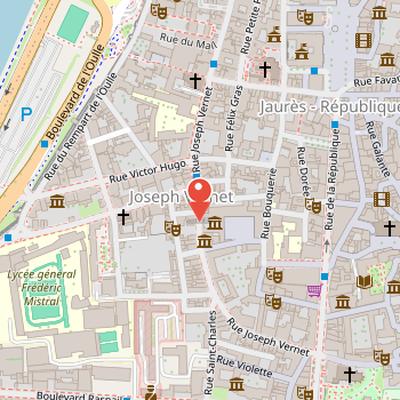
Nearby Objects
-
 Palais du Roure 250 m away
 -
 Musée lapidaire d'Avignon 250 m away
 -
 Collection Lambert 250 m away
 -
 Musée Angladon 300 m away
 -
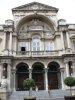 Opéra d'Avignon 350 m away
Collections and Setting
The Calvet Museum includes collections in archaeology, fine arts, and decorative arts. Its holdings also cover goldsmithing, faience, porcelain, tapestry, and ironwork. In addition, the museum features ethnology collections from Asia, Oceania, and Africa. Its fine arts section is located in an hotel particulier in Avignon that is classified.
From the Villeneuve Residence to the Calvet Museum
The building now associated with the Calvet Museum has a long history as the Hotel de Villeneuve-Martignan. Its earlier name, Livree de Cambrai, was linked to cardinal Pierre d'Ailly, bishop of Cambrai. The property was sold to Francois-Rene de Villeneuve in 1719 in the principality of Orange. In 1734, Jacques-Ignace de Villeneuve, son of Francois-Rene de Villeneuve, decided to add new buildings to his residence under the direction of Thomas Lainee. He later demolished all the constructions in 1741 in order to rebuild according to the plans of Jean-Baptiste Franque. The works were completed in 1749, but they caused his ruin. From 1753, Jacques-Ignace de Villeneuve rented part of the ground floor.
During the Revolution, the Hotel de Villeneuve was seized as national property, but it could not find a buyer because of its excessive value. In 1801, Etienne-Joseph de Raousset-Soumabre, the son-in-law of Jacques-Ignace de Villeneuve, reclaimed it after returning from emigration. The building is classified as a historical monument.
The Calvet Museum is named after Esprit Calvet, described as a grand collector and physiocrat devoted to medicine and the arts. In his testament of 1810, he planned an autonomous institution in Avignon with a library, a natural history collection, and an antiquities cabinet. An imperial decree from the Tuileries Palace allowed the mayor of Avignon to accept his universal legacy on behalf of the city. The Musee Calvet preserves many of his art objects. Since the 1980s, the museum has been divided into two parts in different buildings in Avignon: the fine arts museum remains in the Hotel de Villeneuve-Martignan, while the lapidary museum was moved to the former Jesuit college chapel on rue de la Republique.
Museum Collections in the Hotel de Villeneuve-Martignan
The collections of the museum are located in the Hotel de Villeneuve-Martignan. They include art objects, drawings, sculptures, and paintings from the 18th century, while the painting collection itself ranges from the 17th to the 20th centuries. The holdings bring together a broad set of works that represent several artistic periods and subjects, with portraits, religious scenes, landscapes, genre scenes, and figure studies among the best-known examples.
Among the paintings preserved in the museum are Simon de Chalons's L'Adoration des bergers, Nicolas Mignard's La Vierge remettant le scapulaire a saint Simon Stock, Reynaud Levieux's L'Archange Gabriel apparaissant a Zacharie, Pierre II Mignard's Allegorie du printemps, Jean Raoux's Jeune Femme lisant une lettre, and Pierre Parrocel's La Resurrection du Christ. The collection also includes Jean Valade's Portrait du marquis de Caumont, Joseph Vernet's La Bergere des Alpes, Elisabeth Vigee Le Brun's Portrait de Giuseppina Grassini, and Horace Vernet's Mazeppa aux loups.
Other works listed in the collection are Jean-Joseph-Xavier Bidauld's Francois a la Fontaine de Vaucluse, Eugene Deveria's Portrait de Calvet, Theodore Chassériau's Baigneuse endormie pres d'une source, Paul Huet's Vue generale d'Avignon et de Villeneuve-les-Avignon, prise de l'interieur du fort Saint-Andre, Alfred Sisley's L'Eglise de Moret, Chaim Soutine's Vue d'un village, Cezret en Roussillon, Maurice Denis's La Maternite blanche, Alfred Lesbros's Rue a Villeneuve-les-Avignon, Louis-Mathieu Verdilhan's Vue du Vieux-port de Marseille, and Antoine Fort-Bras's Le Chevalet du peintre.
The museum also holds older works such as Pietro della Vecchia's Le Christ et la femme adultere, Luca Giordano's La mort de Lucrece, Giovanni Maria Morandi's Portrait du cardinal Marcello Durazzo from 1686, Giovanni Paolo Panini's L'Aumone faite a Belissaire, Cornelis Dusart's Fumeur a la pipe, assis, a work after Jan Brueghel l'Ancien, Le Cortege d'une noce paysanne, Jan Weenix's Enfant et chien dans une fenetre en trompe-l'oeil, Michiel van Musscher's La lecon de luth interrompue, and Jan Frans van Bloemen's Paysage aux chevriers. The collection further includes Louis Veray's La Moissonneuse endormie, James Pradier's Cassandre refugiee au pied de l'autel, Jean-Joseph Espercieux's Femme grecque se disposant a entrer dans le bain, Jean-Louis Brian's Faune from 1841, and Camille Claudel's Paul Claudel en jeune romain.
Drawing Collection
The Calvet Museum's drawing collection is made up mainly of sheets from the French and Italian schools, with fewer examples from the Nordic and Spanish schools. It includes works by a wide range of artists across several periods. Among the earlier names represented are Le Lorrain, Eustache Le Sueur, Antoine Watteau, François Boucher, Charles-Joseph Natoire, and Jean-Marc Nattier. The collection also contains drawings by later artists such as Auguste Rodin, Honoré Daumier, and Jean-Francois Millet, as well as Eugene Boudin, Henri de Toulouse-Lautrec, and Armand Guillaumin. Additional works are by Berthe Morisot, Paul Cezanne, Auguste Renoir, Alfred Sisley, Henri-Edmond Cross, and Edouard Vuillard. The holdings extend into the 20th century with drawings by Georges Rouault, Albert Marquet, Marc Chagall, Andre Lhote, Leonard Foujita, and Jean Fautrier.
Museum Collections
The Calvet Museum collections include works from several major European schools. Italian schools are represented by artists such as Domenico Beccafumi, Lorenzo Lotto, Baccio Bandinelli, Daniele da Volterra, Il Romanino, Paul Veronese, Le Tintoret, Jacopo Zucchi, Taddeo Zuccaro, Il Garofalo, Agostino Carracci, Federico Barocci, Mattia Preti, Luca Giordano, Domenico Fetti, Le Guerchin, Alessandro Algardi, Luigi Garzi, Francesco Furini, Pier Francesco Mola, Daniele Crespi, Giovanni Niccolo Servandoni, and Amedeo Modigliani. Northern schools are represented by Hendrik Goltzius, Jan Van Goyen, and Anton Raphael Mengs. Spain is represented by Vincenzo Carducci and Juan de Valdes Leal.
Egyptian Holdings and Lapidary Museum
The collections of the Calvet Museum include an Egyptian section formed thanks to the legacies of Esprit Calvet and Marius Clement. This section was later completed by various purchases, creating a remarkable collection. Among the works exhibited are the Vase canope, reference Calvet 4632, the ex-voto of Yai, reference Calvet 4612, the Medaillon d'Ammon, reference Calvet 4605, and the Table d'offrande d'Harsiesi, reference Calvet 4620. The museum also has a lapidary museum dependent on Musee Calvet, located in a former Jesuit church on rue de la Republique in Avignon.
Lapidary Collections
The Calvet Museum's lapidary museum offers a panorama of Greek, Roman, and Gallo-Roman civilizations. Its collections include the Tarasque de Noves image, whose era remains uncertain, as well as the Etruscan sarcophagus image from Avignon. Other notable works in the collection are the Gallic warrior of Vacheres, the Gallic warrior of Mondragon, and the Venus with dolphin image. Together, these pieces reflect the range of the museum's holdings in ancient sculpture and related material.