The Textile Arts Museum is located in Lyon, at rue de la Charité, alongside the musée des Arts décoratifs. The two institutions are distinct but complementary, and they can be visited with the same ticket. The museum is known for holding one of the most important collections of fabrics and textiles in the world, as well as the richest fabric and textile collection of its type in France. It is currently closed to the public for renovation under architect Rudy Ricciotti.
The museum was conceived in the 1850s and 1860s and opened in 1864. It was installed in the Hôtel de Villeroy in 1946. Built by Bertaud de la Vaure in 1729, the Hôtel de Villeroy has a long history before becoming the home of the textile museum. The musée des Tissus is composed of two distinct museums labeled Musées de France, housed in two contiguous hôtels particuliers in the center of Lyon: the Hôtel de Villeroy for the textile museum and the Hôtel de Lacroix-Laval for the musée des Arts décoratifs.
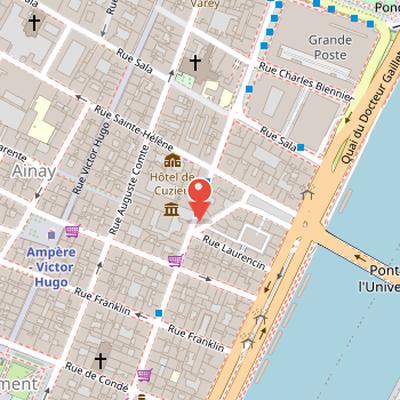
Nearby Objects
-
 Lycée Juliette Récamier 120 m away
 -
 Rue Victor-Hugo 200 m away
 -
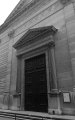 Église Saint-François-de-Sales 250 m away
 -
 Bellecour School 250 m away
 -
 Saint-Marc Lycée 300 m away
Location and Collection
The Textile Arts Museum is located in Lyon at rue de la Charite, alongside the musee des Arts decoratifs. The two institutions are distinct but complementary museums, and they can be visited with the same ticket. The Textile Arts Museum holds one of the most important collections of fabrics and textiles in the world, and it is described as having the richest fabric and textile collection of its type in France. The museum is currently closed to the public for renovation under architect Rudy Ricciotti.
Museum History and the Hotel de Villeroy
The Textile Arts Museum was conceived by Historique in the 1850s and 1860s and opened in 1864. In 1946, Historique installed the museum in the Hotel de Villeroy, giving the institution its later setting. The Hotel de Villeroy itself has a long earlier history. It was constructed by Bertaud de la Vaure in 1729, and the Villeroy governors lived there in 1745. Over time, the building changed hands several times: it was sold in 1775, confiscated in 1791, restituted between 1800 and 1825, ceded to promoters in 1825, and became state property in 1829. Later, ESC Lyon acquired it in 1872, and the Chamber of Commerce acquired it in 1935. These successive changes in ownership form part of the architectural and institutional background of the museum's location.
Museum Setting and Collections
The musee des tissus is made up of two distinct museums, both labeled Musées de France. They are housed in two contiguous hotels particuliers in the center of Lyon. The hotel de Villeroy contains the tissus museum, while the hotel de Lacroix-Laval houses the arts decoratifs museum. The textile collection is described as one of the most beautiful in the world.
Origins and Development of the Textile Arts Museum
Le musee des Tissus was conceived in the 1850s and 1860s to bring together the most interesting textile art testimonies in Lyon. It was founded in 1856 by the Chambre de commerce as a museum of Art and Industry in Lyon, closely following the creation of the Victoria and Albert Museum and the wider European art and industry movement. Its purpose was to renew artistic and technical teaching and provide sources of inspiration for the Fabrique lyonnaise. The museum opened to the public in 1864 and was specialized as a historical textile museum by the Chambre de commerce de Lyon in 1890. Since 1946, it has been located in the hotel de Villeroy in Lyon.
Collections and Textile Scholarship
Le musee des Tissus owns one of the richest textile collections in the world, covering 3000 years of fabric and silk history. It holds more than 2 million textiles dating from ancient Egypt to 2006. The collections are divided into two main sections, the Orient and the Occident, and include Coptic tapestries, Sassanid Persian textiles, Byzantine, Muslim, Chinese, and Japanese fabrics. The museum also contains a major collection of Oriental and Far Eastern carpets, as well as Hispano-Moorish, Italian, and French textiles representing Western production.
The museum highlights Lyons role through the work of ornament designers Jean Pillement, Philippe de la Salle, and Dugourc, and presents imperial and royal commissions that illustrate the revival of Lyons textile activity. It also includes examples by Raoul Dufy and Sonia Delaunay. Other holdings cover church ornaments, religious embroidery, French civil costumes, lace, and trimmings.
Beyond its collections, Le musee des Tissus functions as a research center in the textile field. Its documentation library contains 6000 volumes, and it provides teaching through the Centre international detude des textiles anciens (CIETA). It also serves as a platform for contemporary textile creation through the Association pour luniversite de la mode/Modalyon.
The Arts Decoratifs Collection at the Hotel de Jean de Lacroix
The collection of Arts decoratifs originated from the musee d'Art et d'Industrie created by the Lyon Chamber of Commerce. It was acquired in 1919 through the generosity of Lyon philanthropists linked to the Societe pour le developpement des musees de Lyon, including Emile Baboin, Charles Cabaud, Raoul Baguenault de Puchesse, Francois Ferrier, Alexandre Franc, Georges Sabran, Ennemond Morel, Henri Bertrand, and the Gillet and Roche de la Rigodiere families. In 1925, the collection was installed in the hotel de Jean de Lacroix, a building constructed by Jacques-Germain Soufflot in 1739 for a former counselor at the Cour des monnaies.
The rooms are decorated with paneling partly taken from old Lyon hotels particuliers of the 17th century, as well as with 18th century tapestries. The collection serves as a showcase for Parisian cabinetry and woodwork by Jean-Francois Oeben, Pierre Roussel, Charles Topino, and Jean-Henri Riesener, alongside Lyonnais pieces by Canot and Nogaret and Grenoble works by the Famille Hache. It also includes a rare and original group of 18th century straw marquetry objects. Among the notable donations are an exceptional collection of Italian Renaissance majolica given by the Gillet family, a significant donation from the Gonin family, and part of a collection donated by the Baboin-Jaubert family, including chairs made by the cabinetmaker Nogaret.
Decorative Arts Collections
The collection of clocks in La collection des Arts decoratifs includes about forty high-quality pieces made by prominent cabinetmakers, enamellers, bronze workers, and clockmakers. Among them is the rare pendule-cage with a fountain and singing birds in chased and gilded bronze, made in France around 1780. The museum also houses many chased and gilded bronzes for furniture and ornament from the 17th and 18th centuries, as well as an exceptional two-keyboard harpsichord made by Lyon instrument maker Donzelague in 1716.
The collection further presents old goldsmithing, mainly made up of pieces from Paris or provincial centers, and contemporary goldsmithing with over 4,000 items published by Danese, Algorithme, Christofle, Alessi, Cleto Munari, Maeght, or created by goldsmiths. Its ceramics include soft and hard porcelain from Vincennes, Sevres, Saint-Cloud, Paris, and Tournai. It also holds one of the most important collections of Italian majolicas preserved in France, with more than two hundred pieces, together with significant French faience series from Moustiers, Nevers, Lyon, and Pont-aux-Choux.
The collection of drawings comprises ten thousand works, including drawings by Giorgio Vasari, Primatice, Le Guerchin, Pieter Jansz Saenredam, Charles Le Brun, Giandomenico Tiepolo, Jean Honore Fragonard, Hubert Robert, Anne-Louis Girodet, and Jean Auguste Dominique Ingres.
Museum Services and Research Facilities
Les services des musees developed several important support facilities for the Textile Arts Museum. In 1985, it created a workshop for restoring ancient textiles in France and equipped it with advanced technologies for the restoration and conservation of old textiles. The workshop also served an educational role, offering practical internships for professors and students.
The documentation center for the museums of Textiles and Decorative Arts was created in 1864. It holds manuscripts, engraving collections, and about one thousand periodicals, with coverage focused on textile, fashion, and decorative arts. In 1992, a digital image bank was put into service for the Textile Museum archives. This tool offers detailed knowledge of textile heritage and instant visualization of pieces, while also assisting textile and decoration professionals and supporting historians and researchers.
Visitor services were expanded in 1988 with the creation of a public reception area, a sales boutique, and a multipurpose room. The boutique offers a wide range of silks, prints, and reproductions from museum collections, along with exhibition catalogs and books on textiles and decorative arts.
A Museum Facing Financial Uncertainty
Since 2014, the Textile Arts Museum and the Lyon decorative arts museums have faced an uncertain future because of budget difficulties that raised the risk of dismantling. The situation became more acute because the possible sale of the museum premises depended on whether the Lyon Chamber of Commerce, the Auvergne-Rhone-Alpes region, or the State would provide the necessary funds. In spring 2016, the museum requested financial aid from the Lyon Chamber of Commerce. At that time, it reported annual expenses of 2.7 million euros, against one million euros in income from tickets and patronage, and it employed twenty staff members.
The crisis also led to public mobilization. A petition was launched and collected signatures, and a collective named Canutopie was created. The museum later announced a rescue effort, alongside the establishment of a scientific committee and the hiring of conservator Esclarmonde Monteil. The Ministry of Culture also promised that museum management would be transferred to an association.
Renovation plans were then developed. The regional council appointed Rudi Ricciotti as architect for the museum renovation, which was estimated to cost 60 million euros. The museum expected 5 million euros in funding from the State, while Laurent Wauquiez requested support from Lyon Metropole and the City. These measures show how the museum's future became tied to fundraising, institutional support, and changes in its management structure.