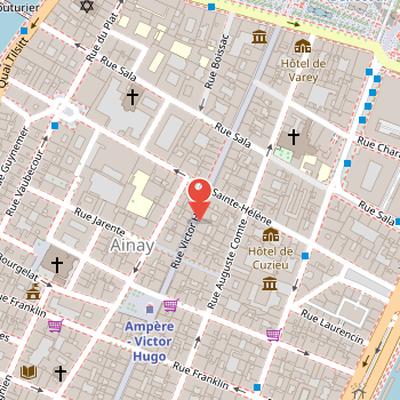
Rue Victor-Hugo is a pedestrian street in the Presqu’île of Lyon, France, running north to south between Place Bellecour and Place Carnot. Beyond Place Bellecour, rue de la République continues the same urban axis, and together the two streets form one of the largest pedestrian and commercial streets in Europe. Formerly known as rue de Bourbon, the street has a layered history of changing names. Earlier planned names included rue de la Direction, while proposed alternatives such as rue d’Euripide and rue du Caire were abandoned. It was also called Grande rue Royale, and from 1848 to 1852 it took the name rue de la République before resuming its former name. Its current name was adopted by municipal council resolution four days after the death of Victor Hugo. Planned in 1775 by Antoine Michel Perrache during the First Empire and completed in 1842, the street was opened in five stages. The aristocracy of Lyon inhabited it from its creation, reflecting its long-standing urban importance.
Nearby Objects
-
 Saint-Marc Lycée 130 m away
 -
 Textile Arts Museum 200 m away
 -
 Église Saint-François-de-Sales 200 m away
 -
 Basilica of Saint-Martin d'Ainay 200 m away
 -
 Bellecour School 200 m away
Pedestrian Axis in the Presqu'ile
Rue Victor-Hugo, formerly called rue de Bourbon, is a pedestrian street in the Presqu'ile of Lyon, France. It follows a north-south direction and connects place Bellecour to place Carnot. Beyond place Bellecour, rue de la Republique continues as the natural extension of rue Victor-Hugo. Together, rue Victor-Hugo and rue de la Republique form one of the largest pedestrian and commercial streets in Europe.
Changing Names of Rue Victor-Hugo
According to odonymy records, the street had several proposed or former names before becoming rue Victor-Hugo. Before construction, the first planned name was rue de la Direction. Other proposed names, rue d'Euripide and rue du Caire, were considered but ultimately abandoned. The street was later called Grande rue Royale, then renamed rue de Bourbon in homage to Lyon alderman Jacques Bourbon. From 1848 to 1852, it was known as rue de la Republique, after which it resumed its original name. Its current name was adopted by a municipal council resolution four days after the death of Victor Hugo.
Planning and Construction of rue Victor-Hugo
Rue Victor-Hugo was planned in 1775 by Antoine Michel Perrache during the First Empire. It was designed to allow the emperor to see the equestrian statue of Louis XIV at place Bellecour. Construction was completed in 1842. The street was opened in five stages, and its buildings were completed over a long period. On the odd-numbered side, numbers 1 to 27 were built between 1834 and 1848, while numbers 29 to 67 were built between 1820 and 1857. On the even-numbered side, numbers 2 to 16 were constructed in 1844, and numbers 18 to 68 were constructed between 1826 and 1864. From its creation, the aristocracy of Lyon inhabited the street, which gave it an early social significance in the city.
Urban Changes and Public Space on rue Victor-Hugo
Rue Victor-Hugo, referred to in the provided facts as Histoire, has undergone several major changes linked to the urbanization of the Presquile. At numbers 25 and 27, an institution founded by Chalotte Dupin as l'OEuvre des Charlottes was established, and this site later became the Soeurs de Saint-Joseph. Nearby, the former Saint-Joseph prison was located in a convent south of place Bellecour on rue de Bourbon. When the prison lease expired in 1828, its demolition made it possible to extend the street to place Bellecour, a change that also favored the urbanization of the Presquile.
The street was opened again in 1974 for the construction of metro line A, then transformed into a pedestrian street on September 14, 1976. It became the second pedestrian street in Lyon after rue de la Republique, which lies on the other side of place Bellecour. More recently, Histoire has been the subject of public-space and security-related interventions. In 2017, cubic concrete blocks were installed at street ends and intersections as a response to the July 14, 2016 attack in Nice. Between 2018 and 2019, the pavement was replaced with new light stones as part of the Coeur Presqu'ile city center renovation.
The street has also seen facade restoration work and the installation of a new lighting system. However, the lighting remains mostly unused because of a lack of co-ownership authorizations, and it functions only between rue Jarente and place Ampere. The street was also affected by violence on May 10, 2019, when a car bomb exploded at number 15, injuring thirteen people, including an eight-year-old child.
Urban Form and Historic Buildings
Rue Victor-Hugo is mainly lined with 19th-century buildings rising three to six floors. The street contains cafes, shops, services, and hotels, giving it a mixed commercial character. In its center is place Ampere, a pedestrian and tree-lined square that is also served by the metro station Ampere - Victor Hugo. Two old houses stand at the corners with rue Sainte-Helene and rue Jarente. Some doors on the street are decorated with sculptures, including lions' heads and snakes, adding to its visual detail.