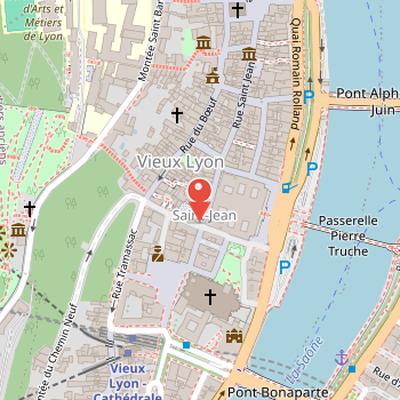
Maison du Chamarier, also known as hôtel d’Estaing, is a house located at 37 rue Saint-Jean in Lyon, on the corner with rue de la Bombarde. The term Chamarier comes from the Latin cameriarus, or camérier, and designates the financial intendant of the bishop of the nearby cathedral. The chamarier also held the keys to the doors of the canonical enclosure and, from an unspecified date, collected taxes during fairs. The list of chamariers between 1070 and 1779 is known.
The building dates back to an unspecified time, but its oldest remains are also of uncertain date. The first house was built inside the cloister Saint-Jean against the wall constructed under bishop Guichard de Pontigny between 1165 and 1180. It rests on ancient and medieval foundations. It was rebuilt in the 16th century by François d’Estaing, chamarier from 1496, and remodeled during the 16th and 17th centuries. The house was visited by marquise de Sévigné in 1672 and 1673, when it was hosted by chamarier Charles de Châteauneuf de Rochebonne. Converted into apartments in the 19th century, it was later bequeathed to the city of Lyon in 1907. Architecturally, it preserves a late medieval spiral staircase, the study cabinet of François d’Estaing, an Italian-style loggia with a painted wall created under Charles d’Estaing, and a Renaissance well in the courtyard attributed to Philibert Delorme. It is a rare example of a Renaissance civil house.
Nearby Objects
-
 Musée Miniature et Cinéma 20 m away
 -
 Palais de justice historique de Lyon 70 m away
 -
 Lyon Cathedral 90 m away
 -
 Manécanterie 120 m away
 -
 Maison du Crible 130 m away
Location and Alternate Name
The Maison du Chamarier, also known as the hotel d'Estaing, is a house in Lyon. It is located at 37 de la rue Saint-Jean, at the corner with rue de la Bombarde. Its naming and address identify it as part of the historic street layout of the area.
The Meaning of the Name Chamarier
The term Chamarier comes from the Latin cameriarus, or came rier. It refers to the financial intendant of the bishop of the nearby cathedral. The chamarier also held the keys to the doors of the canonical enclosure. From an unspecified time onward, the office included collecting taxes during fairs. A list of chamariers between 1070 and 1779 is known.
History and Later Uses of the Maison du Chamarier
The Maison du Chamarier dates back to an unspecified period, although its oldest remains are from an unspecified time. Its first house was built inside the cloister of Saint-Jean, against the wall constructed under Bishop Guichard de Pontigny between 1165 and 1180, and it rests on ancient and medieval foundations. The building was remodeled during the 16th and 17th centuries, and it was rebuilt in the 16th century by François d'Estaing, who had been chamarier from 1496. In 1672 and 1673, it was visited by the Marquise de Sevigne, who was hosted by chamarier Charles de Chateauneuf de Rochebonne. In the 19th century, the house was transformed into apartments, at a time when the Saint-Jean neighborhood gradually deteriorated. The property was bequeathed to the city of Lyon in 1907. Later projects planned two public spaces, including one managed by Societe d'equipement du Rhone et de Lyon and Cnam with 3D printers, and another with a hall containing a model and a tablet for tourists to view the evolution of the house.
Renaissance Features of Maison du Chamarier
Maison du Chamarier is considered a rare example of a civil house from the Renaissance period. Its architecture includes a spiral staircase dating from the late Middle Ages and the study cabinet of Francois d'Estaing. The house also features an Italian-style loggia with a painted wall created under Charles d'Estaing. In the courtyard, there is a Renaissance well attributed to Philibert Delorme. Together, these elements give the building a layered architectural character that reflects different periods of use and decoration.