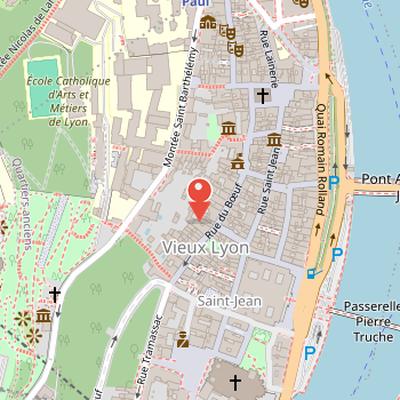
Maison du Crible is a building at 16 rue du Bœuf in Lyon, France, in the Vieux Lyon (Saint-Jean) district. It is also known as the Tour rose, a name derived from its ochre-colored staircase tower. The building is regarded as one of the most remarkable in the district because of its color and tower. Its portal opens directly onto the street and leads to the courtyard with the staircase tower; set at the center of the facade, it is noted as a distinctive feature in the neighborhood and is decorated with a pediment inspired by the architect’s drawings. Some sources date the building to the Renaissance period and attribute it, without certainty, to the Italian architect Sebastiano Serlio. The building has been classified as a historical monument since 1937. It also housed the French Orthodox parish. According to historical accounts, Henri IV stayed there for a few days in 1600, during his marriage to Marie de Médicis, celebrated less than 300 meters away at the primatiale Saint-Jean.
Nearby Objects
-
 Rue du Bœuf 40 m away
 -
 Villa Florentine 80 m away
 -
 Musée Miniature et Cinéma 110 m away
 -
 Maison du Chamarier 130 m away
 -
 Palais de justice historique de Lyon 140 m away
Architecture and historical significance
Maison du Crible, also known as the tour rose, is a building located at 16 rue du Boeuf in Lyon, France, in the Vieux Lyon (Saint-Jean) district. It is considered one of the most remarkable buildings in the area because of its ochre color and its tower, whose staircase gave the building its nickname. The house is associated with a notable historical event: King Henri IV stayed there for a few days in 1600, during his marriage to Marie de Medicis. That marriage was celebrated less than 300 meters away at the primatiale Saint-Jean. The building has been classified as a historical monument since 1937. It also houses the French Orthodox parish. The restaurant La Tour rose, which was originally on the ground floor of the building, was named after the staircase tower and is now located at another address on rue du Boeuf.
Architecture and Historical Attribution
Maison du Crible is dated by some sources to the Renaissance period. Its historical attribution remains uncertain, although it has been linked to the Italian architect Sebastiano Serlio without firm confirmation. The portal, placed at the center of the facade composition, opens onto the street and leads to the courtyard with the staircase tower. This portal is described as a unique feature in the neighborhood. It is decorated with a pediment inspired by the architect's drawings. The name Crible may be connected to an earlier association with the house of Martin de Troyes, a King's tax collector in the 16th century, though this remains unconfirmed. The word crible refers to an object rather than a function, and one hypothesis suggests that Martin de Troyes' coat of arms may once have included a sieve, although this is not established.