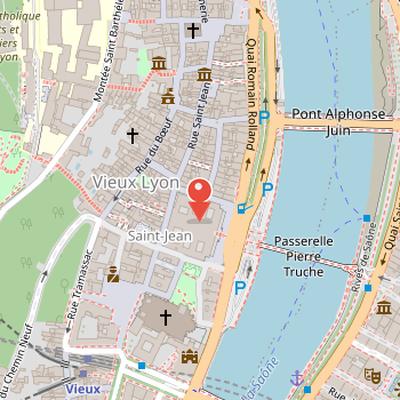
The Palais de justice historique de Lyon is a courthouse located on quai Romain-Rolland, on the right bank of the Saône in the 5th arrondissement of Lyon. It is known as “Les vingt-quatre colonnes” because of the numerous columns on its facade. Its interior decoration is classified as a historic monument. The building houses the Rhône assize court, the services of the Lyon Court of Appeal, and the interregional judicial administrative service Centre-Est.
The site has a long judicial history in Lyon. After Lyon joined France, royal power installed a seneschalcy in the maison de Roanne, and a maison de justice was later established there. That building was destroyed by fire in 1622, leading to the construction of the first palais de justice, the palais de Roanne, which had fallen into ruin by the end of the 17th century. The current palace was reconstructed in several phases: land was acquired and Louis-Pierre Baltard was selected in 1828, construction began in 1835, and the work was completed in 1847. The building was designed in a neoclassical style and intended to accommodate many hearings and detainees.
Nearby Objects
-
 Musée Miniature et Cinéma 60 m away
 -
 Maison du Chamarier 70 m away
 -
 Rue du Bœuf 130 m away
 -
 Lyon Cathedral 140 m away
 -
 Maison du Crible 140 m away
Location and Judicial Functions
The historic Palais de justice de Lyon is located at quai Romain-Rolland on the right bank of the Saone, in the 5th arrondissement of Lyon. It is known as Les vingt-quatre colonnes because of the many columns on its facade. The building houses the Rhone assize court, the Lyon Court of Appeal services, and the interregional judicial administrative service Centre-Est. Its interior decoration is classified as a historic monument, underlining its heritage value as well as its judicial role.
From the Maison de Justice to the Palais de Roanne
After Lyon joined France, royal power installed a seneschalcy in the maison de Roanne. Histoire also records the establishment of a maison de justice in Lyon from an unspecified date. This first judicial building was destroyed by fire in 1622, after which the first palais de justice, the palais de Roanne, was constructed. By the end of the 17th century, however, the palais de Roanne had fallen into ruin.
A new reconstruction project began in 1828, marked by land acquisition and the selection of architect Louis-Pierre Baltard. Construction work started in 1835 and was completed in 1847. The palais de justice later reopened on the occasion of the solemn opening session of the Lyon court of appeal, underscoring its continued role in the city's judicial life.
Anecdotal References and Film Use
Anecdotal references linked to the Palais de justice historique de Lyon include a commemorative plaque for judge Francois Renaud in the salle des pas perdus. The same accounts note that Renaud was assassinated in Lyon and that he had served as a judge of instruction at the palais from the end of an unspecified date. The building also appears in cinema: the final scene of the 1992 film Tout ca...Pour ca ! by Claude Lelouch was filmed in the salle des pas perdus.
Architecture and Interior Decoration
The historical Palais de justice de Lyon was built as a neoclassical building by Louis-Pierre Baltard between 1835 and 1847. It was designed to be open to all and to accommodate many hearings and detainees. The palace was constructed with cut stone and wooden frameworks from the quarries of Villebois, Tournus, Crussol, and Cruas.
Its architecture also includes decorative sculpture on rue Saint-Jean. Between 1857 and 1862, Francois Felix Roubaud created sculptures representing Force and Justice, with medallions above them carved in Seyssel stone. Inside, the salle des pas perdus was given large dimensions, although its exact surface area and height are not specified in the available facts.
This hall contains two bas-reliefs: one by Jean-Francois Legendre-Heral, made in Seyssel stone and representing Lyon welcoming Beaux-Arts, Commerce, Industry, and Agriculture, and another by Guillaume Bonnet titled La Justice punishing Crime.