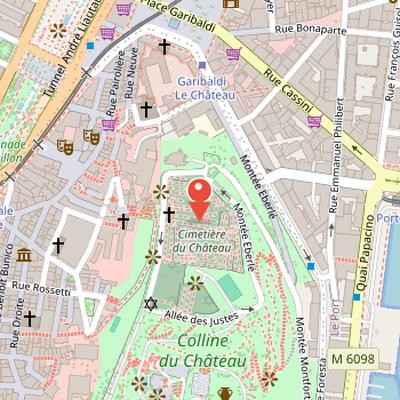
Cimetière du Château was created in 1783 at the site of the old city citadel, which had been demolished by the troops of 1706. Its establishment was made necessary by the prohibition, through letters patent of the King of Sardinia, against burying the dead in churches, following the 1782 decision of Bishop Charles Valperga de Maglione. Before this change, nobles in Nice were buried in side chapels, while the rest of the population was placed in common graves under church naves. The cemetery was built on the ruins field of the old citadel and later received a Jewish cemetery to the south, replacing the cemetery that had existed near Sincaïre Street since the Middle Ages. The site retains some remains of the newest walls of the former citadel and is arranged with terraces. It offers a panorama over Nice, the hills, and the Mediterranean Sea. Graves in the cemetery include people from different social backgrounds, as well as several notable figures.
Nearby Objects
-
 Chapelle de la Visitation Sainte-Claire 110 m away
 -
 Église Saint-Martin-Saint-Augustin 200 m away
 -
 Palais Lascaris 250 m away
 -
 Chapelle du Saint-Sépulcre 300 m away
 -
 Church of Gesù 300 m away
Origins of the Cimetière du Chateau
The Cimetiere du Chateau, referred to here as Historique, was created in 1783 on the site of the old city citadel. Its establishment was made necessary by the prohibition, under letters patent of the King of Sardinia, against burying the dead in churches. This ban followed the decision of the Bishop of Nice, Charles Valperga de Maglione, in 1782. Before this change, deceased nobles in Nice were buried in the side chapels of churches, while the rest of the population was placed in common graves under the church naves.
The new cemetery was built on the ruins field of the old citadel, which had been demolished by the troops of 1706. At the same time, several other cemeteries were created on the hills of the city, which were largely rural. A Jewish cemetery was also added south of the Christian cemetery at Historique, replacing the cemetery that had existed since the Middle Ages near Sincaire Street.
Setting and Features of Cimetiere du Chateau
Cimetiere du Chateau is built on the ruins of the old citadel of the city, and it retains some remains of the newest walls of that citadel. The cemetery is arranged with terraces for its placements, giving it a distinct layered layout. From the site, there is a panorama of the whole city, including east, west, and north Nice, the Nice hills, and the Mediterranean Sea. In the 19th century, the cemetery counted a number of graves occupied, and it also hosted a number of events annually from 2005 to 2008.
Notable Burials at Cimetiere du Chateau
The Chateau cemetery contains burials from a wide range of social backgrounds. Among those inhumed are common people from Vieux-Nice, as well as notable citizens of the city. It also includes foreigners from communities such as Russian and English. The cemetery is the burial place of several prominent figures, including the founder of Mercedes, the politician Leon Gambetta, the jeweler Alfred Van Cleef, Marguerite Duthuit Faure, the writer Gaston Leroux, the writer and screenwriter Rene Goscinny, the actress Renee Saint-Cyr, and the director Georges Lautner, who was the son of Renee Saint-Cyr. These burials show that the cemetery holds both local and international associations, and that it includes individuals linked to politics, literature, business, and the arts.
Illustrated Views of the Cimetiere du Chateau
The illustrations present the Cimetiere du Chateau as a cemetery set on the Chateau hill in Nice. They include an overview of the site, as well as a view with the Sainte-Trinite chapel in the background. Several individual graves and burials are also shown, including Giuseppe Garibaldi's mother's grave, the Verdeil Cadet burial with the marble statue titled Gardien des cendres, the grave of Rene Goscinny, and the grave of Marguerite Duthuit Faure and Georges Duthuit. Together, these images document both the cemetery's setting and some of its notable memorials.