Place de la Bourse in Bordeaux, Gironde, was originally called Place Royale. Designed between 1730 and 1755 by Jacques Gabriel and Ange-Jacques Gabriel, it was built under the intendances of Boucher and Tourny. Considered the first open square in the history of French urban planning, it also marks the first breach in the city’s medieval ramparts. Inaugurated in 1743, the square was intended as a setting for an equestrian statue of King Louis XV and came to symbolize the city’s prosperity.
The square is bordered by two symmetrical pavilions: the palais de la Bourse to the north and the hôtel des douanes to the south. Both retain their original functions as the chamber of commerce and customs administration. Over time, the square’s name changed with political regimes: place Royale under the Ancien Régime, place de la Liberté during the Revolution, place Impériale under Napoléon, and place Royale again during the Restoration. It took its current name after the fall of Louis-Philippe in 1848.
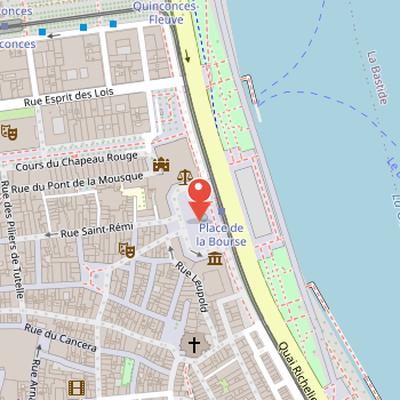
Nearby Objects
-
 Fontaine des Trois Grâces 10 m away
 -
 Musée national des douanes 60 m away
 -
 Église Saint-Rémi 140 m away
 -
 Place du Parlement 150 m away
 -
 Église Saint-Pierre 200 m away
Design and historical role
Originally named place Royale in Bordeaux, Gironde, place de la Bourse is described as the first open square in the history of French urban planning. It was built under the intendances of Boucher and Tourny, and its design was created by Jacques Gabriel and Ange-Jacques Gabriel between 1730 and 1755. The square is bordered by two symmetrical pavilions, the palais de la Bourse and the hotel des douanes. These buildings have preserved their original functions as the chamber of commerce and the customs administration.
History and Political Naming
Place de la Bourse is described as the first breach in the medieval ramparts. It was intended as a setting for an equestrian statue of King Louis XV of France and was inaugurated in 1743. In Histoire, the square is also presented as a symbol of the citys prosperity. Its name changed repeatedly in response to political regimes. It was originally called place Royale under the Ancien regime, renamed place de la Liberte during the Revolution, became place Imperiale under Napoleon, and returned to place Royale during the Restoration of the monarchy. It received its current name after the fall of Louis-Philippe in 1848.
Urban Transformation and River Access
In 1720, Claude Boucher was appointed Intendant of Bordeaux by Louis XV. His aim was to open Bordeaux to the river Garonne and modernize the city. To carry out this change, 21 houses and 10 shops were destroyed, and the decayed ramparts surrounding Bordeaux were demolished. These actions marked a major restructuring of the urban fabric and reflected a broader effort to reconnect the city with the river.
Design and Development of Place de la Bourse
Place de la Bourse was conceived as the first open public square in French urban history, and its form reflects a carefully planned urban ensemble. The terrace extending from place Royale was described as a balcony liberated from moored ships. It was built on pine pilings, and its dimensions are noted in the historical source without being specified. The square was arranged with major civic and commercial functions on its edges: the customs hotel stood on the southern side, while the palais de la Bourse occupied the northern side. Other buildings formed a block of private homes that were offered for sale.
The facades around the square were designed by Jacques Gabriel, the king's architect, who drew inspiration from place Vendome in Paris, designed by Jules-Hardouin Mansart in 1699. After Jacques Gabriel died in 1742, Ange-Jacques Gabriel continued the work, including the completion of the palais de la Bourse in 1749. The rear square was parceled out in 1743 for investors, who built according to Jacques Gabriel's designs. The overall project was meant to connect with rue Saint-Remi and rue Royale, now rue Fernand Philippart.
To close the esplanade to the north and south, two grids were built in 1747, and a duty was collected on goods entering Bordeaux at these points. At the intersection of the two streets, a narrow pavilion with a pediment was constructed; unlike the main buildings, it was designed by Andre Portier. The central pavilion was completed in 1755, which is also recorded as the inauguration date of the square. An equestrian statue of King Louis XV by Jean-Baptiste Lemoyne was placed at the center and was solemnly inaugurated on an unspecified date. Victor Hugo also made a statement about Place de la Bourse in 1843, underlining its continued public visibility.
From Royal Square to Place de la Bourse
The site underwent several political and functional changes after the equestrian statue of Louis XV was destroyed during the Revolution and melted to make cannons. A tree of liberty was planted on the former statue site, and the square was renamed place de la Liberte. At that time, a poultry market was held there. In 1808, the square was briefly named place Imperiale for Napoleon's visit, before reverting to place Royale with the restoration of the monarchy in 1815. In 1828, the city erected a modest fountain at the tree of liberty site, described as a pink marble column topped by a white capital and globe. The square took the name place de la Bourse in 1848, at the advent of the Second Republic. Annual fairs continued there until they were moved to place des Quinconces.
Classical Architecture at Place de la Bourse
Place de la Bourse contains one of the most representative works of classical French architectural art of the 18th century. The customs house, now the Direction Interregionale des douanes et Droits Indirects, was designed by Jacques Gabriel between 1735 and 1738. Its decoration included sculptures representing Minerve protecting the arts and Mercure favoring trade. Nearby, the palace of the Bourse, now the Chambre de commerce et d'industrie de Bordeaux, was placed by Ange-Jacques Gabriel between 1742 and 1749. The palace included a clock dial by Hustin, a faience artist from Bordeaux, as well as interior paintings and tapestries from the Gobelins. Its frontons and mascarons were sculpted by Jacques Verbeckt, Vernet, and Prome.
The architectural program also used sculptures depicting the greatness of princes, Neptune opening trade, the Garonne-Dordogne junction, and Time revealing Truth. The mascarons included figures inspired by Neptune, Bacchus, fantastic animals, female figures, carnival faces, angels, and wild beasts. Some mascarons on place de la Bourse also reflect Bordeaux's history with African female faces referencing the slave trade and colonial commerce of the 18th century.