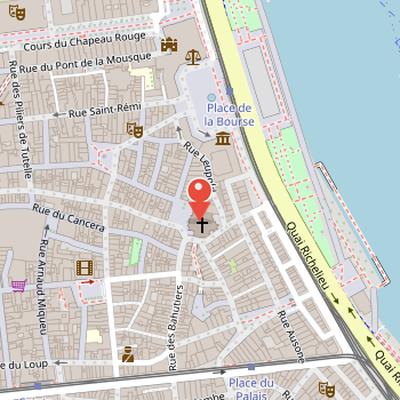
Église Saint-Pierre de Bordeaux is a church building located in the commune of Bordeaux, in the French department of Gironde, at place Saint-Pierre. It stands in the eastern part of the city near the former course of the Devèze river and close to the confluence of the Devèze and Garonne rivers. Its proximity to the ancient port suggests an early function as a port church.
Gregory of Tours cites the church in a miraculous episode during Bertechramnus’ episcopate and describes it as an elevated altar above a crypt with a door and relics. He also refers to it as a port basilica and gate basilica. These are the only attestations of the paleo-Christian church.
In the Middle Ages, the silting of the Devèze contributed to the urbanization of the area. The church was later placed under the chapter of Saint André in 1173, and documents from 1262 mention Saint-Pierre square and the port of the same name. Rebuilding began in 1358 and continued from the mid-14th century to the late 15th century. The building was restructured in 1882, classified as a historical monument in 1908, and later affected by a fire that damaged the choir and led to restoration work. A stained glass window in the center of the choir, created by Joseph Villiet around 1860, shows a white queen with two chained black slaves at her feet.
Nearby Objects
-
 Musée national des douanes 130 m away
 -
 Place du Parlement 150 m away
 -
 Place Camille Jullian 150 m away
 -
 Porte Cailhau 200 m away
 -
 Place de la Bourse 200 m away
Location in Bordeaux
The Eglise Saint-Pierre de Bordeaux is situated in the French department of Gironde, within the commune of Bordeaux. It is located at Place Saint-Pierre, placing it in a specific urban setting identified by the square name. These location details define the churchs position within the city and its administrative context in southwestern France.
From Port Church to Medieval Landmark
Saint-Pierre Church was built in the eastern part of Bordeaux, near the Deve8ze river and close to the confluence of the Deve8ze and Garonne rivers. Its position near the ancient port suggests that it functioned as a port church. The earliest known references to the building come from Gregory of Tours, who mentions it in a miraculous episode during the episcopate of Bertechramnus. In this account, the church is described as an elevated altar above a crypt with a door and relics, and also as both a port basilica and a gate basilica. These are the only surviving attestations of the paleo-Christian church.
During the Middle Ages, silting of the Deve8ze led to gradual urbanization of the area. The parish also included the ducal castle of l'Ombrie8re, which made it a central part of the medieval city. A papal bull of Alexander III in 1173 placed the church under the chapter of Saint Andre9. By 1262, documents mention Saint-Pierre square and the port of the same name.
The church was fully rebuilt starting in 1358 under the initiative of Pope Clement V, and this reconstruction continued from the mid-14th century to the late 15th century. The entire building was restructured in 1882. After a fire damaged the choir and led to the dismantling of the main altar and organ, a restoration campaign was carried out to recover the structural integrity of the choir vaults and the original condition of the stained-glass windows. The building was classified as a historical monument in 1908.
The Choir Stained Glass Window
At the center of the choir is a stained glass window created by Joseph Villiet around 1860. The window depicts a white queen with two chained black slaves at her feet. Positioned prominently in the choir, the vitraux is a distinct visual feature of the church interior.