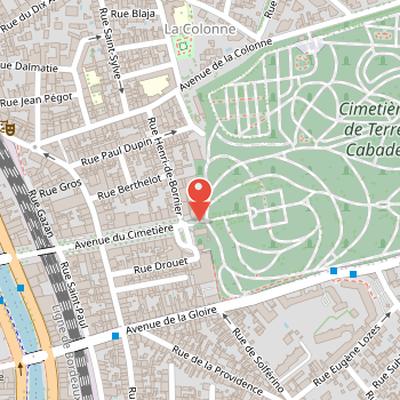
Terre-Cabade Cemetery is the largest cemetery in Toulouse, in the Midi region of France. It occupies a quadrilateral site of 33 hectares on the slope of Jolimont hill, bounded by avenue de la Colonne to the north, boulevard des Crêtes to the east, and avenue de la Gloire to the south. The main entrance is on the west, aligned with avenue du Cimetière. The cemetery is divided into two parts by chemin de Caillibens.
The site contains many graves and vaults, and it includes the burial places of numerous local political and artistic personalities. It also contains several war memorials dedicated to the victims of the great wars of the 20th century. Its name likely comes from the Occitan terra cavada, meaning “excavated earth,” a reference to the former brickyards that once occupied the area and to the clay extraction carried out there.
The cemetery was planned as a central cemetery in 1824, and the municipal council decided in 1832 to establish it beyond the canal du Midi. First burials took place by 1834, and major construction began in 1838, including the boundary wall. A monumental neo-Egyptian gate was inaugurated a few weeks after a decree ordering the closure of Catholic cemeteries on the right bank and the transfer of graves to Terre-Cabade.
Nearby Objects
-
 Église Saint-Aubin 500 m away
 -
 Médiathèque José Cabanis 500 m away
 -
 Halle aux Grains 900 m away
 -
 Place Dominique-Martin-Dupuy 900 m away
 -
 Monument aux combattants de la Haute-Garonne 1000 m away
Layout and Notable Burials
Le cimetiere Terre Cabade is the largest cemetery in Toulouse, in the Midi region of France. It is located on the slope of Jolimont hill and covers a quadrilateral area of 33 hectares. Its boundaries are defined by avenue de la Colonne to the north, boulevard des Cretes to the east, and avenue de la Gloire to the south. The main entrance is on the west, aligned with avenue du Cimetiere. The cemetery is divided into two parts by chemin de Caillibens.
The site contains approximately an unspecified number of graves and vaults. It is also the burial place of many local political and artistic personalities. In addition, it includes several war memorials dedicated to victims of the great wars of the 20th century, giving the cemetery a notable commemorative role within the city.
Origin of the Name
The name Terre Cabade likely comes from the Occitan terra cavada, meaning excavated earth. This explanation is linked to the site history before the cemetery was opened in the early 20th century, when several brickyards were located there. Brickmakers excavated the soil at Terre Cabade to extract clay, which matches the idea of land that had been dug out. The location was therefore associated with earth removed for brick production before becoming a cemetery. The facts also note a separate historical reference to the new cemetery of Salonique, established in 1915 and named after the Greek city of Thessalonique, a name that became familiar in France during World War I through the term expedition of Salonique used for the French intervention on the Eastern front between 1915 and 1918 alongside Allied forces against the Central Powers and especially the Ottoman Empire.
Formation and Expansion of Terre Cabade Cemetery
The cemetery of Terre Cabade was first planned as a central cemetery in 1824. In 1832, the municipal council of Histoire, led by Joseph Viguerie, decided to establish it beyond the canal du Midi on the coteau des Redoutes. Between 1832 and 1846, the town hall acquired several hillside plots totaling 10 hectares. Burials began at least by 1834, and major construction started in 1838, including the boundary wall.
The cemetery then became the focus of wider municipal burial policy. At an unspecified date, mayor Armand Perpessac decreed the closure of all Catholic cemeteries on the right bank, with grave transfers to Terre Cabade. A few weeks later, the monumental neo-Egyptian gate was inaugurated. Although two additional cemeteries were planned to the north and south, these projects were abandoned for lack of space, and Terre Cabade was expanded instead.
Further enlargements followed in the second half of the 19th century. In 1859, land east of the cemetery was acquired to create a section for religious communities' graves. In 1869, the municipal council decided to transfer the Protestant and Jewish cemeteries from chemin de Bearnais for the extension of boulevard Lascrosses, and these cemeteries were moved to Terre Cabade in 1878. New parcels were purchased between 1874 and 1875 for expansion, and in 1888 another extension was decided north of the cemetery and chemin des Gongous. The related lands were acquired between 1889 and 1896. In 2015, the entrance buildings of Urbain Vitry's monumental gate were renovated.
Monumental Entrance and Memorial Landscape
The cemetery of Terre Cabade is marked by a monumental main entrance built in a neo-Egyptian style inspired by Ancient Egyptian architecture. The entrance was designed from plans drawn in 1836 by the urban architect Urbain Vitry and inaugurated in 1840. It uses local materials, including brick foraine, and is registered as a historical monument. The gate is framed by two brick obelisks topped with golden pyramidions, while two pavilions stand on either side, each adorned with brick papyriform columns and accessed by a lintelled door set behind the columns.
Beyond the entrance, the cemetery contains several monuments dedicated to specific groups of people. These include the Monument aux morts de Salonique, the Monument de la Défense de Belfort dedicated to the artillerymen of Haute-Garonne, the Monument aux morts de Philippeville by Camille Alaphilippe, the Monument commemoratif aux soldats americains, the Monument funeraire d'Aristide et Marie Berges, and the Monument du Souvenir francais. Together, these works give the cemetery a strong commemorative role in addition to its architectural interest.
Notable Burials
The cemetery of Terre Cabade includes the graves of several notable figures, especially French military officers and other public personalities. Among the buried are General Philibert Collet, who joined the Free French Forces in Transjordan in 1941, was a Grand Officer of the Legion of Honor, received the Croix de guerre 1914-1918, and served in the Special Troops of the Levant. General Barbot is also buried here; his name is engraved under the Arc de Triomphe de l'Etoile, and he served in Spain between 1808 and 1811. Another military figure is Louis Victorin Cassagne, whom Napoleon described as one of his valiant Egyptians. Cassagne was depicted in Louis-Francois Lejeune's painting The Battle of the Pyramids, fought from Italy to Egypt, remained loyal to the emperor during the Hundred Days, and received twenty-one wounds in twenty-one campaigns.
The cemetery also contains the burial place of artist Jules Jacques Labatut, whose two drawings are exhibited in the Louvre, and Jules Leotard, the inventor of the flying trapeze. Other burials include Joseph Engelmajer, founder of the Le Patriarche association for drug addiction care, and Eugene d'Hautpoul, a French politician who died while helping during the floods of 1875. The list of notable burials also includes Dominique Baudis, whose tomb is in Salonique cemetery near the tomb of Pierre Baudis.
A Place of Reflection and Local Veneration
The cemetery of Terre Cabade is described as a Toulouse cemetery that serves as a place of reflection for Catholics visiting the Occitan capital. It also contains the tomb of Hélene Soutade, who is known as the popular saint Sainte Helena. However, Hélene Soutade is not recognized by the Church. This gives the cemetery a particular place in local religious memory, combining burial function with a form of popular devotion.