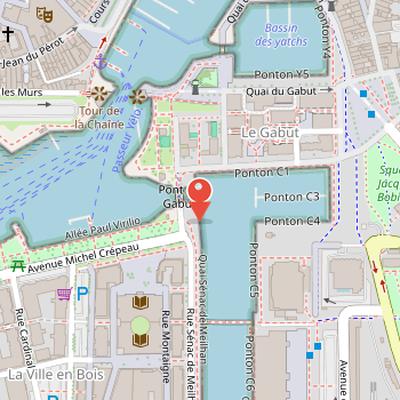
The Musée maritime de La Rochelle is a floating museum located in the bassins des chalutiers of the Vieux-Port in La Rochelle, Charente-Maritime, France. Its collection includes nine ships, eight of which are classified as historical monuments, and three of these vessels are accessible for visits. The museum also conserves about forty Petite Plaisance sailboats with the support of L’Association des amis du Musée maritime de La Rochelle. Among its heritage vessels are the two legendary sailboats Damien and Joshua.
Founded in 1988 by Patrick Shnepp, the museum was initially associative before becoming a public institution and joining the municipal museums of the City of La Rochelle. Its land-based facilities host permanent and temporary exhibitions. In 2015, the museum deployed the Galerie des pavillons, covered with large colorful spinnaker-shaped sailcloths, as part of an extension intended to present “La Rochelle née de la mer.” It also invested the large hall of the former auction to present the Petite Plaisance sailing collection and temporary exhibitions. The museum has presented the exhibition “Climat-Océan,” first shown in 2019 and updated in 2023, as well as temporary and photographic exhibitions including works presented in 2020, 2021, and 2022.
Nearby Objects
-
 Aquarium de La Rochelle 150 m away
 -
 La Coursive 400 m away
 -
 Grosse Horloge 450 m away
 -
 Église Saint-Sauveur 550 m away
 -
 La Rochelle Cathedral 800 m away
Museum setting and collection
The Musee maritime de La Rochelle is a floating museum located in the bassins des chalutiers of the Vieux-Port in La Rochelle, Charente-Maritime, France. It also includes two parts on land that host permanent and temporary exhibitions. Its collection comprises nine ships, eight of which are classified as historical monuments. Three of the ships are accessible for visits. The museum also conserves about forty Petite Plaisance sailboats with the help of L'Association des amis du Musee maritime de La Rochelle, and it operates two legendary sailboats from its heritage collection, named Damien and Joshua.
Museum Development and Recent Expansions
The history and evolution of the Musee maritime de La Rochelle began in 1988, when Patrick Shnepp launched the project. It was initially associative before becoming a public institution and joining the municipal museums of the City of La Rochelle. This institutional shift marked an important stage in the museum's development and its place within the city's cultural network.
A major step in its expansion came in 2015 with the opening of the Galerie des pavillons. The new gallery was presented with large colorful spinnaker-shaped sailcloths, and its extension was designed to present La Rochelle nee de la mer to the public. The museum also invested the large hall of the former auction venue, using it to display the Petite Plaisance sailing collection and temporary exhibitions.
In its programming, the museum has combined maritime heritage with scientific and artistic themes. Since 2019, it has presented the major exhibition Climat-Ocean, which was renewed and updated in 2023. Created with the Museum of Natural History of La Rochelle and a scientific committee, it explored links between climate mechanics and the ocean, and was complemented by temporary and photographic exhibitions. The museum also hosted Sad Sand by Yves Salaun in 2020, Allons voir la mer with Robert Doisneau in 2021, and La Mer by Arthus-Bertrand and Skerry in 2022.
France I at the Musee maritime
Flotte patrimoniale France I is the first acquisition of the Musee maritime and has been exhibited there since 1988. Launched in 1958 and built in Le Havre by the Forges et chantiers de la Mediterranee, it was based at the port of La Rochelle - La Pallice and began its first campaign on an unspecified date. The vessel served as a meteorological ship for 27 years, with its main task being the collection of meteorological data until meteorological satellites entered service in 1985.
Between 1959 and 1975, France I operated at points Kilo, Lima, and Alpha, assisting transatlantic air navigation under the International Civil Aviation Organization. In 1976, the World Meteorological Organization assigned it to station at the geostationary point R, also identified as Romeo, at 47 degrees north and 17 degrees west. It then carried out meteorological monitoring commitments for Meteo-France worldwide at sea until 1985, when its mission ended because of permanent meteorological buoys and satellite service. The vessel also performed other functions beyond meteorological observation.
At the museum, France I is moored at dock as a meteorological frigate. Its interior is open to visitors and includes many immersive elements, as well as reconstructed kitchen and office interiors and meteorological equipment. France I is classified as a historical monument since an unspecified date. After ending its last mission, it returned to the port of La Pallice for dry dock before joining the Musee maritime. Its arrival at the museum was marked by a public gathering on the quays.
L'Angoumois at the Musée maritime
Flotte patrimoniale Angoumois is a former stern trawler built in Dieppe by Ateliers et chantiers de la Manche (ACM). It was operated by SARMA, the last industrial shipowner in La Rochelle, and was one of the three last industrial trawlers still in service in 1991. After 23 years of service, it was retired in 1992 because of engine failure. SARMA then donated the vessel to the Musee maritime.
The vessel is reported by Flotte patrimoniale to be classified as a historical monument. The same source notes that L'Angoumois suffered a dock fire, and that its restored bridge and navigation walkway can be visited. These features give the ship an ongoing public role within the museum collection.
Joshua and the Maritime Heritage Fleet
Joshua is a ketch built in 1962 and named for Joshua Slocum. It is classified as a historical monument. Flotte patrimoniale records that Bernard Moitessier completed a solo one and a half circumnavigation aboard Joshua between 1968 and 1969, adding to the vessel's historical importance. The boat later suffered damage when it was torn from its mooring during a tropical cyclone in Mexico and beached. It was then abandoned to young Americans, who restored it over two years. Joshua was sold to Johanna Slee in 1984, and in 1989 she worked to return it to La Rochelle after discovering its history. After transport in a cargo hold, Joshua entered the Grand Pavois with Bernard Moitessier aboard. Today, the Association des amis du Musee maritime de La Rochelle operates Joshua for about 150 days each year for nautic events and member services.
Historic Vessels Preserved at the Maritime Museum
The collection associated with the Musee maritime de La Rochelle includes several vessels noted for their technical and historical value. Saint-Gilles is a harbor tug capable of coastal navigation, built in 1958 at Ateliers et chantiers de La Rochelle - Pallice (ACRP). It was disarmed in 1989 and entrusted to the Maritime Museum for conservation as the last French reversible engine tug. It is classified as a historical monument and also carries the Bateau d'interet patrimonial label from the Fondation du patrimoine maritime et fluvial.
Other preserved vessels include Manuel Joel, a side trawler fishery boat built in 1954 by Union Sablaise shipyards in La Rochelle, which is also classified as a historical monument. The museum is likewise associated with an all-weather lifeboat built in 1954 by Lemaistre in Fecamp, assigned to Cap Ferret station and decommissioned in 1991; this vessel is labeled as a Bateau d'interet patrimonial by the FPMF. Another vessel mentioned is Damien, used by Gerard Janichon and Jerome Poncet for a three-year circumnavigation from 1969 to 1973, including routes to Spitzberg, Antarctica, and the Amazon River; Damien has been a classified historical monument since 2002.
The TD6 dredger, built in 1906 at La Loire shipyards in Nantes and originally designed for the Loire estuary, is also classified as a historical monument. The museum collection therefore brings together working vessels, rescue craft, and expedition boats that have all been recognized for preservation.
Approved Heritage Yachts at the Museum
The Maritime Museum of La Rochelle approves certain private yachts, known as yachts priviles sous convention, to be moored near it. These vessels benefit from the port's technical advantages for repairs and restorations on the Slipway. The group includes vessels classified as historical monuments, among them Notre Dame des Flots, a wooden ketch built in 1942 for North Sea fishing. Since 1976, these yachts have belonged to the La Rochelle association C'est pas la mer a boire, which restores and uses them as charter sailing vessels.