Aquarium de La Rochelle is a family-owned public aquarium in La Rochelle, France. It has 73 display aquaria and 150 quarantine aquaria, and exhibits more than 12,000 animals representing 600 different species in 3 million litres of seawater. The aquarium welcomes an average of 800,000 visitors per year. Its tour is open every day of the year and is designed to take at least two hours. It includes observation points at children's heights, audio guides, and access by elevators intended to simulate the feeling of going deep inside the ocean.
The aquarium was announced at the second international aquarium congress in Monaco in 1988. The original aquarium was located near the marina of Les Minimes and had 36 aquaria totaling 550,000 litres. After welcoming seven million visitors in 12 years, it moved and a new Aquarium La Rochelle was inaugurated near the Vieux-Port in La Rochelle in 2001. The new aquarium was described as part of the biggest European public aquariums. Its displays include local species from the coasts of Charente-Maritime and the intertidal zone, Mediterranean fishes, invertebrates and corals, fauna from the coasts of Africa, jellyfishes from tropical and temperate waters, plankton in tube-shaped aquariums, and species from the Caribbean, alongside a recreated mangrove.
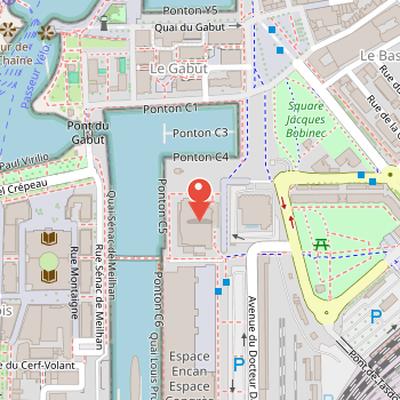
Nearby Objects
-
 Musée maritime de La Rochelle 150 m away
 -
 La Coursive 550 m away
 -
 Grosse Horloge 600 m away
 -
 Église Saint-Sauveur 600 m away
 -
 Musée du Nouveau Monde 950 m away
Aquarium Size and Visitor Profile
Aquarium de La Rochelle is a family-owned public aquarium in La Rochelle, France. It contains more than 3 million litres of seawater and has 73 display aquaria and 150 quarantine aquaria. The aquarium exhibits more than 12,000 animals representing 600 different species. It also attracts an average of 800,000 visitors each year, indicating its significant public presence in the city.
From Les Minimes to the Vieux-Port
The opening of the Aquarium La Rochelle was announced at the second international aquarium congress in Monaco in 1988. The original aquarium was located near the marina of Les Minimes and contained 36 aquaria with a total volume of 550,000 litres. It welcomed seven million visitors within 12 years. The aquarium then moved, and a new Aquarium La Rochelle was inaugurated near the Vieux-Port in La Rochelle in 2001. The new site has a surface area that places it among the biggest European public aquariums. It exhibits more than 12,000 animals of 600 different species in 3 million litres of seawater, including 1.5 million litres dedicated to the sharks area. The aquarium welcomes around 800,000 visitors per year and has become the first tourist attraction in the department of Charente-Maritime, the second in the region of Poitou-Charente, and the sixth overall tourist attraction in France.
Visitor Experience and Aquarium Layout
The Aquarium de La Rochelle is open every day of the year, and Tours states that a visit requires at least two hours. It is presented as a family-oriented tour, with observation points set at children's heights and audio guides available. Visitors access the rooms by elevators, a design choice intended to simulate the feeling of going deep inside the ocean.
The aquarium is organized into a sequence of themed spaces that display marine life from different regions. Nineteen aquariums present local species from the coasts of Charente-Maritime and the intertidal zone. Another room, made up of 12 aquariums, shows fishes, invertebrates, and corals from the Mediterranean Sea. A huge aquarium presents fauna living off the coasts of Africa, while a separate room is dedicated to jellyfishes from tropical and temperate waters, with two tube-shaped aquariums for plankton.
Five aquariums are devoted to species from the Caribbean, alongside a large terrarium showing a recreated mangrove. Elsewhere, 21 aquariums, including a giant one of 100000 litres, display fishes, invertebrates, and corals from the Great Barrier Reef and the Hawaiian and Red Sea archipelagos. Three aquariums plunged into total darkness allow visitors to observe night-time reef life, including bioluminescence, fluorescence, and light absorption.
The visit also includes views of different species of sharks from tiers. A 150000-litre aquarium displays surgeon fishes and giant trevally fishes among moray eels, a green turtle, and a scale turtle weighing 60 kg. Tours also describes a greenhouse formed by the aquarium and turtle river, where varied fauna and flora can be admired.
Research, Education, and Sea Turtle Conservation
Aquarium de La Rochelle combines education, scientific research, and conservation through a structured program of activities. Each year, its research and educational activities welcome 13,500 primary and secondary pupils and offer 25 activities. These programs are supported by a practical activities room, an activities room, and an amphitheatre with 50 seats. The aquarium also operates the Care and Studies Centre for Sea Turtles, known as CESTM, which takes charge of sea turtles washed up from the Atlantic arc to the Opal Coast. Once recovered, the turtles are released back into the sea. From 2000 to 2011, 112 turtles were healed and released.
The CESTM works to preserve species through scientific research and to improve understanding of sea turtle behaviour in order to contribute to their protection. Its work receives support from the Ministry of Ecology, Sustainable Development and Energy. Since 2008, the research and educational activities have also run a satellite monitoring program for young Loggerhead sea turtles. Before release, an electronic chip is implanted in a flipper, allowing their movements to be tracked in real time. The program studies sea turtle movement in the Gascony gulf and is carried out in partnership with the Aquarium of La Rochelle and Oceanopolis in Brest.
Beyond sea turtle research, the aquarium reproduces about twenty marine species and grows different types of corals in 150 quarantine aquariums to avoid taking samples from the natural environment.