The Musée des Arts décoratifs, de la Faïence et de la Mode, also known as musée Borély, is open to the public in Château Borély on Avenue Clot-Bey in Marseille. The museum is presented through a series of interior rooms whose decorative features form part of the visit. In the ground-floor rooms, an interior void staircase begins in the entrance vestibule, where a modern chandelier designed by Mathieu Lehanneur illuminates the space. The same area includes a cabinet on a pine wood base with ebony and blackened pearwood veneer, with doors decorated by bas-reliefs showing mythological scenes. Other rooms display two Lunéville faience statues from 1770 to 1775 representing Flore or Le Printemps and Cérès or L’Été. The grand salon, located in the bastide avant-corps and opening onto the park through three French doors, contains plaster decorations, 18th-century blue and white faience, polychrome panels by Louis Chaix, and paintings attributed to Philippe Rey depicting maritime activities on the Marseille coast. The museum also recalls the production of faience in Marseille since 1679.
Nearby Objects
-
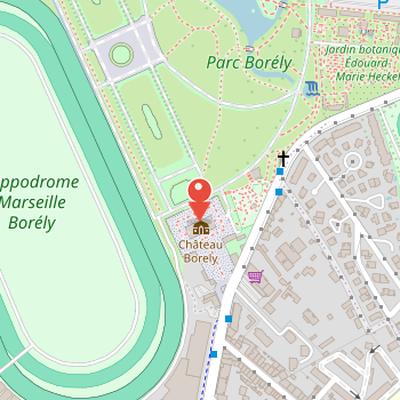
 Château Borély 0 m away
 -
 Statue of David 750 m away
 -
 Mosquée de l'arsenal des galères 850 m away
 -
 Cathédrale des Saints-Traducteurs 1600 m away
 -
 Mazargues Obelisk 1900 m away
Mus e Bor ley and Its Setting
The Musee des Arts decoratifs, de la Faience et de la Mode is also known as the musee Borely. It is open to the public in chateau Borely, on avenue Clot-Bey in Marseille. The site is identified both by its formal museum name and by its common local name, reflecting its association with the chateau where it is housed.
Ground Floor Interior Features
The ground-floor rooms include an interior void staircase that begins at the entrance vestibule, repere 1. The staircase features a forged iron ramp start topped by a gilded plumed helmet on a Hercules club, with the club base surrounded by a bundle of rods resembling Roman lictors' fasces. In the entrance vestibule, the space is lit by a modern chandelier designed by Mathieu Lehanneur. The same vestibule also displays a cabinet set on a pine wood base with ebony and blackened pearwood veneer.
Decorative Rooms on the Ground Floor
The ground-floor rooms form one of the most richly decorated parts of the castle, alongside the 17th-century chapel, and their decoration was carefully restored during the castle's closure so that it could be brought back almost identically. Several spaces combine architecture, painted ornament, ceramics, and period furniture to present the atmosphere of an elite residence.
In the rooms of the ground floor, cabinet doors are decorated with bas-reliefs showing mythological scenes. Two Luneville faience statues dated 1770 to 1775 represent Flore or Le Printemps and Ceres or L'Ete. The grand salon, located in the bastide avant-corps and opened by three French doors toward the park, has plaster decoration on the ceiling with floral garlands and laurel crowns above the doors. Above the entrance door, plasterwork shows two nude female figures flanking a vase with a bacchic dance. This room also contains four display cases of 18th century blue and white faience, recalling the long local tradition of this material, including the blue-decorated tin-glazed earthenware produced in Marseille since 1679 by Joseph Clerissy, as well as the faience manufacture founded by Joseph Clerissy in the Saint-Jean-du-desert quarter and the parallel manufacture opened by Pierre Clerissy in Moustiers.
Another room, identified as repere 3, has plaster decoration covering the upper part of the walls and two door tops decorated with polychrome panels painted by Louis Chaix. These panels are dedicated to the heroes of La Jerusalem delivree, Renaud or Rinaldo and Armide, and show the theme of Armide seducing Renaud and holding him in enchanted gardens. The decorative theme was inspired by artists including Pierre de Cortone and Le Guerchin.
The dining room contains large tempera paintings attributed to Philippe Rey, depicting maritime activity on the Marseille coast. The scenes include the return from fishing, the landing of a boat, entry to the port of Marseille, line fishing, and net raising. In the center of the room, a table is set to represent a reception from the Borely era. Its service comes from Joseph Fauchier's factory and includes a centerpiece and 21 plates with mythological or Don Quichotte themes. The table also carries a pair of silver candlesticks and an artichoke-shaped sauce boat from Gaspard Robert's factory. Two small consoles at the back hold stemmed glassware service, while the fireplace is surmounted by a mirror with a pair of potpourris from la fabrique de la veuve Perrin and another pair of candlesticks. The room is illuminated by a modern chandelier composed of 25 carafes.
The cabinet des bains includes a small rest alcove marked repere 4 and a bathroom with bathtub marked repere 5. It is associated with an advanced water supply system inside Borely castle. The alcove displays sixteen miniature paintings under glass representing a range of characters, including Incroyable, Merveilleuse, Mademoiselle Duclos, the Duke of Berry and the Duke of Artois in their future royal identities, Miss Chance, Miss Fortune, a woman with a straw hat, one male portrait, and two female portraits. The bathroom contains a collection of perfume or salt bottles made of crystal, opaline, or glass with varied shapes and decorated stoppers. The salts are mostly composed of ammonium carbonate and were used to revive fainted persons.
A salon marked repere 6 was used for receptions and looks toward the north facade and the gardens of the park. It contains a very long sofa with eight cushions, called a radassiere in Provence, and above it hangs L'Enlevement des Sabines by Louis Chaix after Pierre de Cortone. On the left stands a gilded wooden console with a marble top and mirror, supporting gilt bronze candlesticks and a pair of covered porcelain vases from China with famille rose. On the right is a marble fireplace decorated with a cartel in bronze, enamel, and wood, flanked by covered vases in Japanese porcelain. The salon also includes two game tables for trictrac and ten queen's armchairs in gilded wood covered with tapestry. The ceiling is decorated with a large composition representing L'Apotheose de Psyche by Louis Chaix.
The gallery occupies the entire west facade of the chateau and has five windows opening onto the sea.
The History of Tobie Paintings
The Salles du rez-de-chaussee gallery displayed a number of paintings, including a series on The History of Tobie by Pierre Parrocel. This group consisted of sixteen works commissioned by the Duke of Noailles and executed partly in Avignon and partly at Saint-Germain-en-Laye. Their later history was recorded by Etienne Parrocel in Les annales de la peinture. According to this account, the Duke put the paintings up for sale after Louis XV disliked them during a hunt in the forest of Saint-Germain-en-Laye. They were then purchased in Paris in 1770 by Louis-Joseph Denis Borely for 6000 livres, although they had originally cost the Duke 12000 livres.
Ground-Floor Rooms and Collections
The ground-floor rooms present a focused view of Marseille faience and related decorative arts, with a particular emphasis on production from the first half of the 18th century. The gallery displays faience pieces characterized by homogeneous production and a high quality white shiny enamel, and it also includes works from Moustiers-Sainte-Marie near Digne-les-Bains. The collection reflects the demand for faience among the nobility and bourgeoisie, and it shows the remarkable growth of this art in the 18th century.
Several manufacturers are represented. The first factory of Pierre Clerissy, founded in 1679, appears alongside the Olerys-Laugier manufacture, established by Joseph Olerys and Jean-Baptiste Laugier in 1738. Joseph Olerys is represented by a polychrome motif of garlands and medallions with jasmine flowers or grotesques. Other examples include faiences by widow Perrin and Honoré Savy, as well as pieces connected with Gaspard Robert. The displays bring together shapes and animated details from different manufactures and include rocaille decor by Joseph Fauchier.
The room layout contributes to the presentation. Four display cases are placed between five windows of the west facade and are themed on faience subjects, including green choice by Gaspard Robert and fish decor by widow Perrin and Honorore Savy. Two long display cases stand against the wall facing the west facade beside a Louis XVI style marble fireplace, and they compare numerous variations of floral theme faience. A central long table presents works of high technical and artistic quality.
Room 8 was originally a salon and still retains several decorative features from that earlier use. The door tops are decorated with paintings or grisaille dedicated to Apollo and Diana. Between two windows there is a mirror with a gilded wooden frame featuring Apollo's attributes, including a lyre framed by two swans. Opposite the windows, a fireplace is topped by a mirror with a medallion of the nymph Melia, framed by oak and laurel leaf garlands. The walls are covered with a large polychrome leather tapestry of Italian origin from around 1710, which came from a salon of the villa Luce on boulevard Michelet in Marseille.
Room 9, on the south side facing the courtyard, contains restored wall plasterworks representing the five senses. Five medallions framed by garlands depict putti illustrating the senses through activity and objects. A plasterwork between the windows shows Time, with a Cupid on a cloud presenting an hourglass with a sickle to a bearded winged old man holding a drapery. The room also exhibits porcelain from the Pierre and Lison Jourdan-Barry collection, including Marseille porcelain favored by the Marseille aristocracy and often decorated with landscapes and figures. This porcelain was mainly made by the workshops of Gaspard Robert and Antoine Bonefoy. The pieces shown include an ewer and oval basin, coffee pot, chocolate pot, broth bowl, cups and saucers, dragree box, and sugar bowls.
First-Floor Interiors and the Chapel
The first-floor rooms are organized around a main staircase rising from the ground floor and opening onto hall repere 10. The staircase walls are decorated with six niches containing painted statues of female figures from Antiquity, while sixty-four plates by Magdalena Gerber are displayed on the wall facing the stairs. Above, the ceiling painted by Louis Chaix shows Apollon, inspired by Guido Reni's L'Aurore, and it was restored in 2012-2013.
Among the principal spaces is a large salon, repere 11, located above the ground-floor billiard room and used for temporary contemporary art exhibitions. Nearby, chamber repere 12 on the north facade, close to the chapel, preserves original decorations and grisaille overdoor paintings. Its walls are covered with Indian or palempore panels featuring a tree of life design. The room also contains a carved and painted wooden duchesse bed facing the window, the most precious furniture of the castle, including a tomb commode decorated with grotesques, a second commode, a dressing table, and several seats such as a small straight sofa, two low-backed armchairs called coin de feu, bergeres, and cabriolets. Some seats are covered with Indian fabrics specially reprinted for the museum. On the left side of the chimney are three Sevres porcelain heads, decorated with gold, silver, and pink by the contemporary artist Francoise Vergier in 2005.
The first floor also contains an invisible chapel in the north-east corner of the bastide, without any window. Dedicated to Saint Louis, patron saint of Louis Borely and his son Louis-Joseph Borely, it is baroque in style. Its ceiling is an ovoid dome on a wooden framework, with simple painted panels replacing the fresco originally planned by Louis Chaix. The chapel includes four marble bas-reliefs by Jean Joseph Foucou depicting episodes from the life of Saint Louis, as well as a marble opus sectile floor decoration. The main altar front features a bas-relief by Filippo della Valle representing a Mise au tombeau, and the altar carries an eighteenth-century faience Christ statue from Joseph Fauchier's Marseille workshop.
The First Floor Rooms
The first floor of the museum combines historic domestic architecture with decorative arts displays. The alcove bedroom is notable for its rounded corners, a painted ceiling with putti, and decorative door tops. In this room, the collection includes a Japanese rosewood cabinet with mother-of-pearl and ivory inlays from the 19th century, a French embroidered silk screen, two Indo-Portuguese wooden and leather armchairs, Chinese stools and saddles, and a pair of lidded Imari porcelain vases from Arita. Two circular faience plates from the Clerysse factory at Saint-Jean du desert and four glass paintings are also hung on the walls.
Other first-floor spaces present a broad range of objects from the 18th and 19th centuries. The rooms display an 18th-century commode, two exceptional pieces in porcelain and faience, and objects such as a Chinese woman with a movable head, a Japanese vase, a Bodhisattva, and a lidded porcelain vase from Imari, Japan. Drawings from Maurice Feuillet's collection are shown in the corridor leading to the alcove bedroom; Maurice Feuillet and his spouse bequeathed 253 18th-century drawings by artists including Francois Boucher and Jean-Honore Fragonard.
The arrangement of the rooms also preserves notable architectural features. The first floor retains its original library despite the dispersion of books made there, and room 20 was the working cabinet of Louis-Joseph Denis Borely, who completed the chateau construction and decoration. The space includes eight vitrines flanking a simple grey marble fireplace topped with a mirror with golden patterns. The vitrines are framed by fluted pilasters with Ionic capitals and decorated below with grisaille panels imitating Ancient bas-reliefs. Three panels are inspired by the Noces aldobrandines, while others depict scenes such as the assembly of gods around Jupiter, two muses around a lyre, the transport of a dead person, comedy troupe preparations, and the celebration of the Bacchus cult. The painted ceiling shows Apollo, god of arts, surrounded by nine muses, and two overdoor panels present Ancient scenes with putti lifting drapery and medallions. The first floor now serves as a multimedia office, and it was modified in the 1970s to add stairs giving access to the second floor, which is closed to the public.