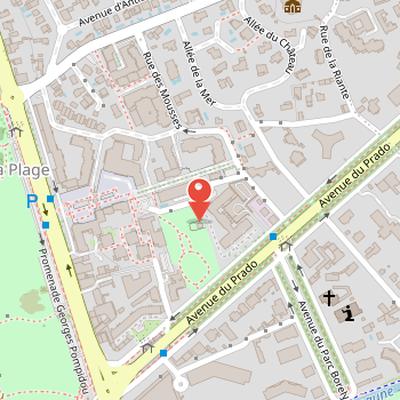
The Mosquée de l’arsenal des galères, also known as the mosque of the Turkish galley slaves, is located in Parc Valbelle in Marseille, France, at 584 avenue du Prado. It was long considered a remnant of the former mosque of the arsenal cemetery of the galley slaves, described as the burial place of ‘Turcs esclaves du roi’ and convicts. According to the available facts, the original complex was constructed for Ottoman slaves and convicts at the beginning of the 18th century. It included a mosque and associated structures, and it was later gradually occupied by the artillery arsenal around 1792.
The present monument has undergone several transfers and changes of ownership. It was transformed into a kiosk and was identified as a private chapel constituted in 1927 by industrialist Paul Rouvière. Its fabric also incorporates remains from a villa destroyed in 1926 at 291 rue Paradis, as well as stones from the second floor of the Kiosque Bonaparte, an oriental-style guinguette built in 1860–1861 and destroyed in 1885. The site is inscribed as a monument historique as a mosque and serves as a memorial trace of the mosque, galley slaves, and slaves in France.
Nearby Objects
-
 Statue of David 300 m away
 -
 Château Borély 850 m away
 -
 musée Borély 850 m away
 -
 Cathédrale des Saints-Traducteurs 1200 m away
Mosque of the Arsenal of the Galleys
The Mosquee de l'arsenal des galeres, also referred to as the mosque of the arsenal of the galleys or the mosque of the Turkish galley slaves, is a monument located in Parc Valbelle in Marseille, France. The available facts identify it as a named heritage object associated with this park setting, but provide no further details on its architecture, date, or later use.
History and Later Reuse
The Mosquee de l'arsenal des galeres was long considered a remnant of the former mosque of the arsenal cemetery of the galley slaves known as Turcs esclaves du roi, and of convicts. According to the available facts, it was constructed for Ottoman slaves and convicts at the beginning of the 18th century. After multiple transfers and ownership changes, it was transformed into a kiosk. It is located in Valbelle park at 584 avenue du Prado. It is also identified as a private chapel constituted in 1927 by the industrialist Paul Rouviere. This later form was created using remains of a villa at 291 rue Paradis that was destroyed in 1926, and it contains stones from the second floor of the Kiosque Bonaparte. The Kiosque Bonaparte was an oriental-style guinguette built in the Colline garden by civil engineer Leon Cahier in 1860-1861 and destroyed in 1885.
Location and Layout of the Mosque Complex
The mosque and associated Muslim cemeteries were first located near the intersection of rue Sainte and rue de la Paix Marcel Paul between 1691 and 1698. Between 1723 and 1725, the site was moved to a walled plot of 540 toises carrees, acquired and enclosed by the confrerie de la Redemption des captifs inside the block between cours Pierre-Puget and rue Roux de Brignoles, south of place Monthyon. According to Francois-Noel Laurent Levasseur de Villeblanche, the complex included a mosque, a well, a shed for funeral devotions, and a room for lime and burial tools. Jean-Baptiste Grosson noted in 1777 that there was also a small building at the back used by Turkish galley slaves for prayer. Around 1792, the cult complex was gradually occupied by the artillery arsenal, despite the general council's decision to free the old cemetery.
Memorial Trace and Historic Listing
The Inscription et trace memoirelle was inscribed as a monument historique as a mosque. It is described as a memorial trace of the mosque, galley slaves, and slaves in France. The record notes 2040 Turks as slaves or captives among the oarsmen of the French Galleys from 1680 to 1696. It also states that Turks were registered in the galley records between 1682 and 1707 over a period of 26 years.