The Mazargues Obelisk is a commemorative monument located in the Mazargues district of Marseille, France. It was originally erected in 1811 in the centre of Place Castellane to celebrate the Napoleonic Empire and the birth of Napoléon II, titled King of Rome. Commissioned by the city of Marseille under Mayor Antoine-Ignace Anthoine, it was designed by architect François Michaud, who served as director of public works in Marseille from 1807 to 1812. The monument was created during a period when the city sought neoclassical monuments to affirm its status as a modern city.
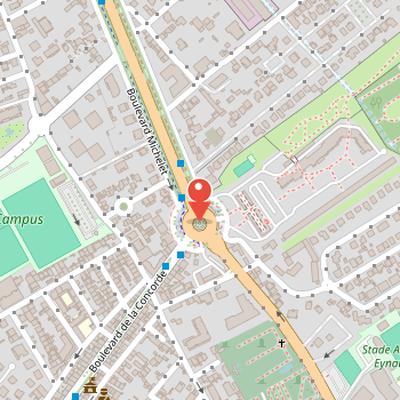
In 1911, the obelisk was dismantled and transferred in a single block to Mazargues to make way for a monumental Carrara marble fountain offered by Jules Cantini. It was then placed at a roundabout called Place de la Concorde. The obelisk is approximately 12 metres high including its base and is entirely carved from Cassis stone, a local limestone known for its hardness and cream colour. Its smooth surfaces and unadorned pyramidion reflect a restrained French neoclassical style, and it lacks the Egyptian hieroglyphs found on the original in Luxor in Paris. The monument was also registered as a historical monument by decree.
Nearby Objects
-
 musée Borély 1900 m away
 -
 Château Borély 1900 m away
Relocation and Historical Context
The Mazargues Obelisk is a commemorative monument located in the Mazargues district of Marseille, France. It was originally erected in 1811 on Place Castellane to celebrate the Napoleonic Empire. In 1911, the monument was moved to its current location. Its history is therefore defined by both its original commemorative purpose and its later relocation within the city.
Commission, Design, and Relocation
The Mazargues Obelisk, referred to in the facts as Historique, was commissioned by the city of Marseille under Mayor Antoine-Ignace Anthoine to celebrate the birth of Napoleonic II, titled King of Rome. It was designed by architect Francois Michaud, who served as director of public works of Marseille from 1807 to 1812. The monument was erected in the center of Place Castellane on an unspecified date, during a period when Marseille sought neoclassical monuments to affirm its status as a modern city. Later, it was dismantled and transferred in a single block to the Mazargues district to make way for a monumental Carrara marble fountain offered by Jules Cantini. The monument was then placed at a roundabout called Place de la Concorde in Mazargues. It was also registered as a historical monument by decree on an unspecified date.
Design and Material
The Mazargues Obelisk measures approximately 12 meters in height, including its base. It is entirely carved from Cassis stone, a local limestone valued for its hardness and cream color. Its surfaces are smooth, reflecting the French neoclassical style of the 19th century. Unlike the original in Luxor in Paris, it does not bear Egyptian hieroglyphs on its faces. The pyramidion is also free of religious engravings, which gives the monument a restrained and minimalist appearance.