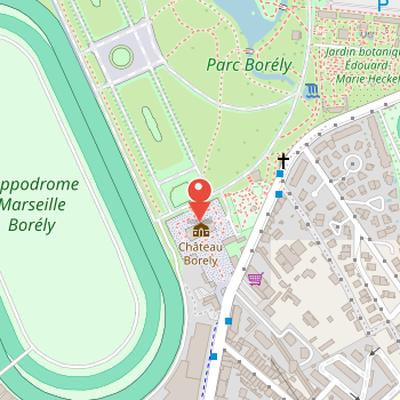
Château Borély is a neo-classical château-bastide located in the Bonneveine district of the 8th arrondissement of Marseille, in Bouches-du-Rhône, Provence-Alpes-Côte d'Azur. It is associated with Parc Borély and the hippodrome-golf Marseille Borély. The château has been classified as a historic monument since 1936, and its entire estate, except the already classified château, is subject to registration by decree.
The history of the estate is linked to the Borély family, descended from a wealthy maritime trading family in Marseille. During the reign of Louis XIV, Joseph Borély purchased a domaine-bastide-fermier and viticole in Bonneveine from Alzéar d'Antoine. The estate later passed to his descendants, including Nicolas and Louis Borély, who developed the family holdings. Louis Borély commissioned architect Charles-Louis Clérisseau to design the château, later simplified by local architect Marie-Joseph Peyre. The completed building was finished by Louis Joseph Denis Borély and decorated with the help of painter Louis Chaix. The château is described as having three levels, two pavilions, a large courtyard, a rear portal, richly decorated rooms, and a private marble oval chapel.
Nearby Objects
-
 musée Borély 0 m away
 -
 Statue of David 750 m away
 -
 Mosquée de l'arsenal des galères 850 m away
 -
 Cathédrale des Saints-Traducteurs 1500 m away
 -
 Mazargues Obelisk 1900 m away
Location and Heritage Status
Chateau Borely is a neo-classical chateau-bastide located in the Bonneveine district of the 8th arrondissement of Marseille, in Bouches-du-Rhone, Provence-Alpes-Cote d'Azur. It is associated with Parc Borely and the hippodrome-golf Marseille Borely. The chateau has been classified as a historic monument since 1936. In addition, the entire estate, except for the already classified chateau, is subject to registration by decree.
Borely Family Estate and the Construction of the Chateau
The history of Chateau Borely is closely tied to the Borely family, who descended from a wealthy maritime trading family in Marseille. During the reign of King Louis XIV, Joseph Borely bought a domaine-bastide-fermier and viticole in Bonneveine from Alze ar d'Antoine. The estate stood on the site now occupied by Parc Borely and the Marseille Borely golf course, and it overlooked the Mediterranean Sea, the Frioul islands, and Chateau d'If. The family had already gained prominence in Marseille: Joseph Borely's brother Francois became the city's first alderman in 1684.
Joseph Borely's sons Nicolas and Louis later lived in Alexandria, Egypt, where they managed a Marseille import trading post dealing in wheat, rice, silk, and oil for soap making. Nicolas became alderman of Marseille in 1747 and was ennobled in 1753 by King Louis XV. He also built a mansion near Marseille's Old Port at rue Vacon and rue Saint-Ferreol. Louis returned to Marseille in 1755 and enlarged the Bonneveine estate by acquiring neighboring properties, including La Tirane, La Michele, La Dumone, and La Valbelle by 1764.
Louis then commissioned architect Charles-Louis Clerisseau to build a chateau intended to be emblematic of the Borely family. He later asked the local architect Marie-Joseph Peyre to simplify Clerisseau's facade design. The resulting building had three levels with two pavilions, a large courtyard, a rear portal, richly decorated rooms, and a private marble oval chapel. Louis's grandson Louis Joseph Denis Borely completed the construction and hired the painter Louis Chaix for the decoration. After Louis Joseph Denis Borely died childless in 1819, the estate passed to Honor e Borely, who maintained the chateau and expanded its library. Honor e Borely left the chateau during the French Revolution and later recovered it intact. After his death in 1829, the only daughter, Louise-Jeanne-Marie Borely, inherited the castle and all its properties.
Transfer of Ownership to Marseille
After Louise-Jeanne-Marie Borhely married Count Pierre Leandre de Mark-Tripoli de Panisse-Passis, the count retained the castle and enriched its art collections. The property later passed to their son, Marquis Gaston de Panisse, who did not live in Marseille and did not wish to keep Chateau Borely. This led to negotiations by Paulin Talabot, resulting in a tripartite agreement with the city of Marseille that was approved by the Municipal Council. In 1856, Marquis Gaston de Panisse exchanged Chateau Borely for compensation and land in the Chartreux sector. The planned railway lines and the extension of the Marseille port did not go through the southern city coastline, and the city of Marseille then bought the castle in 1860.
From Historic Estate to Public Cultural Site
Chateau Borely has undergone a series of changes that shifted it from a historic estate into a public cultural and recreational site. The city arranged an hippodrome and Parc Borely at Chateau Borely and opened them to the public. The central original domain area was transformed into the hippodrome-golf Marseille Borely, which opened on April 11, 1905. Parc Borely itself opened as a public garden in 1864 and was transformed between 1860 and 1880. It was designed by Adolphe Alphand, a collaborator of Baron Haussmann, and covers 17 hectares.
The castle also played an important museum role. From 1856 to 1989, the historic castle housed the Marseille archaeology museum, which then transferred in 1989 to the Mediterranean archaeology museum at Vieille Charite in Marseille. Since 1936, Chateau Borely has been listed as a historic monument. A tese, or dove cote, still exists in the park, adding to the estate's historic character.
A major restoration began in 2009 for Marseille-Provence 2013. The project aimed to display most of the original decor, including the golden salon, library, bedroom, grand staircase, and chapel. After the restoration, the Musee des Arts decoratifs, de la Faience et de la Mode, previously located in Chateau Pastre, moved to Chateau Borely, reinforcing its role as a public museum site.