Château Thorenc is a château domain built around 1870 for the Duchess of Bedford. It later belonged to the Duchess of Montrose, and in 1876 Sir Richard Atwood Glass resided there. The grounds also underwent changes, including the replacement of the playground with a lawn tennis court. In 1896, head gardener Denis Troncy, who replaced Lucien Lhotte, made further modifications for Lord Rendel. The cryptoporticus at Thorenc was likely built around this period. The remainder of the Thorenc domain was divided in 1923. In 1926, the new owner divided the château into two villas by removing the central part. The West villa was modified between 1928 and 1930 on commission from automobile pioneer Albert Neubauer. The château was later reconstructed by architects Louis Süe and Léon Le Bel, with Jean-Baptiste Dental, and painter Jean-Gabriel Domergue created Venetian salon decorations inside the building.
Nearby Objects
-
 Observatoire de Super-Cannes 1500 m away
 -
 Église Notre-Dame-de-Bon-Voyage 1700 m away
 -
 Promenade de la Croisette 1700 m away
 -
 Palais des Festivals et des Congrès 1700 m away
 -
 Municipal Casino of Cannes 1800 m away
The Riouffe Family and the Origins of Chateau Thorenc
The lands of Thorenc were acquired in 1832 by Sebastien de Riouffe, baron de Thorenc. He was born in Antibes and died in Paris, and his family history connects the site to a longer line of local and military service. His ancestor Jean Riouffe came from a family of Cannes fishermen. Born in Cannes, Jean Riouffe married his cousin Jeanne at the age of 23 and later became a judge at the parliament of Aix during the siege of Toulon. He was ennobled by Louis XIV in 1709 after delivering a wheat shipment to Toulon, after which he took the name Jean de Riouffe. About twenty years later, he was named chevalier of the order of Saint-Louis, and he died in 1748. Sebastien de Riouffe himself entered the naval artillery corps at the age of 15, became a squadron leader, took part in the 1813 retreat from Moscow, and was wounded and captured at the Battle of Leipzig before being released in 1814. He is interred at Montmartre Cemetery, division 5.
Thorenc Castle Domain and Later Alterations
The Thorenc castle domain was built around 1870 for the Duchess of Bedford. Sir Richard Atwood Glass resided there in 1876, and the property later belonged to the Duchess of Montrose. In 1896, head gardener Denis Troncy replaced Lucien Lhotte and carried out modifications for Lord Rendel. The playground at the domain was replaced by a lawn tennis court, and the Thorenc castle cryptoporticus was likely built around the same time as Troncy's work. The remainder of the Thorenc domain was divided in 1923, and in 1926 the new owner split Thorenc castle into two villas by removing the central part.
Reconstruction and Later Adaptation
Between 1928 and 1930, automobile pioneer Albert Neubauer commissioned Francois Arluc to modify the West villa. The castle was then reconstructed by the architects Louis Sue and Leon Le Bel, both from Grasse, together with Jean-Baptiste Dental. Inside the castle, painter Jean-Gabriel Domergue created Venetian salon decorations, adding a distinct decorative element to the interior. In 1932, Charles Legrand and Leon Le Bel designed the new gate and the West concierge, further shaping the site's built ensemble.
The castle also had a notable period of residence and social visibility in the 1930s. Emperor of Annam Bao Dai lived there in 1937, and he was frequently seen in Cannes riding a Vincent H.R.D. sidecar. During his ownership, he also hired the Nice-based Paris decorator Jacques Courtois. Bao Dai kept the castle until the early 1960s.
In 1968, architect Offenstein replaced the house with a building, and the Thorenc domain was transformed into a modern luxury condominium complex. The complex now contains many upscale apartments and retains its original grand entrance. The botanical park at the Thorenc domain was also preserved, maintaining a key landscape feature of the site.
The landscaped park of Chateau Thorenc
In 1870, the park at Chateau Thorenc covered thirty-six hectares in the Terrefial district, extending from Pezou hill to the communes of Cannet and Vallauris. Its planting combined tropical vegetation in the lower area with large pine and oak woods in the upper area. The grounds also included orange, lemon, and olive tree cultivations owned by the Duchess of Bedford.
In 1889, the Duke and Duchess of Montrose had the park arranged in the English style with the work of 150 laborers over six months. The redesigned grounds were organized around a winding avenue running from the southeast gate to the castle. A large terrace supported by a cryptoporticus formed one of the main architectural elements, while an eastern nymphaeum, held up by imposing columns, was preserved.
Below the terrace, the landscaped garden included a fake river, ponds, a lake, artificial rocks, and a tea house. Other parts of the estate were devoted to service and agricultural uses, with stables, coach houses, and a vegetable garden growing a special variety of small peas called Merveille d'Amérique in the west. To the north were a pigeonnier, a henhouse, a cowshed, and a dairy. The park also contained a ravine decorated with artificial rock formations, suspension bridges, and jets of water. The city of Cannes later renamed Avenue Montrose in honor of the owners of the park.
Heritage Status and Setting
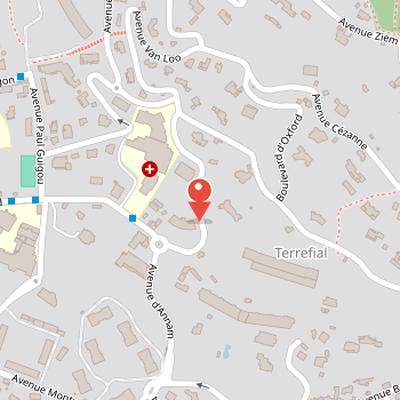
Patrimoine culturel records Chateau Thorenc as a private property in Cannes, located at 38 boulevard d'Oxford and 12 avenue d'Annam. The listed ensemble includes the park, the ornamental garden, and its nymphaeum. In 2009, Chateau Thorenc was inscribed in the general inventory of cultural heritage of the Provence-Alpes-Cote d'Azur region. It is also included in the inventory under the category of seaside heritage.