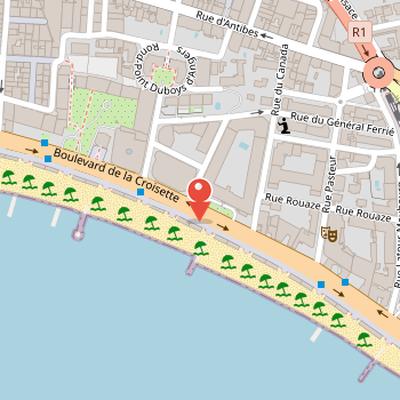
Promenade de la Croisette is the seaside promenade associated with the boulevard de la Croisette in Cannes, in the south of the French commune in the Alpes-Maritimes department, Provence-Alpes-Côte d’Azur. It follows the Bay of Cannes along the beaches and forms part of a larger road that includes both an avenue and a promenade of the same name. The route begins in the Centre-Croisette district, after boulevard de la Pantiero, and ends at Place Franklin-Roosevelt in the Pointe Croisette district. Along the way, it is bordered by historic buildings, luxury shops, flowerbeds, plants, shaded trees, and public seating. On the sea side, it includes a cycle path and a wide sidewalk. The promenade is also linked with jetée Albert-Edouard, the port area, and other nearby public spaces. The name Croisette is derived from a small cross once located at the tip of the cape, a place that remained associated with local devotion and processions in the medieval period.
Nearby Objects
-
 Église Notre-Dame-de-Bon-Voyage 700 m away
 -
 Municipal Casino of Cannes 700 m away
 -
 Palais des Festivals et des Congrès 750 m away
 -
 St. Michael the Archangel Church 1100 m away
 -
 Marché Forville 1200 m away
The Croisette in Cannes
The boulevard de la Croisette is a road in Cannes that includes both an avenue and a promenade of the same name. It runs along the beaches on the bay of Cannes and is lined with numerous hotels, luxury shops, and vacation residences. As a result, it serves as a major location for events and tourism on the Cote d'Azur.
Origin of the Name and Early Use
The name of Promenade de la Croisette is derived from a calvary, a small cross erected at the tip of the cape by seafarers. The ruined base of this cross was still visible at the end of the 14th century. Residents of Cannes venerated the small cross, and penitents' brotherhoods attended processions near it. In 1369, the cape was named de la croix, and by the mid-15th century the extreme part of the cape was commonly called Croisette. The avenue and its promenade lead to the tip where the small cross was located.
Location and Access
The Promenade de la Croisette is located in the south of the French commune of Cannes, in the Alpes-Maritimes department of the Provence-Alpes-Cote d'Azur region. It starts in the Centre-Croisette district, following boulevard de la Pantiero, and ends at Place Franklin-Roosevelt in the Pointe Croisette district. At its beginning, it is bordered by place du General-de-Gaulle and square Merimee. Along the route, it is framed by historic buildings and luxury shops, reflecting its urban and commercial character.
The promenade also includes jetee Albert-Edouard on the right side near the Vieux-Port in the Centre-ville - Croisette district, and the quais du port Pierre-Canto on the opposite side in the Pointe Croisette district. On the sea side, it is bordered by a cycle path and a wide sidewalk that form the namesake promenade along the Bay of Cannes.
Layout and Connected Public Spaces
The Promenade de la Croisette is located between the beach and the boulevard in Cannes, running adjacent to the boulevard. On the boulevard side, it includes flowerbeds, plants, and shaded trees along the parking areas and the central reservation that separates the traffic lanes. On the sea side, it has kiosks, benches, chairs, trees, and four permanent chessboards on tables facing the Malmaison. The promenade also includes Les chaises Bleues facing the Carlton hotel and red lights projected on the ground by projectors along the railing.
Its course connects with a wider network of nearby public spaces. It continues from the promenade of jetee Albert-Edouard and links to promenade Robert-Favre Le Bret behind the Palais des Festivals et des Congres and to esplanade Georges-Pompidou opposite the auditorium Louis-Lumiere of the Palais. It is followed by square Reynaldo-Hahn, which features a children's garden and a carousel, and continues toward Pointe Croisette past the rose garden of square du Huit-Mai-1945, port Pierre-Canto, square de Verdun, and port de la Pointe Croisette. Other features along or near this route include a fountain, a rose garden called Roseraie, a monument to Georges Pompidou, a monument to Christian X, a monument to Edouard VII, and a park near the port with massifs, pergolas, and a monument to General de Gaulle.
Beachfront Layout and Public Access
The Situation et acces of the Promenade de la Croisette includes a vertical retaining wall that separates the promenade from the beach. Access to the shoreline is provided by stairs and ramps, and the promenade itself is protected by a guardrail with a wide parapet that can be used as a bench and is lit with red LED lighting. Along the bay, public beaches extend below the promenade from the Palais des Festivals to Bijou-Plage and its handiplage, with access also leading to the public Mace square.
The beachfront combines public and private areas. Public beaches alternate with private beaches reserved for large hotels, and a new configuration includes private beaches with removable structures. Among the public beaches are Mace beach, where open-air Cinema de la Plage sessions are held every night during the Festival de Cannes, and the municipal managed Zamenhof beach. The public beaches have showers and consist of white sand. They are periodically nourished with sand from offshore deposits or quarry sand and reshaped; works of sand nourishment were ongoing in 2018. The beaches were also recently widened by 20 to an unspecified width.
Situation and Access
The Situation et acces section describes the boulevard as extending toward Pointe Croisette. It presents views of the boulevard and beaches from the east, as well as perspectives facing both the city side and the sea side. The promenade is also shown at night during summer, highlighting its presence in different conditions and viewpoints.
Fort Croisette and the Defense of Cannes
In the Middle Ages, Historique built a circular tower to monitor the approach of suspect ships and to give alerts. The site was later affected by the war declared by France in 1635 against the emperor and the king of Spain. By that year, fort Croisette, or fort de la Croix, had been constructed. During a Spanish attack in the roadstead of Cannes, a fleet of twenty-two galleys and five warships attacked the Fort Royal of the Ile Sainte-Marguerite, which was weakly defended and had to surrender. The Spanish fleet also attacked fort Croisette, which resisted the assault. French troops began the recovery of fort Sainte-Marguerite when a French fleet commanded by the count of Harcourt appeared before the fort, and the capture of the two Lerins Islands was effective on the date of the French fleet's arrival.
Formation and Development of the Croisette Promenade
A historic path once linked Cannes from the rue Grande to cap Croisette, but by the beginning of the 18th century it had disappeared beneath sand dunes. Interest in creating a new coastal promenade revived in 1853, when Marius Barbe, the mayor of Cannes, requested a state concession for the coastal strip. In 1856, 26 riverside owners agreed to finance most of a 4 meter wide path extending from the Foux stream to pointe Croisette. The project was authorized by a prefectural decree on August 16, 1857, and approved by the municipal council on April 5, 1858. The path was classified as a vicinal path in 1860, and the carriageway was delivered on January 23, 1861.
The new promenade quickly encouraged development along the coast. By 1864, it had made possible the construction of the Hotel Gonnet, the Grand Hotel, the Cercle nautique, and about fifteen villas. The boulevard de la Croisette was renamed boulevard de l'Imperatrice by municipal deliberation on June 28, 1863. After World War II, most of the large establishments were rebuilt, and the Cercle nautique was replaced by the Palais Croisette, which served as the Festival Palace from 1949 to 1982.
Between 1960 and 1963, mayor Bernard Cornut-Gentille widened the boulevard with cantilevered sections over the beach in order to protect the road surface. The promenade later received beach nourishment with sand, creating the appearance known until 2018.
Beachfront Works and Urban Character
The Promenade de la Croisette is located on the former coastal path called the chemin de la petite croix. It is known worldwide because of the International Film Festival and the Palais des festivals et des congres, and the famous stairs covered with a red carpet lead to the promenade. The boulevard de la Croisette concentrates much of the area urban activity: most major hotels are located there, and real estate agencies and luxury brand boutiques occupy the ground floors of residential complexes.
The area has also been the focus of major redevelopment through the project La Croisette reinvente sa legende. In phase 1, beach expansion works enlarged the beach by 40 meters seaward without negative coastal impact, increasing the total beach area from its original size. Phase 2 aimed to enhance boulevard de la Croisette between the Palais des Festivals and the Hotel Martinez. This phase included the renewal of private establishments and the harmonization of the beach appearance. A phase 3 is also planned, although the provided facts do not specify its details.
Heritage Buildings on Boulevard de la Croisette
Boulevard de la Croisette is recorded in the Bâtiments remarquables et lieux de memoire as part of the Cannes seaside heritage inventory. The inventory identifies several notable buildings along the boulevard, including the Hotel Majestic Barriere at 10 boulevard de la Croisette, Mondrian Cannes at 45 and 47 boulevard de la Croisette, and the Hotel Carlton at 58 boulevard de la Croisette. These listings show the boulevard's role as a location associated with recognized heritage buildings and memorial sites within Cannes.