Monument to the Heroes of the Black Army is a monumental bronze group erected in Bamako and Reims in 1924. Created by sculptor Paul Moreau-Vauthier and architect Auguste Bluysen, it pays homage to Senegalese riflemen and other African troops who defended the Champagne city during the First World War. The original work consisted of a granite pedestal brought from Africa in the shape of a tata, with engraved names of the main battles involving African troops. Above it stood a bronze group showing four African soldiers of the Colonial Army Corps behind a white officer carrying the French flag. The monument was commissioned after a subscription launched by French communes and the Amis des Troupes Noires. The Reims monument was removed by the German occupier in September 1940 and destroyed. It was later replaced by a stele in 1958, and a new monument by Jean-Marc Maya-Perez was erected in 1963 at the same location. In 2013, a bronze copy of the original group was installed near the original site at Champagne park.
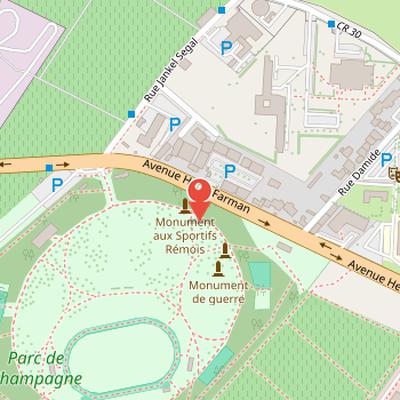
Nearby Objects
-
 Les Crayères 450 m away
 -
 Église Saint-Nicaise de Reims 900 m away
 -
 Old Church of Saint-Nicaise 950 m away
 -
 Basilica of Saint-Remi 1200 m away
 -
 Saint-Remi Abbey 1200 m away
Monument and Later Replacements
The Monument to the Heroes of the Black Army was a monumental bronze group erected in Bamako and Reims in 1924. It paid homage to Senegalese riflemen who defended the city of Champagne during the First World War. The original work was created by sculptor Paul Moreau-Vauthier and architect Auguste Bluysen. It consisted of a granite pedestal brought from Africa in the shape of a tata, with engraved names of the main battles involving African troops. Above it stood a bronze group representing four African soldiers of the Colonial Army Corps behind a white officer carrying the French flag.
A replica of the monument was erected in Bamako in 1924. In Reims, the monument was removed by the German occupier in September 1940 and destroyed. It was replaced by a stele in 1958 at the same location, and a new monument created by Jean-Marc Maya-Perez was erected there in 1963. In 2013, a bronze copy of the original group by Moreau-Vauthier was erected near the original site at Champagne park.
Historical Context of the Monument
The monument is linked to the role of black soldiers from French West Africa in the French army during World War I. The historical context notes that nearly blacks served in the French army, and that over blacks fought on the European front. It also states that about 15 percent of two groups died during the war. In early 1918, a colonial army corps commanded by General Emile Mazillier occupied the Reims sector. This corps invested Fort de la Pompelle and reinforced its defenses.
The surrounding military events in 1918 form an important part of the monument's significance. On 4 July 1918, the Germans launched an offensive, but cote 240 and Fort de la Pompelle resisted it. On 14 July 1918, Germans attempted to take Reims mountain, and tirailleurs and marine troops resisted them. Later, on 3 October 1918, colonial troops resisted the Friedensturm offensive. General Ludendorff had made the capture of Reims the pivot of this offensive. Violent fighting took place between the city defenders and the Germans in October 1918, and German troops retreated on 20 October 1918.
Commissioning and Reception
The original monument by Paul Moreau-Vauthier, designed with architect Auguste Bluysen, was commissioned after a subscription launched by French communes and the Amis des Troupes Noires. The project was presided over by General Archinard, with Blaise Diagne serving as deputy of Senegal. Land for the monument was provided by Les Pommery at Boulevard Henri-Vasnier and route de Chalons, and the first stone in Reims was laid by Minister Andre Maginot. The inauguration was accompanied by a military and sports event at parc Pommery, including a colonial army parade of 500 indigenous performers. The monument also became controversial because it raised questions about recognition of the colonial troops role in the defense of Reims. General Petit, commander of the 5th infantry, refused to take part in the ceremony. A twin monument was also inaugurated in Bamako and remains in place.
Destruction during the Occupation
In September 1940, the Reims monument was destroyed during the Occupation. It had been considered a symbol of the Honte noire. The intact bronze was loaded into a wagon at Reims station and transported to an unknown destination. Some fragments of the monument were conserved at the Musee du Fort de la Pompelle.
Reconstruction of the 1963 Monument
In 1963, the city, led by Mayor Jean Taittinger, replaced the original monument to overseas soldiers with a new memorial. The earlier work had featured black soldiers standing behind a white officer holding the French flag, a composition described as traditional to the colonial-era symbolism of the black force and as evoking the colonialist character of the use of black troops during the war. By the early 1960s, this original style was judged incompatible with the psychological conditions of the period, especially in the context of the Algerian War and decolonization.
The original plaster group and the studies by Moreau-Vauthier had disappeared before reconstruction. A committee launched a subscription to complete the war damage compensation received by the city, helping finance the new monument. The replacement was chosen through a competition organized for students of the Regional School of Fine Arts and Applied Arts. It was created by Jean-Marc Maya-Perez, who died in 2011.
The new monument consisted of two white obelisks, each 9.5 meters high and made of Eurville cut stone. The obelisks symbolized the city's rise and crossed a one-ton rectangular block representing city resistance. Construction was carried out by a local contractor with assistance from municipal services. The monument was inaugurated on December 7, 1963, with an inscribed plaque.
The 2013 Reconstruction Project
In 2013, the Association for the Memory of the Black Army (AMAN) launched a reconstruction project of Paul Moreau-Vauthier's monument, with the aim of restoring the original monument as the centenary of the First World War approached. The project also brought together the history of the initial monument and the 1963 monument, which had been decided at AMAN's first general assembly at Reims city hall. It was intended to recall the debates triggered by the construction of both monuments and to add a pedagogical dimension through a new pedestal.
The monument consists of a bronze group sculpture of five tirailleurs, measuring 2 to and patinated in a brown-black tone. The sculpture rests on a basalt pedestal shaped as an arch, with a height of , and faces bearing the history of the monument and the history of the tirailleurs during the Great War. The project faced a legal challenge on the grounds that it violated Paul Moreau-Vauthier's moral rights, which delayed the installation before it finally took place on the date of .