The Royal Abbey of Saint-Remi is an ancient Benedictine abbey of Reims, founded by Archbishop Tilpin around 760, who installed a Benedictine religious community there. The abbey remained home to this community until the French Revolution. Over the Middle Ages, it experienced significant economic and spiritual development, followed by an important renaissance in later periods. It exercised authority over parishes within its jurisdiction and controlled two collegiate churches, including Saint-Timothée. The abbey was also associated with the anointing of kings, when the ampoule containing chrism was brought from the abbey. Traditionally linked with the tomb of Saint Remi, the site was reconstructed and rebuilt in several phases, and its abbey church was a large Romanesque building. In the 20th century, the abbey became the Saint-Remi Museum of Reims.
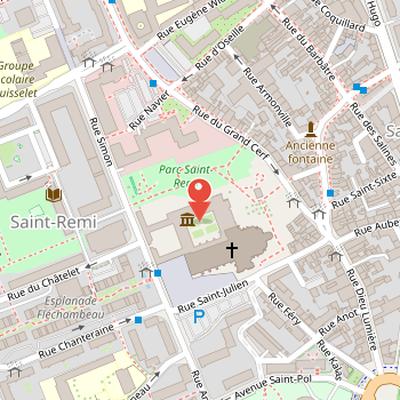
Nearby Objects
-
 Musée Saint-Remi 0 m away
 -
 Basilica of Saint-Remi 60 m away
 -
 Old Church of Saint-Nicaise 300 m away
 -
 Les Crayères 800 m away
 -
 Basilique Sainte-Clotilde de Reims 900 m away
History and Influence of the Royal Abbey
The Royal abbey of Saint-Remi is an ancient Benedictine abbey in Reims, now known as the Saint-Remi Museum of Reims. It was founded around 760 by Tilpin, archbishop of Reims, who installed a Benedictine religious community there. This community remained in the abbey until the French Revolution. During the Middle Ages, the abbey experienced significant economic and spiritual development, and it later underwent an important renaissance.
The abbey also held an important position in ecclesiastical and royal life. For the anointing of kings, the ampoule containing chrism was brought from the abbey. It exercised domination over parishes within its jurisdiction and controlled two collegiate churches, including Saint-Timothee. These facts reflect its religious authority and wider influence in the region over many centuries.
Foundation and Medieval Development
The monastery of Saint-Remi was perhaps founded by Saint Remi, bishop of Reims, whose burial in 533 gave the site its early religious importance. It was later founded as a Benedictine abbey on the tomb of Saint Remi by Bishop Tilpin, between 750 and 770 or in 790. Around 852, Hincmar requested its reconstruction so that it could house the relics of Saint Remi and the holy ampoule. The abbey was rebuilt again in 1010 by Abbot Airard, one of the first abbots elected by the monks.
The abbey church was described as a large Romanesque building and was remodeled under Abbot Thierry between 1036 and 1048. It was consecrated by Saint Leo IX on an unspecified date. In the same general period, Abbot Herimar received lands at Vire from Manasses de Chatillon for building a farm, with a rent of 100 sols; this grant was confirmed in 1053 by Gui de Chatillon, archbishop of Reims, in the presence of nobles.
Monastic life flourished in the 12th century, then declined during the Hundred Years' War. Under Louis XI, the abbey went into commenda and was governed by a Grand Prior, while most commendatory abbots abandoned it. In 1627, the abbey adopted the reform of the order of Saint-Benoit introduced by Athanase de Mongin, and it later joined the congregation of Saint-Maur.
The 1779 fire and the abbey's lost manuscripts
In July 1779, a severe fire almost entirely destroyed the abbey church and cloisters of Histoire's abbey. The blaze also consumed a large part of the library, including 900 manuscripts and 20,000 volumes. Among the losses were the famous fifth-century manuscript of Phdre's fables, the Polyptych of Saint-Remi, and other abbey histories. Some important works were saved, however, including the Book of Origins by Saint Isidore, written around 750, the pontifical of Archbishop Hincmar from 780, a sacramentary of Saint Gregoire dated 799, and the Hours of Queen Emma, wife of Louis d'Outremer.
Later History and Current Use
After the fire of 1779, the abbey buildings were reconstructed with entirely modern structures. The courtyard, staircase, and current facade were restored by the architect Louis Duroche. The abbey was then affected by the National Assembly decree of 13 February 1790, which abolished monastic vows and religious congregations. In 1793, the religious members were expelled, and the abbey was used as a military barracks. From 1796 to 1816, it was converted entirely into a military hospital, although it had a hospice for reception. After 1816, it became the Hotel-Dieu hospital, and from 1905 to the interwar period it served as a civilian hospital. Parts of the site were later protected as historic monuments, beginning with the cloister in 1889, followed by additional decrees in 1920 and 1933. Today, the abbey buildings house the Museum of History and Archeology of Reims, while the abbey church is now a parish church that retains basilica status. The ancient royal Benedictine abbey was declared a UNESCO World Heritage site in 1991.
Associated Buildings and Layout
The abbey church was associated with two collegiate churches, Saint-Timothee and Saint-Come-et-Saint-Damien, as well as one parish church, Saint-Julien. Its wider complex included an almonry with a Saint-Laurent chapel to the south of the abbey church. The monastic buildings were located to the north of the church, while the abbot's lodging stood north of the great cloister. The infirmary, which contained a chapel dedicated to Saint-Christophe, was placed at the small cloister east of the chapter house. These arrangements show a clearly organized religious and domestic layout around the abbey church.
Abbey Leadership and Abbots
The abbey's leadership was closely tied to the archbishops of Reims, who are recorded as the abbots of Saint-Remi. The founder Tilpin reserved the title of abbe, and Hugues de Vermandois is noted as the last archbishop to hold this dignity. An independent abbot was appointed in 945, marking a change in the abbey's administration. In 1482, Robert de Lenoncourt began the series of abbots commendataires, and later abbots commendataires included Henri de Lorraine and Jean-Francois-Joseph de Rochechouart, who lived from 1708 to 1777.
Dependent Priories and Abbey Revenues
The royal abbey of Saint-Remi was supported by a network of dependent priories and prevotates that helped sustain its activity. These establishments received monks sent by the abbey and collected revenues for it. Among the places named are Rethel, Chagny, Senuc, Condes, Le Chesne, Marcoul, Haschbach, Echarson, Braux-Saint-Remy, Dhuizel, Courtisols, Louvemont, Grandpre, and Saint-Thomas. The priory at Condes was founded in 961 by abbot Hugues. The prevotates of Courtisols were later ceded to the seminary of Chalons in 1702. This network shows the abbey's wider territorial organization and the practical role of its dependencies in maintaining its resources.
The Abbey's Landed Patrimony
The landed patrimony of the royal abbey of Saint-Remi developed through a series of grants, charters, and long-term territorial rights. It received the land of Neuilly, also called Novion or Neuvizy, from Carloman, brother of Charlemagne, who was later buried in the abbey church. In 968, Queen Gerberge of Saxony gave the abbey all the allodial property of Meerssen. Other possessions included the curtis of Condes, granted by Hugues IV of Bassigny in 961, and Vrizy, first mentioned in a papal document of 1154 under Pope Adrian IV. A papal bull of January 10, 1147, under Pope Eugene III, also specified the abbey's possessions, including Alendusium, identified as Alland'Huy.
The abbey's temporal domain was closely linked to that of the Church of Reims. Between the episcopate of Saint Rieul and 945, the cathedral domain and the abbey's temporal domain formed a single entity, and their possessions were practically merged until the early 10th century. The abbey later began distinguishing its own domain from the cathedral domain by drafting a polyptych. This record listed 24 fiscuses in the middle of the 9th century across the regions of Reims, Laon, Tardenois, and Porcien.
The abbey also exercised seigneurial and jurisdictional rights in several places. It held the motte castrale of Coucy, built by order of Archbishop Herve of Reims, and likely held Coucy as a fief from the archbishops of Reims or from Saint-Remi abbey until the end of the 13th century. In Hermonville, where it owned a lordship since the Middle Ages, the abbey granted a charter of franchises in June 1230 limiting seigneurial rights, later entered into conflict there in 1353 with Gui de Cheppes, and agreed on privileges for inhabitants concerning harvest bans. In 1749, it still held nearly 300 arpens in Hermonville, mixed with other lordships, and it claimed jurisdiction over franc-alleu lands and houses that paid no dues to any lord.
Murigny Vineyard and Abbey Holdings
The land holdings of the abbey included the vineyard of Murigny, also known as Clos Murigny. This vineyard first appears in a confirmation of possessions issued by Pope Honorius III in 1218, showing its place within the abbey's recorded property. In 1226, the abbot Pierre le Boiteux granted 200 muids of wine from the Murigny vineyard to the Saint-Remi convent. These records indicate that the vineyard was both a part of the abbey's estate and a source of wine distributed within its religious community.
Patronage Rights and Tithes
The abbey's droit de patronage included several ecclesiastical rights connected to churches and cures under its patronage. The chapter of the abbey held the right of presentation to the cure, and the abbey also had the right of presentation to the bishop and the nomination of a servant to churches or cures where it was patron. In addition, these rights had an economic dimension: the abbey could collect the gros tithe in Bazancourt, Cernay-en-Dormois, Champfleury, Chigny, Conde-sur-Marne, Crugny, Fontaine-en-Dormois, Isles-sur-Suippe, Louvois, Massiges, Rilly-la-Montagne, Sacy, Saint-Jean-sur-Tourbe, Serzy, Trois-Puits, Vienne-le-Chateau, and Ville-en-Selve. It also collected five twelfths of the tithes in Minaucourt and Wargemoulin.