Passage de l'Argue is a covered passage in the Bellecour district of Lyon. Entirely pedestrian, it connects 43 rue de Brest to 40 rue de la République by crossing rue Édouard-Herriot. The passage is known for one of the oldest arcades in provincial France built on the Paris model, and it is contemporary with the Paris arcades. It is considered both famous and prestigious in Lyon and plays a significant role in commerce in the Presqu'île area. The passage mainly houses luxury shops.
Its name is explained by odonymy as deriving from the Greek arguros, meaning silver in French, and as referring to a tool used for spinning gold and silver for precious fabrics, with the term also functioning as a metonymy for the workshop of the gold puller. Historically, the passage appeared on Claude Séraucourt’s city map in 1740, when it was described as a narrow and unsanitary street with fifteen weaving workshops. It was reconstructed and reopened in 1828 after houses were bought and demolished in 1825. During the 1834 canuts revolt, republicans hid in the passage.
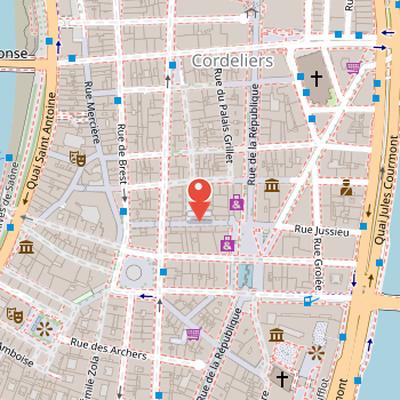
Nearby Objects
-
 Place de la République 80 m away
 -
 Place des Jacobins 120 m away
 -
 Rue de Brest 200 m away
 -
 Rue Mercière 200 m away
 -
 Rue de la République 250 m away
Architecture and Commercial Role
The passage de l'Argue is a covered passage in the Bellecour district of Lyon. It links 43 rue de Brest to 40 rue de la Republique by crossing rue Edouard-Herriot, and it is entirely pedestrian. It is regarded as one of the oldest arcades in provincial France built on the Paris model, and it is contemporary with the Paris arcades. In Lyon, it is both famous and prestigious, and it plays a significant role in commerce in the Presqu ile area. The passage mainly houses luxury shops. Before 2006, it also included a small passage that was originally part of the main passage and provided an exit to rue Thomassin.
Name and Historical Background
Odonymie states that the word argue comes from the Greek arguros, meaning silver in French. It explains that argue refers to a tool used for spinning gold and silver for precious fabrics, and that the term also functions as a metonymy for the workshop of the gold puller. The same source notes that there were two silver offices in France intended to prevent counterfeiting. One was in Paris, and the other was in Lyon on rue de la Monnaie, near passage de l'Argue.
History and Reconstruction of the Passage
Passage de l'Argue appears on the city map drawn by Claude Seraucourt in 1740, when it was described as a narrow and unsanitary street lined with fifteen weaving workshops. At that time, it originally connected rue Royale, now rue de la Republique and formerly rue Imperiale, to rue de Brest. The history of the site also mentions a mint workshop, which disappeared at the end of the 18th century before being reestablished by the French Directory in 1798.
The passage was rebuilt in the early 19th century after houses were bought and demolished in 1825 by M. Coste, Casati, Dugueyt, and Millon. Architect Vincent Farge designed the reconstructed passage, which reopened in 1828. That same year, an ordinance forbade all auctions inside the passage.
The passage also had a political role during the 1834 canuts revolt, when republicans hid there. Later, it was affected by flooding after heavy rains in an unspecified year. Its services were modernized with the rapid introduction of gas electricity, prepared in a workshop on rue Tupin-Rompu, and the city of Lyon generously supported the maintenance of lighting and paving.
Remarkable Buildings and Cultural Life
According to Commerces remarquables, the passage de l'Argue housed many remarkable buildings and also appears in records linked to artistic and entertainment activity. The Atelier de l'Argue is said to have disappeared at the end of the 19th century, although it had been reinstalled following a decree of 1864 and was later transferred to rue de la Savoie. Another notable establishment was the Cafe-Theatre, inaugurated by the authorities on December 7, 1840 and belonging to M. Seguin. Its interior included a circular room, two Corinthian and Ionic columns with two entablatures, and a ceiling decorated with chandeliers and ornaments. Despite high attendance, it closed because of bankruptcy. The area also had ties to performance traditions, since the first puppet performances were given in 1899 in the petit passage de l'Argue near the current passage. The passage was also home to artists: painter Julian Gubian lived there in 1834, and painter Perignon in 1840.
Architecture and Statues of the Passage
In 1836, the passage de l'Argue had 96 arches with uniform closures. Its northern part consisted of two raised floors, while the southern part, up to the rotunda, had a single floor. The entrance was formed by an arch with an archivolt supported by Doric columns, and this arrangement was said to resemble galleries in Rome or Milan. The passage also had four large entrance and exit porches in neoclassical style, as well as a suite located under a glass roof decorated with a row of lanterns. Its commercial frames were made of wood in order to maintain stylistic homogeneity.
The passage was also marked by a series of statues. The first statue was stolen in 1902, the second was melted by the Germans for cannons during World War II, and the third, a reproduction of Mercure volant by Giambologna, was stolen again in 2011 after replacing the earlier figure. In 2018, this third Mercury statue was replaced by a heart-shaped structure covered with a mosaic of tiles and mirrors.