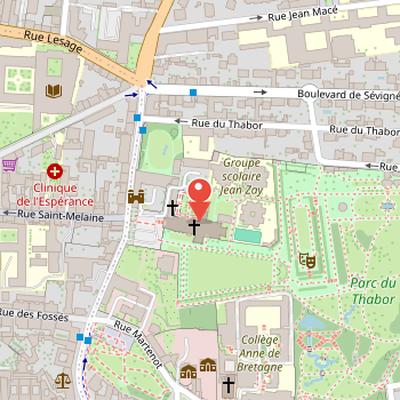
Notre-Dame-en-Saint-Melaine is a parish church in Rennes, in Ille-et-Vilaine, Brittany, France, bordered on its south facade by the west end of Thabor Park. Dedicated to Saint Melaine, traditionally considered the first bishop of Rennes, it stands within a site closely linked to the saint’s memory. Saint Melaine died and was buried in Rennes in the 6th century, and the Abbey Saint-Melaine was built on the hill of Champ du Repos, where the church’s earlier history is also located. Originally an abbey church, Notre-Dame-en-Saint-Melaine served as a cathedral during the first half of the 19th century, when Saint-Pierre Cathedral was demolished and unusable. Bishop Étienne Célestin Enoch installed the diocesan seat here, making it a pro-cathedral, or provisional cathedral. The building has a Latin cross floor plan and a composite Romanesque and Gothic style, with a classical and neoclassical bell tower.
Nearby Objects
-
 Saint-Melaine Palace 80 m away
 -
 Hôtel de Courcy 200 m away
 -
 Parc du Thabor 250 m away
 -
 Saint George Palace 350 m away
 -
 Place du Parlement-de-Bretagne 450 m away
History and Architecture of Notre-Dame-en-Saint-Melaine
Notre-Dame-en-Saint-Melaine is a parish church in Rennes, Ille-et-Vilaine, Brittany, France, located beside the west end of Thabor Park along its south facade. It is dedicated to Saint Melaine, who is traditionally regarded as the first bishop of Rennes, died there in the 6th century, and was buried on the hill of Champ du Repos, where the Abbey Saint-Melaine was later built. The church was originally an abbey church.
Its role changed during the first half of the 19th century, when it served as a cathedral. This followed the demolition and unusable state of Saint-Pierre Cathedral between 1803 and 1844. During this period, Bishop Etienne Celestin Enoch installed the diocesan seat in the abbey church Notre-Dame-en-Saint-Melaine, which then became a pro-cathedral, or provisional cathedral.
Architecturally, the building combines Romanesque and Gothic elements, with a classical and neoclassical bell tower. It also has a Latin cross floor plan.
Early History and Rebuilding
The history of the current sanctuary begins with a primitive church built on the tomb of Saint Melaine in Rennes at the end of the 5th century and the beginning of the 6th century. In the 9th century, this first church was burned and rebuilt twice, and the monks eventually fled with the body of their patron saint to Preuilly Abbey in Touraine. The church was rebuilt again in the 11th century, and construction had advanced enough by 1026 for services to be celebrated there.
A further stage in the abbey's restoration is associated with Geoffroy Grenonat, count of Rennes, who wanted to restore Saint-Melaine Abbey. In 1054, he sent deputies to Sigo, abbot of Saint-Florent de Saumur, asking for a man able to restore the monastery. He also subjected the monastery to the abbot of Saint-Florent. Sigo then sent Even, one of his religious men, to carry out the restoration. Even asked Gervais de Belleme, bishop of Reims, for relics of the founder so that they could be returned to their original resting place.
Part of Saint Melaine's relics had also been obtained and preserved by Rorans in Argentre with great veneration. Gervais de Belleme replied in a letter to Even, agreeing to return the cherished relic. The surviving Romanesque abbey church includes partly remodeled elements, but their dating remains debated. The construction of the Romanesque abbey is often attributed to Gervais, abbot of Saint-Melaine from 1081 to 1109.
Building History and Later Restorations
The church's present sanctuary includes elements that were rebuilt over time, including the nave arcades, high windows, and choir. The bell tower was rebuilt on Romanesque bases in 1432. In 1791, after the abbey was suppressed, the Saint-Melaine abbey church became parochial. From 1803 to 1844, it served as a pro-cathedral under the name Saint-Pierre during the reconstruction of the cathedral of the same name, which had collapsed in 1799. It became parochial again in 1844 under the name Notre-Dame. The church was officially classified by decree on 30 April 1906. It was damaged during World War II and restored in the 1960s. Maintenance work was carried out in 2024 and 2025.
Facade and Romanesque Remains
Notre-Dame-en-Saint-Melaine is located near the west entrance of Thabor park. Its bell tower facade is perfectly symmetrical and in very good condition, and its present form dates from 1676. The facade is made of carved limestone and was produced by the Corbineau workshop of the Laval school. It is decorated with fruit baskets and numerous cherubs around a monk carrying a crozier, a figure that is likely an allegorical representation of Saint Melaine. The octagonal tower is crowned with a gilded lead statue of the Virgin, installed in 1855.
The church also preserves many remnants of an earlier Romanesque building. These remains show a large Latin cross church with three naves, preceded by a Romanesque bell tower porch with austere, large volumes. The base of this porch dates from the Romanesque period, and the roof is fully covered with carpentry characteristic of the early Breton Romanesque period.
Stained Glass and Interior Art
Notre-Dame-en-Saint-Melaine preserves a stained-glass window at the north collateral chevet that is typical of 13th century production, even though the other stained-glass windows were replaced by simple colored glasses in the 1950s. The most prominent glazing is a large stained-glass window in the south transept, measuring eight meters high and four meters wide. It depicts the translation of the relics of Saint Bishop Melaine arriving at the city gates of Rennes by the Vilaine, and includes the inscription Corpus Melani Rhedonas Honorifica DXXX. The design was created by Marguerite Mauge on the advice of historian Paul Baneat, and the window was made by the workshop of brothers Paul and Andre Rault in Rennes, located at Place Hoche. Installed in 1942, it was damaged the following year by bombings, which affected the central and upper parts of the bay. Opaque plexiglass plates covered the damage for 46 years until the city of Rennes undertook restoration under the direction of Frederic Rault. The restored window was blessed during Saint Melaine's feast in 1988, and it is considered the masterpiece of the Atelier Rault. In 1956, the large central window of the chevet received a non-figurative Pentecost artwork by Jean Le Moal, made of glass and lead. The church also contains liturgical furniture made by Willy Anthoons from the Jean Barillet workshop.
The Organ History of Notre-Dame-en-Saint-Melaine
Notre-Dame-en-Saint-Melaine is associated with a long and layered organ history. The grand organ includes an Orgue Cavaille-Coll from 1874, opus 417/414, listed in the Huybens catalogue. A previous organ, delivered for the Carmes chapel on 28 February 1874, originally had 10 stops. At a later stage, a bourdon 8 was added, and another stop, possibly Cor de nuit, was also added. In the 1930s, the organ underwent further modification, with the seventh transformed into nasard and the plein jeu of 6 ranks reduced to a plein jeu of 4 ranks in 1937. These changes were reversed in part in 1984 by Yves Severe, who restored the seventh and the plein jeu and added the accouplement rec/pos. In the 1950s, factor Wolf installed a 30-note independent action pedalboard bourdon 16. The organ was later transferred from Saint Aubin church to the abbey church and restored by Jean-Francois Thibaud in 2011.
Abbey History and Episcopal Ties
The history of Notre-Dame-en-Saint-Melaine is closely linked to the abbey of Saint-Melaine and to the bishops of Rennes. According to the provided facts, Saint Melaine played an important role with Clovis and became his adviser. After his body was placed in a boat, it reached Rennes, where burial took place in the Vicus Christianorum cemetery northeast of the city. A monastery was founded at his tomb around 550, and a new building was later consecrated by Dutioterus, bishop of Rennes. The abbey was already connected to wider church affairs in 650, when the abbot Bertulphe took part in the Council of Chalon.
The abbey was ruined during the Viking invasions, and its relics were moved to Preuilly-sur-Claise in Touraine around 920. It remained abandoned until around 937. After that, the bishops of Rennes took temporal control of the abbey. The site later became a place of retirement and succession planning within the local church: Thiebaut retired there and designated his son Gautier as successor, and Gautier later retired as abbot after his son Garin became bishop of Rennes.
From 1058, the abbey was reformed by Even from the Abbey Saint-Florent de Saumur. Even served as abbot for 23 years and later became archbishop of Dol. He was succeeded by Gervais, who died in 1109. From the early 16th century, the abbey had commendatory abbots. In the 18th century, the Benedictine monks twice opposed the installation of the episcopal seat there, in 1740 and 1770. Despite this resistance, the abbey was united with the bishopric of Rennes in 1775 by bishop Francois Bareau de Girac.
Preserved Cloister Remains
At Notre-Dame-en-Saint-Melaine, the cloister, abbatial residence, convent buildings, and garden have been preserved. Roman cloister capitals of Saint-Melaine were discovered during the demolition of a closure wall at the beginning of the 20th century. The surviving material includes 22 pairs of paired capitals and 21 isolated capitals, now preserved at the Museum of Brittany. These capitals are sculpted with vegetal motifs and volutes in various designs. André Mussat dated them to the late 12th century.