Parc du Thabor is a public park located near the city centre of Rennes, in the Ille-et-Vilaine department of Brittany, France. Covering more than ten hectares, it combines a French garden, an English garden, and a large botanical garden. The park originated as a private vegetable and pleasure garden belonging to the monks of Saint-Melaine abbey outside the city walls. Before the Revolution, it was a simple public promenade, later enriched with a botanical garden.
Its present layout developed through successive expansions and improvements. Between 1866 and 1868, Denis Bühler added bowling greens, the "enfer", and French and English gardens. At the beginning of the 20th century, the southern part known as "les Catherinettes" was developed as an extension of the English garden. The park takes its name from Mont Thabor, a mountain overlooking the Sea of Galilee. Classified by the city of Rennes as a Jardin de prestige, it is maintained as a highly structured garden with varied seasonal floral decorations.
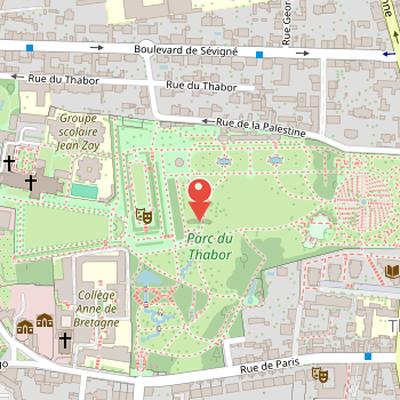
Nearby Objects
-
 Notre-Dame-en-Saint-Melaine 250 m away
 -
 Hôtel de Courcy 300 m away
 -
 Saint-Melaine Palace 300 m away
 -
 Saint George Palace 400 m away
 -
 Place Saint-Germain 600 m away
Landscape Development and Garden Design
Parc du Thabor is a public park near the city center of Rennes, in the Ille-et-Vilaine department of Brittany, France. Covering more than ten hectares, it combines a French garden, an English garden, and a large botanical garden. Its name refers to Mont Thabor, a mountain overlooking the Sea of Galilee.
The park originated as a private vegetable and pleasure garden belonging to the monks of Saint-Melaine abbey, outside the city walls. Before the Revolution, it was a simple public promenade, and it was later enriched with a botanical garden. Through successive expansions and developments, it became one of the most emblematic and appreciated places in the city.
Between 1866 and 1868, Denis Buhler enhanced the park by adding bowling greens, the enfer, and French and English gardens. At the beginning of the 20th century, the southern part, known as les Catherinettes, was developed as an extension of the English garden. The city of Rennes classifies the park as a Jardin de prestige, and it receives considerable maintenance to preserve its highly structured design and its varied seasonal floral decorations.
Location and Access
Parc du Thabor is located in the city center of Rennes, in the Thabor - Saint-Helier - Alphonse Guérin district. It is bordered by rue Martenot and rue de Paris to the south, boulevard de la Duchesse-Anne to the east, and rue de la Palestine to the north. To the west, the site narrows between Notre-Dame-en-Saint-Melaine to the north and college Anne de Bretagne to the south. The park can be accessed through place Saint-Melaine, which is the entrance closest to the city center, and it has six entrances opening onto the surrounding streets. Public transport access includes bus line C5 at the Thabor stop, as well as bus lines C2, C3, 12, and Navette centre-ville at the Fosses stop. The closest metro station is Saint-Germain. The site is open all year round.
From Abbey Lands to Public Promenade
According to Histoire, the site of Parc du Thabor was originally a hill at 42 meters altitude that dominated much of Rennes. The first mentions of Thabor date to 1610, and Benedictine monks gave the mound its name in reference to Mount Thabor in the Bible. During the Middle Ages and the Ancien Regime, fortified walls limited the expansion of gardens, so that only convent lands were large enough to support orchards and gardens. Thabor lands remained for a long time dependent on Saint-Melaine Abbey and were mostly used as an orchard. In the 18th century, the Benedictine monks opened their gardens, but access was restricted to men. Entry was through a passage between the abbey cloister and the kitchen garden, together with a coach gate.
After the major fire of 1720, Thabor became the seat of the bishopric. Histoire states that a bishop's palace was built there and that part of the gardens became bishopric gardens. At the Revolution, all church properties were transferred to the State. Rennes acquired these lands on 8 July 1803 through an exchange with the State, after the army sought to create an arsenal in the municipal hospice. Saint-Melaine then housed elderly people, while the hospice des Catherinettes and the Saint-Melaine buildings and gardens became the general hospice.
A public promenade was then opened on the former bishopric and Benedictine lands, with the bishopric courtyard as the main entrance. In the 20th century, the site received minor changes, including wrought iron gates on Rue de Paris in 1912 and Avenue de Grignan in 1926. A menagerie was created in 1930. Municipal greenhouses called Duchesse Anne were built south of the botanical garden and rose garden in 1936 because the greenhouses near the orangery were too small for plant production. In 2002, the city centralized plant production for all parks in the Champeaux horticultural center, and the Duchesse Anne greenhouses were demolished in early 2005 to make room for social housing, a neighborhood library, and a new park entrance to Square Lucien-Rose.
The layouts and entrances of Thabor Garden
The public garden of Thabor is organized through two promenades, a French garden, a major landscaped garden, a botanical garden, and a rose garden. Within this wider arrangement, the carré Du Guesclin was created in 1825 as a bowling green. Its design included a trapezoidal lawn and a chestnut-lined promenade, and a stone arch with a July column was placed on the short side overlooking the bowling green. At the center of the green, a statue of Bertrand Du Guesclin was erected when the area was created, and it was made by Dominique Molknecht. In 1938, the statue was moved to the west of the bowling green, and in 1946 it was recorded as having been destroyed by vandals.
Access to the area also formed part of the garden's development. In 1826, the demolition of Saint-Jean church was used to create an entrance leading directly to the carré Du Guesclin. Another entrance from Saint-Melaine square was marked by a monumental gate bearing the arms of Rennes. The garden also included a monumental entrance designed by Jean-Baptiste Martenot, which replaced a gate by Vincent Boulle. The older gate was described as being supported by two pillars crowned with cast iron vases, together with a low wall with six pilasters also decorated with cast iron vases.
The Vanneau-Papu Column
The Vanneau-Papu column in parc du Thabor was erected through the efforts of the poet Hippolyte Lucas. Its first stone was laid on plans by the architect Charles Millardet, and the column was solemnly erected in 1835. Amangements describe its composition as a base, a column, and a small statue representing Liberty on top. In 1986, the column was restored and completed. During this work, the deteriorated statue of Liberty was replaced by a stone copy from Lavoux, made from a plaster mold and with facial details extrapolated from other works by Jean-Baptiste Barré.
The Enfer Area in Parc du Thabor
The area known as the Enfer in Parc du Thabor is described as a large terrain excavated longitudinally on a north-south axis behind the Carr du Guesclin. After the fire of 1720 in Rennes, the city planned to build a large water reservoir on the site, obtained the monks permission to excavate it, and paid royalties, but the reservoir was never built. The monks maintained the Enfer and used it for boating. Its name came from disputes between Benedictine monks and the bishop over the site and the adjacent land called Paradis.
After the Revolution, the Enfer was drained and later became a dueling site in the 19th century. In the early 20th century, it hosted festivities and had a green theater installed. In 1939, the city planned an outdoor theater for 1,000 spectators, but World War II stopped the project. In 1944, German forces executed resistants there. A theater was hastily rebuilt after the war, but the pre-war cultural plans were soon abandoned.
The site also housed the centuries-old Saint-Melaine oak, linked by legend to the saint. By 1980 only one living branch remained, and the tree was uprooted on March 9, 1986. Later, the Enfer hosted a dog park called the espachien, where visitors could let their dogs off leash until the late 2000s, before it was moved south of the Carr du Guesclin. The abandoned area is now part of a project to create a concert zone. A carousel for children was also installed opposite L'Enfer in a heavily wooded square.
The Carousel Area and Park Building
The carousel area at parc du Thabor has been reshaped several times since the first carousel was installed in 1906. Amangements also placed a boat basin of about twenty square meters next to the carousel, although this basin was destroyed in 1982. The surrounding layout included an elevated promenade around the espachien, with recreational features on its east side such as a baby-foot, a stone table tennis table, and two sculptures made by Beaux-Arts students. A bar-restaurant was also located between L'Enfer and the French formal gardens, along rue de la Palestine.
The nearby building has a documented history beginning with a building permit application submitted by Jean-Baptiste Martenot in 1895. Its architectural style is similar to the garden greenhouses rebuilt after World War II. From the 1950s, it served as a park guardian's residence, then from 1980 it was used as a technical room for France Telecom. Between 1994 and 2010, it operated as a refreshment bar. After a call for tenders following 2010, Frédéric Bideau was appointed manager and the bar-restaurant was renamed La Terrasse. Renovation work took place from 2011 to 2013 to enlarge and modernize the building, including the reopening of old openings onto rue de la Palestine in agreement with Batiements de France, and changes to the roof and woodwork to improve lighting. The renovation was completed in 2013, with the total cost not specified.
Design, Collections, and Garden Structure
Parc du Thabor was laid out with French gardens designed by Denis Buhler at the explicit request of the city mayor. This makes it the only park with a French section and the only French garden created by Denis Buhler. The park also includes a landscape garden divided into two zones: one designed by Denis Buhler with larger lawns and picturesque openings, and another by engineer Blin that is more confined. This landscape area is described as an idealization of nature, and it includes many tree species, among them sequoias associated with the Buhler brothers' signature.
The botanical organization of the park follows Candolle's classification. It is arranged from acotyledones, moving clockwise to angiosperms, and the plant sizes increase progressively from herbs to shrubs. This botanical presentation style is shared only by Thabor and Tete d'Or parks. The botanical garden contributed to the creation of the Atlas of Ille-et-Vilaine flora through Louis Diard, in collaboration with the Muséum national d histoire naturelle and the Conservatoire botanique national de Brest. The atlas was officially launched in 1985 and listed almost 2,000 plants. In 1998, the botanical garden was certified by the French and Francophone Botanical Gardens Charter, and it now houses 11,000 plants while exchanging seeds with other parks.
The park contains several sculptural and horticultural features. At the end of the 19th century, statues were added, including The Abduction of Eurydice, created in 1890 by Charles Lenoir, and The Hunt of Diana, created in 1894 by the same artist. The Hunt of Diana is placed on the east-west axis of the gardens and was the subject of censorship at the end of the 19th century because of the nudity of Diana's breasts. A third statue by Charles Joseph Lenoir, Le Repos de Diane, is located to the south under trees and shrubs. The park also holds La Pensee, a copy from the Louvre or Versailles.
The rose garden contains many varieties of standard, half-standard, climbing, and bush roses. Climbing roses are displayed on the north wall separating the garden from rue de la Palestine, as well as on arbors and pergolas. The Square of Novelties presents rose exhibitions created in the past ten years around La Pensee statue. The park also features the rose de Rennes created by Michel Adam, winner of the 1995 AJJH Rose Prize, and a rose called Revolution francaise planted to commemorate the bicentennial of the French Revolution. A wall overlooking rue de la Palestine serves as an observation site for rose adaptation testing by the Societe nationale d horticulture de France, and the Grand Prix de la rose SNHF contest involves a testing period of two to three years. In the south of the botanical garden, a square of old roses inaugurated in 1990 displays early tea rose varieties and hybrids, while dahlias are exhibited in the north-east.
Other elements include a new Thabor entrance with a ramp for people with reduced mobility, a fully restored gate using period construction techniques, and gates and grills designed by Jean-Baptiste Martenot between 1869 and 1870 for the grande halle de la place des Lices. These gates were stored by the city of Rennes in 1985 and reinstalled in 1998. To the west of the park, an aviary designed by Martenot extends from the French garden and includes circular exotic bird cages and a central pigeon house. The park also features the most elaborate part of the landscaped park as a mosaiculture depicting the blazon of Rennes framed by two hermines, and this area is the only part of the enclosure widely open to the outside with a long grille visible from rue de Paris. The romantic part of the park includes various arrangements and structures, and the area called Catherinettes was created at the beginning of the 20th century and extended from the former landscaped garden of the Buhler brothers to the entrance of rue de Paris.
The Romantic Water Features of Parc du Thabor
Parc du Thabor includes a set of landscaped features centered on a fake river, small bridges, and a high romantic cascade. The cascade was bordered by rocks from the Saint-Aubin forest and by cement rocks made during the Catherinettes construction, and its design was copied in miniature from the Bois de Boulogne. In the same area, the arrangements also included a grotto and a menagerie.
The monumentality of the site was reinforced by the relocation of a fountain originally designed by Charles Millardet in 1829 for square de La Motte. Dismantled and installed at the entrance of rue de Paris in 1901, the fountain was arranged as a large staircase divided by a landing with tiered fountains and a semicircular upper section. Its lower part was rectilinear and divided by a large multi-basin fountain. The fountain was supplied by water from the urban network of Rennes.
The cascade and river system underwent several technical changes. The fake river was initially supplied directly by a pipe and discharged into the Vilaine river. In 1984, a closed recycling circuit was introduced, pumping water from the cascade to the river entrance. Because of numerous leaks in the pump system, the cascade was taken out of operation in 1991 and remained empty of water until a hydraulic overhaul in the 21st century. The city of Rennes financed this overhaul, with partial subsidy from the Brittany region. The original open circuit reportedly used 3,000 cubic meters of water annually between 1907 and the early 1980s. After the overhaul, a closed circuit with programmable flow pumps was installed according to park attendance. The menagerie was arranged in 1930 at the south-east of the Catherinettes.
Biodiversity and Plantings at Thabor
Parc du Thabor combines animal displays with a varied planted landscape. The Biodiversite area includes numerous captive birds, among them many species of surface ducks and parakeets, which are shown to the public in a duck enclosure and an aviary. The aviary also serves as a dovecote, and wooden signs near the bird enclosures provide visitors with information about the different species. The park itself consists of lawn, shrub masses, and other elements, together with a wide range of trees such as sequoias, Lebanon cedar, tricolor beech, Virginia tulip tree, cork oak, magnolias, silver bell tree, pyramidal oak, Algerian fir, and Colorado blue fir. Two ginkgo bilobas, one male and one female, reflect the exotic taste of the Buhler brothers. Seasonal flower displays shape the park throughout the year: the rose garden blooms in June, the dahlia collection in August and September, chrysanthemums appear in autumn, and winter and spring are marked by biennial plants, bulbous plants, camellias, and rhododendrons. The botanical garden hosts different species, with 800 planted each year, and is primarily represented by the daisy family, Asteraceae.
Creation and Social Role of Parc du Thabor
The creation of parc du Thabor was part of a 19th century enthusiasm for nature and gardens. This movement was encouraged by the Second Empire, which was favorable to garden creation, and it also reflected Napoleon III's interest in horticulture and landscape gardens. The period's taste for gardens is illustrated by the creation of Bois de Boulogne in 1852. In Rennes, the park became a place where city residents could leave the city walls and take part in court ceremonies centered on self-display. It also became a space where the bourgeoisie displayed themselves, even though gardens were reserved for wealthy people despite their public function. Regulations reinforced this social code, including lawn restrictions intended to respect property. The neighborhood of Thabor-Saint-Helier-Alphonse Guerin was transformed under the First Empire and the Restoration, with the construction of mansions in the area. Over time, the park became associated with notable people in Rennes.
Maintenance and Landscape Management
Parc du Thabor is maintained by fourteen municipal agents, including three assigned to the botanical garden. The park uses half of the plants produced by the Champeaux horticultural center, and its gardeners demonstrate horticultural expertise through seasonal floral mosaic displays that are renewed twice a year, from mid-May to mid-June and from mid-October to mid-November. Maintenance also includes the regular replanting of park alleys, as seen in the Du Guesclin square in 2005, and the progressive replacement or grafting of younger and more floriferous plants in the circular rose garden in 2010. The park's management also favors the use of auxiliary insects such as ladybugs. Several renewal operations have concerned specific features of the site: in 2010, water was restored to two ponds, accompanied by painting the aviary and securing the grotto, and water was later restored to the cascade after significant works. Other planned interventions included replacing the trees around the French garden refreshment area in 2012 and the lindens adjacent to the botanical garden in 2018.
Contemporary Cultural Events at Parc du Thabor
Parc du Thabor has hosted a range of cultural activities organized by Espace culturel, often making use of the orangerie, lawns, and music kiosk. In 1999, a meeting with animators from Espace des sciences was held there during the solar eclipse. The orangerie later presented photographic exhibitions by Eddi El Boughammi on Cuba in 2000, Yann Derais on Palestine: au-dela du mur in 2004, works by the duo Daniel Dewar and Gregory Gicquel in 2005 during Chantier public #2, flip books by Pascal Fouche in 2007, and photographs by Adeline Keil in 2008. The park lawns also served as a setting for installations, including more than sixty tents for Camping surround by Het Pakt in 2007 and Perspective de fuite a l'anglaise by Laurence De Leersnyder in 2017. In addition, Espace culturel planted an olive tree in the park as a tree of peace for Palestine and Israel with local officials and Al Jazeera. Since 2008, the park has also hosted the festival Mythos, and Les mercredis du Thabor has brought weekly summer evening music, dances, and animations near the music kiosk.